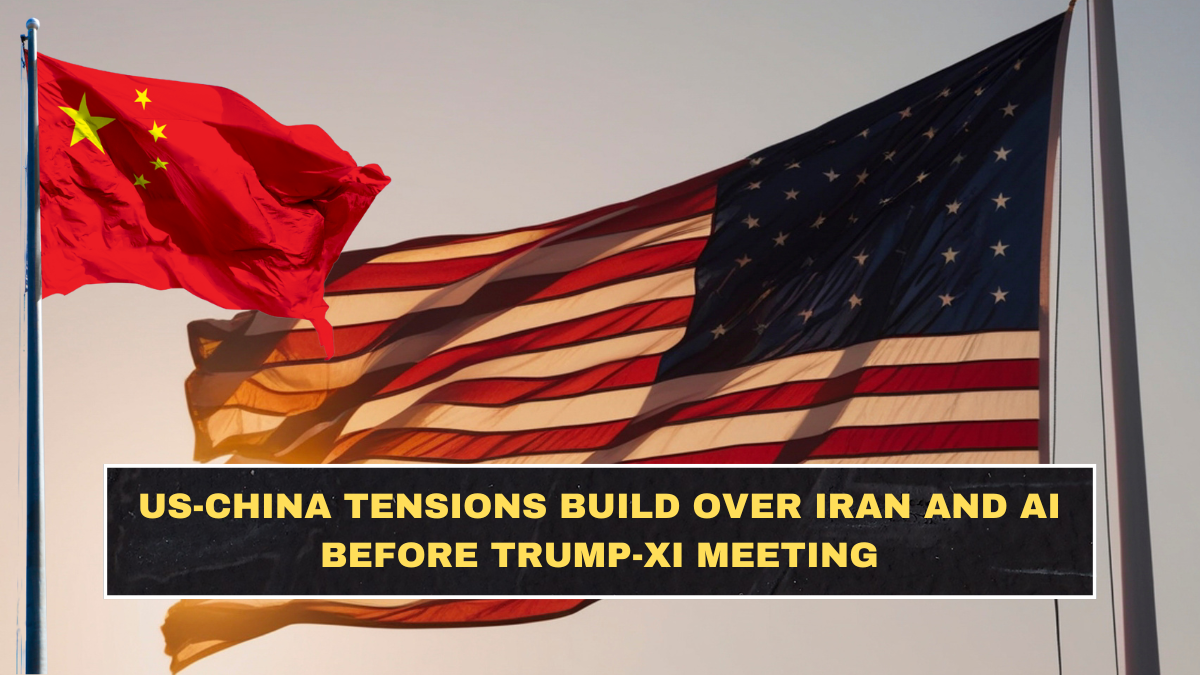
US-China tensions are rising before the Trump-Xi meeting because both sides are entering the summit with major strategic problems already on the table. Iran, oil sanctions, Taiwan, artificial intelligence, export controls and global trade are all competing for space in the same diplomatic conversation. Bloomberg reported that both leaders want to stabilize ties, but that calm is being tested by strategic vulnerabilities over Iranian oil and AI.
This is why the meeting is bigger than a normal trade summit. Trump wants leverage over Iran and wants China to stop helping Tehran survive US pressure through oil purchases. Xi wants to protect China’s access to technology, avoid being boxed in by US export controls and keep Taiwan at the top of Beijing’s agenda. The danger is obvious: one summit is being asked to carry too many unresolved conflicts.
How Is Iran Creating A New US-China Flashpoint?
Iran is creating a US-China flashpoint because China remains the most important buyer of Iranian oil. Reuters reported that Chinese independent refiners import around 90% of Iran’s oil, and their purchases hit a record 1.8 million barrels per day in March 2026. That means US sanctions pressure on Iran cannot fully work unless Chinese buyers are forced to slow down.
Washington sees this as a direct problem. If China keeps buying Iranian crude through shadow routes, Iran continues earning money despite US sanctions and blockade pressure. Beijing, however, rejects unilateral US sanctions and treats its trade with Iran as legitimate. That creates a nasty diplomatic clash: Trump sees China as weakening his Iran strategy, while Xi sees Washington as trying to police China’s energy choices.
| Issue | US Position | China Position | Why It Matters? |
|---|---|---|---|
| Iranian oil | China should stop buying sanctioned crude | Trade with Iran is legitimate | Iran keeps earning revenue |
| AI chips | Advanced tech must be restricted | US is blocking China’s rise | AI race becomes geopolitical |
| Taiwan | Maintain current US policy | Oppose Taiwan independence more clearly | Summit language can trigger crisis |
| Trade truce | Keep pressure but avoid chaos | Buy time and build leverage | Calm may be temporary |
| Sanctions | Use secondary pressure | Reject US overreach | Banks and refiners face risk |
Why Are Chinese Refiners Under US Pressure?
Chinese refiners are under US pressure because they are central to Iran’s oil revenue. The US Treasury recently warned financial institutions about dealing with Chinese “teapot” refineries that buy Iranian oil. The Wall Street Journal reported that Treasury targeted Iran’s shadow banking networks and highlighted sanction risks for entities tied to designated Chinese refiners.
This is not just about oil tankers. It is about banks, shell companies, insurance, shipping records and hidden payment systems. If Washington can scare banks away from Iranian-linked trades, Chinese refiners may find it harder to pay, insure or move cargoes. But if China pushes back, the sanctions fight can spill into the broader US-China relationship before Trump and Xi even sit down.
Why Is AI Becoming The Other Major Battleground?
AI is becoming the other major battleground because both countries see it as a foundation of future military, economic and technological power. The fight is not only about chatbots or apps. It is about advanced chips, cloud computing, model training, data centers, robotics, surveillance, military targeting and industrial automation. Whoever controls the AI supply chain gains leverage across the entire modern economy.
That is why export controls matter so much. The US wants to limit China’s access to the most advanced AI chips and tools. China wants to reduce dependence on American technology and prove it can compete through domestic firms. Reports ahead of the summit say the tech battle is intensifying even as trade tensions have appeared calmer.
Why Does DeepSeek Matter In This Tension?
DeepSeek matters because Chinese AI progress changes the political mood in Washington. NDTV reported that Chinese AI startup DeepSeek recently unveiled its V4 model, adding to concerns that China is moving quickly in the AI race before Trump and Xi meet.
For the US, Chinese AI breakthroughs raise the fear that export controls may not be enough. For China, every domestic AI advance becomes proof that American restrictions cannot stop its technology rise. That makes compromise harder. Trump cannot look soft on China’s AI growth, and Xi cannot look like he is accepting a permanent second-place role in strategic technology.
How Does Taiwan Make The Summit Even More Dangerous?
Taiwan makes the summit more dangerous because Beijing wants stronger US language against Taiwan independence. Reuters reported that Taiwan is at the top of Beijing’s agenda for the Trump-Xi summit, with China pushing Washington to shift from “not supporting” Taiwan independence toward clearer opposition.
This matters because Taiwan is also a semiconductor powerhouse. The AI race and Taiwan issue are connected through advanced chip supply chains. If Trump changes language on Taiwan, Beijing may treat it as a diplomatic win. If he refuses, China may harden its position. Either way, Taiwan turns the summit from a trade discussion into a security test.
Why Is The Trade Truce Not Enough To Calm Things?
The trade truce is not enough because it does not solve the structural rivalry. Reuters reported that China has expanded its economic pressure toolkit even under the cover of the trade truce with Trump. That means Beijing is not simply waiting peacefully for talks. It is building leverage through market access, export controls, investigations and supply-chain pressure.
The US is doing the same through sanctions, tariffs, export controls and financial pressure. This is the blunt reality: both sides want a stable-looking summit, but both are preparing for conflict if talks fail. A truce can reduce noise, but it cannot erase mistrust over Iran, AI, Taiwan and strategic dominance.
What Could Trump And Xi Actually Agree On?
A realistic agreement would probably be limited. They may agree to keep communication open, avoid sudden tariff escalation, manage sanctions fallout and create working channels on AI safety or technology rules. They may also try to prevent the Iran dispute from exploding into a wider US-China sanctions war.
But expecting a grand reset is fantasy. The conflicts are too deep. Trump needs to show pressure on China over Iran and technology. Xi needs to show China cannot be dictated to by Washington. The summit may produce softer language and temporary calm, but the underlying competition will remain.
What Is The Bottom Line?
US-China tensions are building before the Trump-Xi meeting because Iran and AI are now testing the limits of diplomacy. China’s Iranian oil purchases weaken Trump’s pressure campaign against Tehran. China’s AI progress challenges US technology dominance. Taiwan adds a military and semiconductor risk that neither side can ignore.
The blunt truth is that this summit is not about friendship. It is about damage control. Trump and Xi may want stability, but both are walking into the meeting with red lines, domestic pressure and strategic distrust. If they fail to manage Iran and AI, the next phase of US-China rivalry could become much sharper.
FAQs
Why Are US-China Tensions Rising Before The Trump-Xi Meeting?
Tensions are rising because Iran sanctions, Chinese purchases of Iranian oil, AI competition, Taiwan and export controls are all becoming major disputes before the summit.
Why Is Iran A Problem Between The US And China?
Iran is a problem because China buys most of Iran’s exported oil, weakening Washington’s sanctions pressure on Tehran. Chinese independent refiners import around 90% of Iran’s oil.
Why Is AI Such A Big US-China Issue?
AI is central because it affects military power, advanced chips, automation, cloud computing and economic leadership. The US wants to restrict China’s access to key technologies, while China wants to build independent AI strength.
What Role Does Taiwan Play In The Summit?
Taiwan is expected to be one of Beijing’s top agenda items. China wants stronger US language opposing Taiwan independence, while Taiwan fears being used as a bargaining chip.
Can Trump And Xi Reduce Tensions?
They can reduce immediate tension through limited agreements and communication channels, but a full reset is unlikely because the core disputes over Iran, AI, Taiwan and trade remain unresolved.