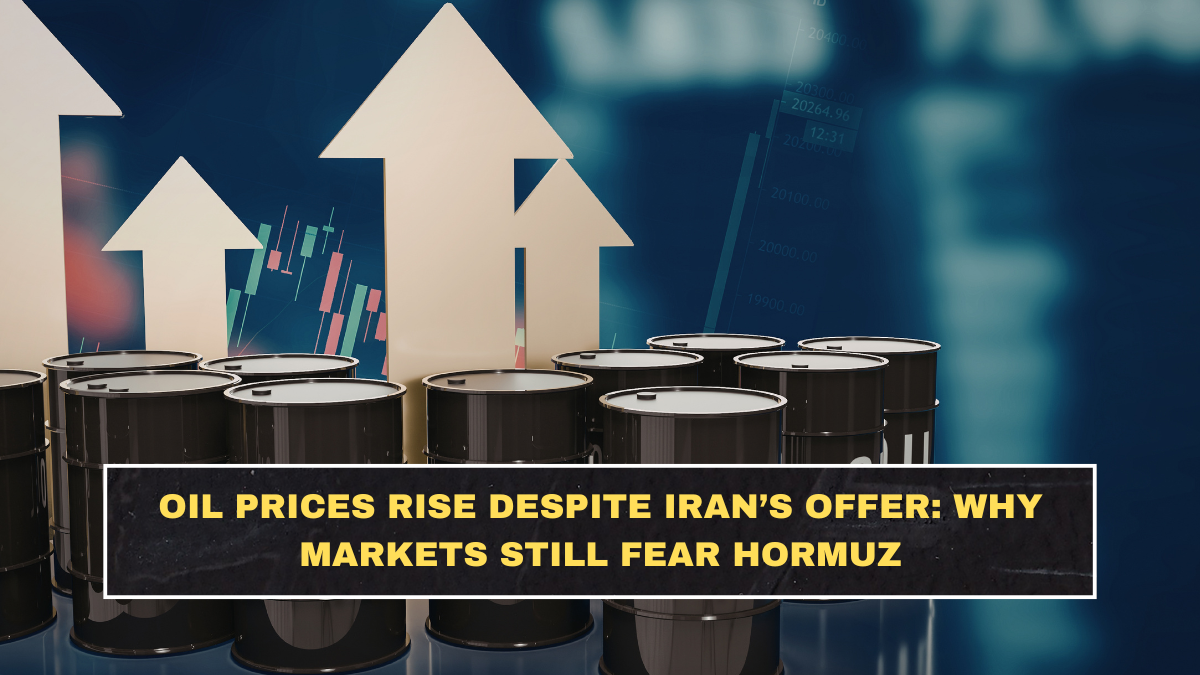
Oil prices are rising because traders are not buying the headline yet. Iran may have offered to reopen the Strait of Hormuz, but markets want proof, not promises. A diplomatic statement does not automatically mean tankers can move safely, insurance costs will fall, or the US blockade will disappear overnight. That gap between political talk and physical shipping reality is exactly why oil remains under pressure.
Reuters reported that Brent crude reached around $111.20 while US crude climbed near $99.10 as the Iran conflict and unresolved Hormuz disruption kept markets nervous. The key point is simple: traders are pricing the risk that the deal fails, not the hope that it succeeds. Until ships actually move freely through Hormuz, oil markets will remain tense.
Why Does The Strait Of Hormuz Control So Much Market Fear?
The Strait of Hormuz is one of the most important energy chokepoints in the world. Oil and gas from Gulf producers depend heavily on this narrow route to reach Asia, Europe, and global markets. When the strait becomes unsafe, the problem is not limited to Iran or the US. It spreads into fuel prices, airline costs, shipping rates, factory input costs, and inflation expectations.
Reuters reported that shipping through Hormuz has collapsed from around 125–140 daily transits to just seven, with no oil export cargo moving through the route in that snapshot. That is the kind of data markets care about. Iran’s proposal sounds positive, but the shipping numbers still show disruption, and disruption is what keeps prices elevated.
| Market Signal | What It Means For Oil Prices |
|---|---|
| Brent above $110 | Traders still fear supply disruption |
| Hormuz traffic sharply down | Physical shipping has not normalized |
| US blockade still active | Iran’s offer has not become a working deal |
| Nuclear talks unresolved | Political risk remains high |
| Tanker insurance uncertainty | Shipping costs can stay expensive |
What Is The Real Reason Traders Do Not Trust The Peace Talk?
The real reason is that Iran’s proposal has conditions attached. Tehran is not simply saying the strait is open without limits. The reported offer links Hormuz reopening to the US ending the blockade and postponing nuclear talks. That makes the proposal a bargaining move, not a finished settlement. Markets understand this very clearly.
Al Jazeera reported that Brent crude rose despite Iran’s offer because the proposal would reopen the waterway in exchange for deferring nuclear talks. That detail matters. If Washington rejects the delay on nuclear discussions, the Hormuz offer may collapse. So oil traders are not reacting to “Iran opens Hormuz.” They are reacting to “Iran may open Hormuz if the US accepts terms it may dislike.”
Why Is The Nuclear Issue Affecting Oil Prices?
The nuclear issue affects oil prices because it decides whether the wider deal is believable. The US does not want a short-term shipping fix that leaves Iran’s nuclear programme untouched. Iran does not want to discuss nuclear limits while under pressure. That mismatch makes the peace proposal fragile, and fragile diplomacy is bad for oil stability.
This is why energy markets follow diplomacy so closely. Oil prices are not only about barrels produced today. They are also about the risk of barrels being blocked tomorrow. If the nuclear disagreement keeps the US and Iran locked in conflict, Hormuz remains vulnerable. That vulnerability gets priced into Brent crude, fuel contracts, and shipping decisions.
What Happened To Shipping Through Hormuz?
Shipping has not returned to normal. Reuters reported that the US blockade has turned back 37 ships since April 13, including six Iranian oil tankers carrying about 10.5 million barrels of crude. The same report said some vessels had tried to evade restrictions, while Iran had also detained ships that did not comply with its transit rules.
That is why the market is still nervous. One or two ships moving through the area does not prove the route is safe. Traders need consistent, verified, and unrestricted movement. They also need to see insurers, shipowners, and energy buyers behaving normally again. Until that happens, the Strait of Hormuz remains a risk premium machine for oil prices.
Why Can Oil Rise On Good News?
Oil can rise on good news when the good news is weaker than expected. If traders were hoping for a clean reopening but instead received a conditional proposal, prices can move higher. That is not irrational. It means the market expected relief but got uncertainty. In energy markets, uncertainty is expensive.
There is another factor: supply disruption has already happened. Even if a deal is signed tomorrow, delayed cargoes, changed routes, insurance disputes, and refinery planning problems do not disappear instantly. Markets are forward-looking, but they also understand operational reality. Restarting confidence is harder than restarting a headline.
How Could This Affect Ordinary People?
If oil stays high, ordinary people may feel it through petrol and diesel prices, airline fares, freight costs, and imported goods. Countries that rely heavily on imported energy are especially exposed. Even businesses that do not buy oil directly can face higher logistics costs, because transport and fuel are built into almost every supply chain.
The bigger risk is inflation. When energy prices rise sharply, they can push up the cost of food, travel, manufacturing, electricity, and shipping. Central banks then face pressure to keep interest rates higher for longer. That means one regional conflict can quietly affect household budgets far away from the Middle East.
What Would Make Oil Prices Calm Down?
Oil prices would likely calm down only if three things happen together. First, Hormuz shipping must visibly normalize. Second, the US and Iran must show a credible path toward de-escalation. Third, the nuclear issue must stop blocking the entire peace process. Without those three pieces, markets may continue treating every optimistic headline with suspicion.
Reuters reported that a previous declaration about Hormuz being open caused oil to fall sharply, but that drop came with hopes of progress in US-Iran negotiations while the US blockade still remained in effect. That shows how sensitive prices are to diplomacy, but also how quickly hope can reverse when real conditions do not change.
Conclusion
Oil prices are rising despite Iran’s offer because markets do not trust incomplete peace talk. The Strait of Hormuz is still disrupted, the US blockade remains central, nuclear talks are unresolved, and shipping confidence has not returned. Traders are not ignoring diplomacy. They are refusing to treat a conditional proposal as a finished deal.
The simple truth is this: oil prices will not calm down because leaders sound hopeful. They will calm down when tankers move freely, insurers relax, the blockade eases, and nuclear talks stop threatening the whole process. Until then, Hormuz remains the biggest fear sitting inside every barrel of oil.
FAQs
Why are oil prices rising despite Iran’s offer?
Oil prices are rising because Iran’s offer is conditional and not yet a working deal. Markets want evidence that ships can safely and freely pass through the Strait of Hormuz before pricing in real relief.
How much oil passes through the Strait of Hormuz?
The Strait of Hormuz is one of the world’s most important oil and gas routes, carrying a major share of Gulf energy exports. Any disruption there can affect global fuel prices and supply chains.
What is Brent crude?
Brent crude is a major global benchmark used to price oil. When Brent rises, it often signals higher costs for fuel, shipping, aviation, and energy-linked goods around the world.
Will oil prices fall if Hormuz reopens?
Oil prices could fall if Hormuz reopens in a verified and stable way. But prices may stay high if the reopening is conditional, temporary, or blocked by unresolved US-Iran nuclear tensions.