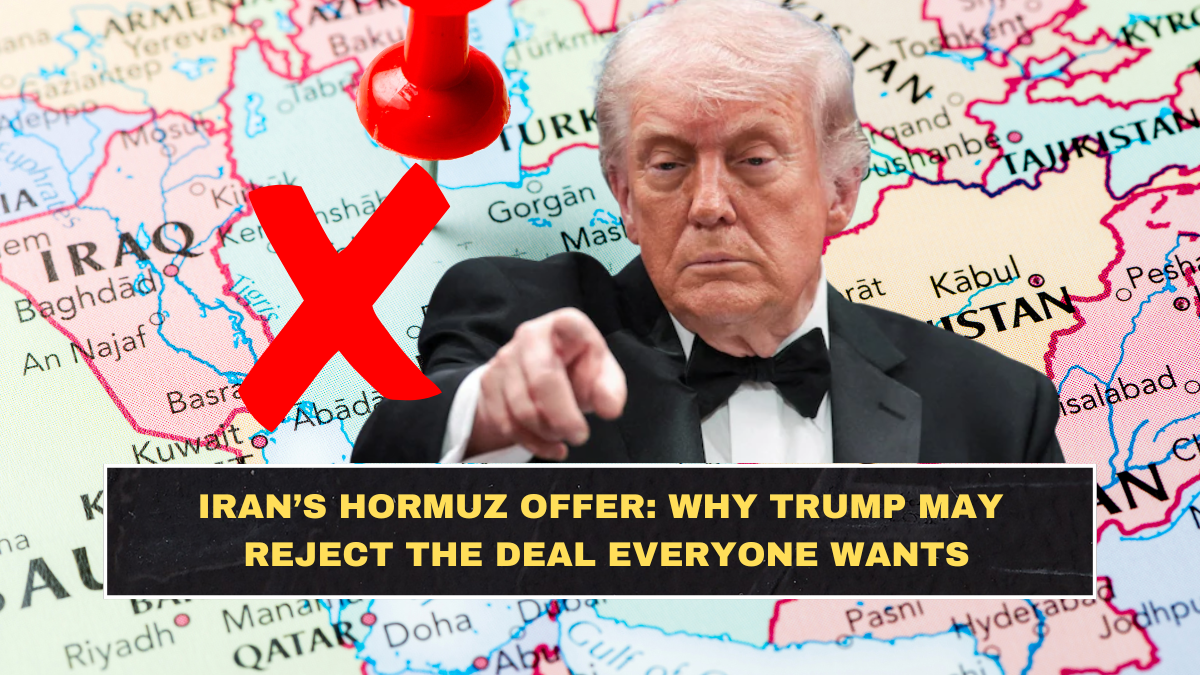
Iran has reportedly offered to reopen the Strait of Hormuz if the United States lifts its naval blockade and agrees to end the war. On paper, this sounds like the kind of deal almost everyone should want: shipping resumes, oil markets calm down, and the risk of a wider regional disaster drops. But international deals are rarely that clean, especially when Iran, the US, Israel, Russia, and global energy markets are all involved at once.
The proposal matters because the Strait of Hormuz is not just another waterway. It is one of the world’s most important energy routes, with a major share of global oil and liquefied natural gas normally passing through it. Reuters reported that daily transits through the strait have fallen sharply, from around 125–140 ships to only a handful, as the US-Iran standoff continues.
Why Is the Strait of Hormuz So Important?
The Strait of Hormuz connects the Persian Gulf with the Gulf of Oman and the wider global shipping system. Oil and gas from Gulf producers such as Saudi Arabia, the UAE, Qatar, Kuwait, Iraq, and Iran depend heavily on this route. When it becomes unsafe or restricted, the impact does not stay inside the Middle East. It reaches fuel pumps, airlines, factories, shipping companies, and food importers around the world.
This is why even a partial disruption creates panic in energy markets. According to Reuters, the current crisis has heavily reduced traffic through the strait, with no clear US-Iran deal in sight. Some tankers have turned back, while others have reportedly tried to evade restrictions. That means the issue is no longer only diplomatic; it is also a shipping, insurance, energy, and humanitarian problem.
| Key Issue | Why It Matters |
|---|---|
| Strait of Hormuz reopening | Could restore oil and LNG shipping confidence |
| US blockade | Washington’s pressure tool against Iran |
| Iran’s demand | End the war and lift the blockade |
| US concern | Iran wants to delay nuclear talks |
| Market reaction | Oil prices remain sensitive despite peace talk |
Why May Trump Reject Iran’s Proposal?
The main problem is the nuclear issue. Iran’s offer reportedly focuses on reopening the Strait of Hormuz and ending the war, but it delays direct talks over Tehran’s nuclear programme. For Washington, that is not a small detail. It is the central issue. AP reported that the US appears unlikely to accept a proposal that leaves the nuclear question for later, with Secretary of State Marco Rubio rejecting the idea of postponing those discussions.
This is where Iran may be misreading Washington. Reopening Hormuz would reduce global pressure, but it could also remove the biggest leverage point the US currently has. If Trump accepts the deal without nuclear commitments, critics will say he gave Iran relief while getting no long-term security guarantee. That political risk is massive, especially in a conflict where every move is being judged by allies, opponents, and markets.
What Does Iran Gain From This Proposal?
Iran gains time, pressure relief, and diplomatic space. By offering to reopen the strait, Tehran can present itself as reasonable while blaming Washington if the deal fails. It also shifts the conversation from Iran’s nuclear programme to the humanitarian and economic damage caused by the blockade. That is a clever move, not a generous one. Iran knows the world wants energy stability more urgently than it wants another long nuclear negotiation.
There is also a Russia angle. Iranian Foreign Minister Abbas Araghchi travelled to Russia as the proposal was being discussed, raising questions about Moscow’s influence in the crisis. AP noted that the timing of the proposal came alongside Araghchi’s Russia visit, which makes the diplomacy look more layered than a simple Iran-US exchange.
Why Are Markets Still Nervous Despite The Offer?
Markets do not trust words when ships are still at risk. A proposal is not the same as a signed deal, and a signed deal is not the same as safe passage. Reuters reported that even though one ADNOC LNG tanker recently crossed the strait, analysts warned against overreading that single movement because ship-tracking data can be unreliable and the wider route remains dangerous.
Oil traders are watching three things: whether the US lifts restrictions, whether Iran stops threatening or controlling traffic, and whether insurance companies believe the route is safe again. Until all three happen, prices can stay volatile. This is why oil may rise even when peace talk headlines look positive. The market is not reacting to hope; it is pricing risk.
Could The Deal Still Happen?
Yes, but only if both sides find a face-saving formula. Trump could accept a temporary Hormuz reopening while demanding a fixed timeline for nuclear talks. Iran could agree to limited nuclear discussions without calling them full negotiations. That kind of compromise would allow both sides to claim victory. But if either side demands total surrender, the deal dies quickly.
The uncomfortable truth is that everyone wants Hormuz reopened, but not everyone wants the same political outcome. Iran wants blockade relief before nuclear pressure. The US wants nuclear pressure before major relief. Gulf economies want shipping stability. Europe and Asia want lower energy risk. Israel will likely oppose any deal that allows Iran to regain room without strict security limits.
What Happens If Trump Says No?
If Trump rejects the proposal, the crisis could move into a more dangerous phase. Iran may accuse Washington of blocking peace, while the US may argue that Iran is using global energy supplies as bargaining power. More ships could remain stuck, oil prices could stay elevated, and pressure on Asian and European importers could grow. That is the real danger: a regional military dispute turning into a worldwide economic shock.
A rejection would not automatically mean full-scale escalation, but it would narrow the diplomatic space. The longer the Strait of Hormuz remains disrupted, the more likely it becomes that one mistake, one drone strike, one tanker incident, or one misread military move triggers something bigger. That is why this proposal matters, even if it is imperfect.
Conclusion
Iran’s Hormuz offer looks simple from the outside: reopen the strait, lift the blockade, end the war. But the hidden fight is about nuclear leverage. Trump may reject the deal because it gives Iran immediate relief while delaying the issue Washington cares about most. That does not mean the offer is meaningless; it means it is a pressure move.
For ordinary people, the issue is not abstract diplomacy. If Hormuz stays unstable, oil prices, flight costs, shipping delays, and inflation risks can all rise. The world may want this deal, but Washington is unlikely to accept it unless Iran gives something serious on the nuclear question too.
FAQs
Why is the Strait of Hormuz important?
The Strait of Hormuz is one of the world’s most important oil and gas shipping routes. If traffic through it slows or stops, energy supplies can be disrupted globally, affecting oil prices, fuel costs, shipping, aviation, and inflation.
What is Iran offering the US?
Iran has reportedly offered to reopen the Strait of Hormuz if the United States lifts its blockade and agrees to end the war. However, the proposal appears to delay deeper talks on Iran’s nuclear programme.
Why might Trump reject Iran’s proposal?
Trump may reject the proposal because it does not immediately solve the nuclear issue. Washington may see the deal as giving Iran economic and strategic relief without enough security guarantees in return.
Will oil prices fall if the Strait of Hormuz reopens?
Oil prices could fall if ships can safely pass again and insurance risks reduce. But prices may remain unstable until traders believe the reopening is real, durable, and backed by a serious US-Iran agreement.