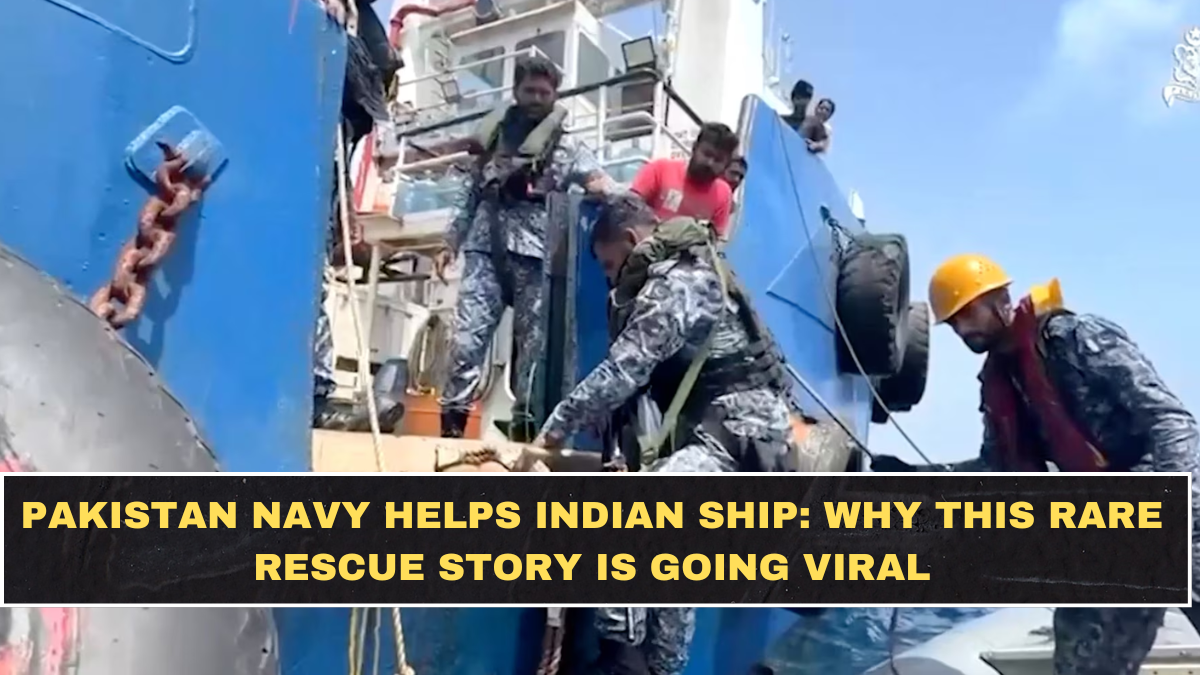
A rare India-Pakistan maritime story is going viral after Pakistan Navy helped an Indian vessel stranded in the Arabian Sea. The vessel, MV Gautam, reportedly suffered a serious technical failure while travelling from Oman to India, leaving its crew in need of urgent support. Reuters reported that the ship had seven crew members, including six Indians and one Indonesian, and Pakistan sent naval support after receiving the distress call.
What makes the story powerful is not just the rescue itself, but the timing and emotion around it. India and Pakistan usually appear together in headlines about border tension, cricket politics, diplomatic disputes or military rivalry. A rescue story at sea cuts through that noise because it shows a basic truth people often forget: when lives are at risk, maritime duty comes before nationality.
What Exactly Happened At Sea?
MV Gautam was reportedly stranded in the Arabian Sea after a major technical issue made the vessel unable to continue normally. The distress request was routed through maritime channels, and reports say the Maritime Rescue Coordination Centre in Mumbai contacted Pakistani authorities for assistance. Pakistan Navy, with support from the Pakistan Maritime Security Agency, then moved to help the vessel and crew.
The crew was reportedly given food, medical support and technical help to stabilise the situation. This detail matters because rescue does not always mean dramatic evacuation by helicopter. Sometimes the most important help at sea is immediate supplies, medical checks, communication support and technical assistance until the vessel becomes safe again. That is why the story is being seen as a humanitarian moment rather than just a routine naval update.
Why Is This Rescue Getting So Much Attention?
The story is getting attention because it goes against the usual emotional script around India and Pakistan. People are used to seeing both countries framed as rivals, not as neighbours responding to a distress call. That contrast makes the rescue highly shareable, especially on social media where stories of unexpected cooperation often travel faster than standard diplomatic statements.
Here is why the story is spreading fast:
- It involves India and Pakistan in a rare positive headline.
- The rescue happened in the Arabian Sea, a strategically important region.
- The crew included Indian nationals, making the story emotionally strong.
- It shows maritime cooperation despite political tension.
- It gives people a human story beyond rivalry and border politics.
What Are The Key Details?
| Detail | Information |
|---|---|
| Vessel Name | MV Gautam |
| Route | Oman to India |
| Problem | Serious technical failure |
| Location | Arabian Sea |
| Crew | Seven people |
| Nationalities | Six Indians and one Indonesian |
| Help Provided | Food, medical aid and technical support |
| Responding Side | Pakistan Navy and PMSA support |
These details make the incident clear without turning it into propaganda. The important point is not to over-romanticise the rescue or pretend it changes India-Pakistan relations overnight. It was a maritime emergency response, and the crew received assistance because safety at sea requires quick coordination. That is the real story, and it is stronger than exaggerated political commentary.
Does Maritime Law Encourage Such Help?
Yes, maritime rescue is built on the principle that people in distress at sea must be helped regardless of nationality. The International Maritime Organization says the SAR Convention was created to establish a global search-and-rescue system so that rescue operations can be coordinated when accidents happen at sea. This is why countries may cooperate during emergencies even when political relations are tense.
That is also why this rescue should be understood maturely. Pakistan did not suddenly become India’s friend because of one operation, and India-Pakistan disputes have not disappeared. But at sea, rescue rules and humanitarian duty can force practical cooperation. Anyone turning this into blind nationalism from either side is missing the more serious point.
What Does This Mean For India-Pakistan Relations?
This rescue does not mean diplomatic relations are improving in a major way. That would be a lazy conclusion. India and Pakistan still have deep disputes, and one maritime rescue cannot erase years of military, political and security tensions. However, it does show that communication channels and emergency coordination can still work when human life is involved.
The best way to read this incident is as a small but meaningful humanitarian signal. It reminds both countries that even rivals need rules, discipline and emergency cooperation in shared regional spaces. The Arabian Sea is not just a strategic zone; it is also a working route for ships, crews, trade and rescue operations.
Conclusion: Why Does This Rescue Matter?
The Pakistan Navy helping an Indian ship matters because it gives people a rare story where humanity outruns hostility. MV Gautam’s crew needed help, and the response came through maritime channels that prioritised safety over politics. In a region where India-Pakistan headlines are often aggressive, this incident stands out because it is practical, human and difficult to ignore.
Still, people should not exaggerate it into a diplomatic breakthrough. It is a rescue story, not a peace treaty. Its real value lies in showing that even hostile neighbours can act responsibly when lives are at risk. That is exactly why the story is going viral and why it deserves attention beyond social media emotion.
FAQs?
Which Indian Ship Did Pakistan Navy Help?
Pakistan Navy reportedly helped MV Gautam, an Indian offshore tug and supply vessel stranded in the Arabian Sea. The vessel was travelling from Oman to India when it suffered a serious technical failure. Reports said the crew included six Indian nationals and one Indonesian national.
What Help Was Given To The Crew?
The crew reportedly received food, medical assistance and technical support after the distress call was handled through maritime rescue channels. The aim was to stabilise the situation and keep the crew safe. This kind of support is common in maritime emergencies where immediate safety matters more than political identity.
Why Is This Story Going Viral?
The story is viral because it involves Pakistan helping an Indian vessel, which is unusual compared with the normal hostile tone of India-Pakistan headlines. People are reacting strongly because the incident shows a rare humanitarian moment between two rival countries. The emotional contrast makes it highly shareable online.
Does This Mean India-Pakistan Relations Are Improving?
No, one rescue operation does not prove that India-Pakistan relations are improving. It only shows that maritime rescue coordination can work during emergencies. The serious interpretation is that humanitarian duty at sea can function even when political relations remain tense.