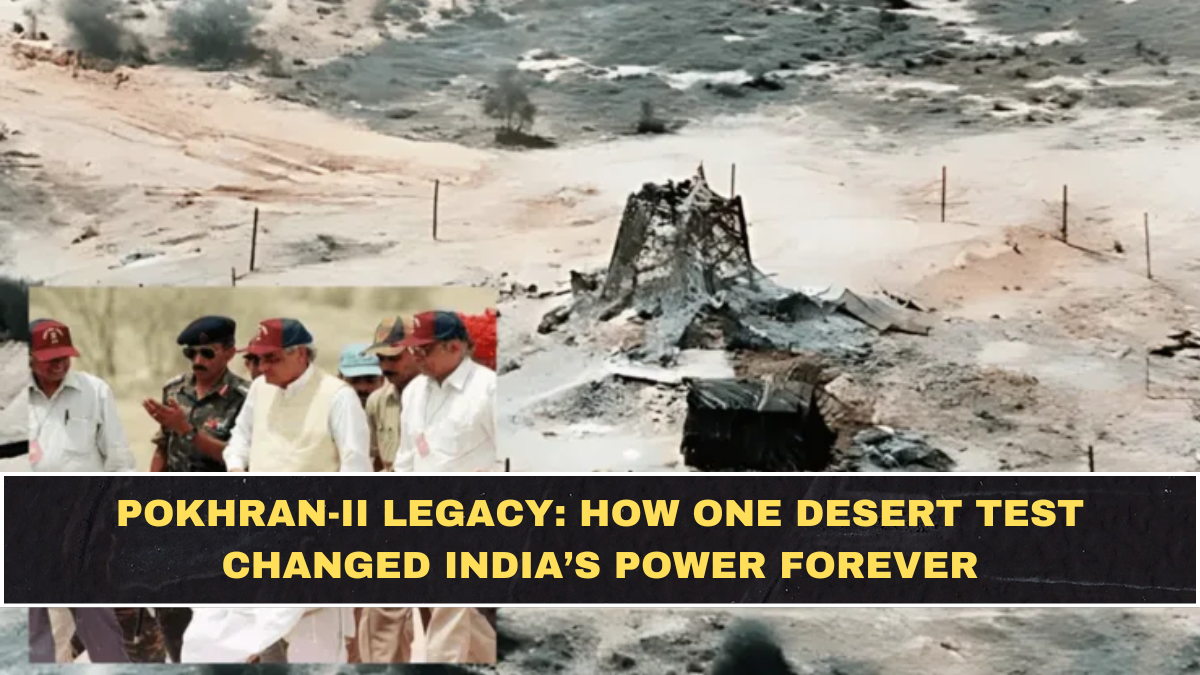
Pokhran-II was not just a nuclear test in the Rajasthan desert. It was the moment India stopped asking for strategic space and started claiming it. Conducted in May 1998 under Operation Shakti, the tests announced that India had the scientific depth, political will and defence confidence to stand firm even under global pressure.
The legacy of Pokhran-II still matters because power in the modern world is not decided only by population, economy or diplomacy. It is also decided by technological control, deterrence strength and the ability to protect national interest. That is why one desert test continues to shape India’s defence thinking decades later.
Why Did Pokhran-II Shock The World?
India conducted successful nuclear tests under Operation Shakti on May 11, 1998, a moment officially remembered through National Technology Day. The Government of India notes that May 11 also marked the maiden flight of the indigenously developed Hansa-3 aircraft, making the date a wider symbol of scientific achievement.
The shock was not only about the tests themselves. The bigger shock was India’s ability to keep preparations secret and execute a high-risk strategic move despite international surveillance and pressure. For a country still emerging from economic challenges, Pokhran-II sent a direct message: India would not remain permanently dependent on other powers for its security choices.
| Pokhran-II Factor | Why It Changed India |
|---|---|
| Date | May 1998 |
| Codename | Operation Shakti |
| Location | Pokhran, Rajasthan |
| Strategic impact | Strengthened nuclear deterrence |
| Political message | India would decide its own security path |
| Long-term legacy | Defence technology and strategic autonomy |
What Changed After The Tests?
Pokhran-II changed India’s global standing because it forced the world to deal with India as a serious strategic power. There were sanctions and criticism, but India did not step back from its position. Over time, the same world that reacted sharply had to engage India more deeply on security, trade, technology and diplomacy.
This is the uncomfortable truth many people miss: global respect does not come only from moral speeches. It often comes from capability. Pokhran-II showed that India could take tough decisions when national security demanded it, and that confidence later influenced defence planning, foreign policy and technology development.
How Did It Shape India’s Nuclear Doctrine?
Pokhran-II laid the foundation for India’s modern nuclear deterrence approach. India’s official position has repeatedly emphasised credible minimum deterrence and a no-first-use posture, meaning India maintains nuclear capability primarily to prevent nuclear coercion or attack, not to start a nuclear conflict.
That balance is important. India wanted strength without reckless signalling. The idea was not to build an uncontrolled arms race, but to create enough deterrence so that adversaries would understand the cost of nuclear aggression. This is where Pokhran-II became more than a test; it became the base of a long-term security doctrine.
Why Is The Nuclear Triad Important Now?
A nuclear triad means the ability to deliver nuclear weapons from land, air and sea. This matters because it improves survivability. If one platform is threatened, another can still respond, making deterrence more credible. Recent defence discussions continue to highlight India’s land-based missiles, aircraft delivery capability and sea-based nuclear platforms.
This is where Pokhran-II’s legacy becomes visible in today’s defence structure. A nuclear test alone is not enough; a country must also build reliable delivery systems, command structures and second-strike capability. India’s progress toward a stronger triad shows how the 1998 decision shaped long-term military technology planning.
What Are The Biggest Lessons?
Pokhran-II gives India three hard lessons that still matter in 2026. First, strategic technology cannot be borrowed forever. Second, scientific talent becomes powerful only when backed by political clarity. Third, national security decisions often invite pressure, but serious countries prepare for that pressure before acting.
Key lessons from Pokhran-II include:
- Scientific capability must be protected and funded consistently
- Defence technology needs secrecy, discipline and long-term planning
- Strategic autonomy is impossible without indigenous innovation
- Global pressure is manageable when national consensus is strong
- Deterrence works only when capability and credibility move together
Was Pokhran-II Only About Weapons?
No, and treating it only as a weapons story is a lazy reading. Pokhran-II became a symbol of India’s wider technological self-confidence. It showed that Indian scientists, defence planners and engineers could deliver complex national missions under extreme secrecy, time pressure and global risk.
That matters even outside defence. The same mindset is needed in semiconductors, space technology, artificial intelligence, cybersecurity and clean energy. If India wants to become a true technology power, it needs the Pokhran-II attitude again: less noise, more capability, sharper execution and stronger belief in Indian talent.
Conclusion: What Did Pokhran-II Really Prove?
Pokhran-II proved that India could take control of its strategic future. It was not just about entering the nuclear club; it was about refusing to let other countries permanently define India’s security limits. The tests gave India deterrence, confidence and a stronger voice in global affairs.
But the real legacy is not something India can simply celebrate every year. It has to be protected through research, defence modernisation and technological independence. Pokhran-II changed India’s power forever, but the next challenge is clear: India must now build future breakthroughs with the same seriousness.
FAQs
What Was Pokhran-II?
Pokhran-II was a series of nuclear tests conducted by India in May 1998 at Pokhran in Rajasthan under the codename Operation Shakti. The tests demonstrated India’s nuclear capability and became a major turning point in the country’s strategic history.
Why Is Pokhran-II Important For India?
Pokhran-II is important because it strengthened India’s nuclear deterrence and changed its global strategic image. It showed that India had the scientific ability and political will to make independent security decisions despite international pressure.
What Is Operation Shakti?
Operation Shakti was the codename for India’s 1998 nuclear tests at Pokhran. It became one of the most important defence and science missions in modern Indian history, linking technology, national security and strategic autonomy.
How Did Pokhran-II Help India’s Nuclear Triad?
Pokhran-II helped establish the foundation for India’s long-term nuclear deterrence strategy. Over time, India moved toward strengthening land, air and sea-based nuclear delivery capability, making its deterrence posture more credible and survivable.