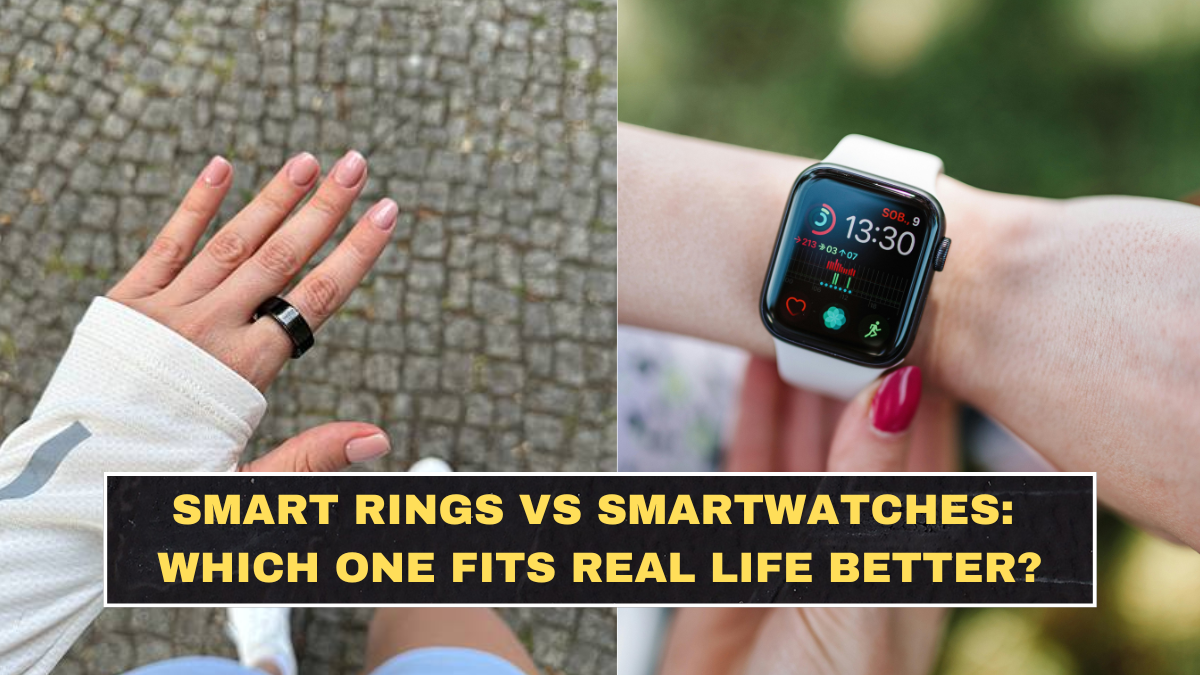
Smart rings are no longer just a niche gadget for early adopters. The category is still much smaller than smartwatches, but it is growing quickly because people want health tracking without the bulk, screen distractions, or daily charging that often comes with a watch. IDC says global wearable shipments reached 611.5 million units in 2025, and it specifically expects emerging form factors like smart rings to keep gaining traction. IDC also noted that smart ring sales were about 880,000 units in 2023 and forecast to rise to 3.2 million by 2028, which tells you the category is still small but growing far faster than the mature smartwatch market.
What makes smart rings different from smartwatches?
The real difference is not just size. It is behavior. A smartwatch is built to do many things at once: notifications, workouts, calls, timers, navigation, and health tracking. A smart ring is more focused. It is mainly a passive health wearable meant to disappear into your routine while still collecting useful data on sleep, recovery, heart rate, and readiness. That narrower purpose is exactly why some people prefer it. Samsung markets the Galaxy Ring as a lightweight all-day wearable with three built-in sensors and up to 7 days of battery life, while Oura positions Ring 4 around uninterrupted health tracking and 5 to 8 days of battery life.
Which one feels better to wear every day?
For sleep and all-day comfort, rings usually win. That is the blunt truth. Many users do not mind wearing a ring to bed, but a watch can feel bulky, sweaty, or annoying during sleep. IDC explicitly pointed to sleep tracking as a major advantage for smart rings because many people dislike wearing a smartwatch overnight. That said, rings are not universally more comfortable. If you dislike jewelry, your fingers swell easily, or you lift weights often, a ring can become irritating faster than a watch. So the comfort winner depends on how your body behaves, not on marketing.
How do battery life and convenience compare?
Battery life is one of the clearest wins for rings and fitness bands over full smartwatches. Oura Ring 4 is rated for 5 to 8 days, and Samsung’s Galaxy Ring is rated for up to 6 to 7 days depending on size. By contrast, Apple lists the Apple Watch Series 10 at up to 18 hours of normal use, with up to 36 hours in Low Power Mode. That gap matters in real life because wearables are only useful when you keep them on. If daily or near-daily charging already annoys you, a smartwatch is probably the wrong tool unless you need the screen and app functions badly enough to tolerate it.
Which device tracks health and sleep better?
Here people get lazy and overconfident. Neither category is perfect, and both can be useful. A 2025 systematic review of smart rings found high accuracy for heart rate and heart rate variability and reported sleep detection sensitivity around 93% to 96%. Another 2025 paper found Oura comparable to medical-grade sleep studies for commonly measured sleep parameters. But smartwatch research is not weak either. A 2025 study on Fitbit Sense reported high sleep detection accuracy and very high sensitivity, while another 2025 study found smartwatch sleep-stage agreement above 70% for most stages. The honest takeaway is that both categories are strong enough for trend tracking, but neither should be treated like a diagnostic device.
| Factor | Smart Ring | Smartwatch |
|---|---|---|
| Comfort during sleep | Usually better | Often bulkier |
| Battery life | Commonly 5–8 days | Often 18–36 hours |
| Notifications and apps | Very limited | Strong advantage |
| Workout interaction | Passive | Better live controls |
| Discretion and style | More subtle | More visible |
| Best use case | Sleep, recovery, background health tracking | All-in-one fitness and lifestyle device |
Who should buy a smart ring instead?
A smart ring makes more sense if your main goal is sleep tracking, recovery data, heart-rate trends, and lower-friction daily wear. It also fits people who already wear a traditional watch and do not want to replace it with a screen on the wrist. If you care more about long battery life, subtle design, and silent tracking than about apps and alerts, a ring is the smarter buy. In plain terms, it is for people who want health data without another device constantly demanding attention. That is why ring compliance can be strong in research settings too, with one 2025 Nature study reporting at least 70% participant wear compliance for most of the study period.
Who is still better off with a smartwatch?
A smartwatch still wins if you want a more capable device, not just a smaller one. It is better for live workouts, quick replies, GPS use, on-wrist timers, media control, and constant notification handling. If you run, cycle, or train in ways that benefit from checking pace, heart rate zones, or prompts during exercise, a smartwatch remains more practical. The mistake people make is pretending these devices do the same job. They do not. A ring is mostly a quiet data collector. A smartwatch is a wearable computer with health features attached.
Which one fits real life better in 2026?
For pure real-life simplicity, smart rings are increasingly the better choice for people focused on sleep, recovery, and comfort. For pure versatility, smartwatches still dominate. So stop trying to find one universal winner. The right answer depends on what you actually do every day. If you hate charging, hate sleeping in a watch, and mostly want passive health insights, go with a smart ring. If you want one device to handle fitness, alerts, and productivity from your wrist, a smartwatch still makes more sense. The market is moving toward both categories coexisting, not one replacing the other.
Conclusion?
Smart rings fit real life better for people who value comfort, sleep tracking, and lower-maintenance health data. Smartwatches fit real life better for people who want a richer feature set and do not mind charging more often. The blind spot most buyers have is assuming more features automatically means better value. It does not. The better wearable is the one you will actually keep wearing every day.
FAQs
Are smart rings more accurate than smartwatches for sleep tracking?
Not automatically. Current research suggests both can be useful for sleep tracking and trend monitoring, but accuracy varies by brand, sensor quality, and the metric being measured.
Can a smart ring replace a smartwatch completely?
Only if you do not care much about notifications, apps, calls, navigation, or live workout controls. For passive health tracking, yes. For all-purpose wearable use, no.
Do smart rings last longer on a charge?
Usually yes. Leading smart rings commonly claim around 5 to 8 days, while many mainstream smartwatches still need charging every 1 to 2 days.
Should first-time buyers choose a ring or a watch?
Choose a ring if your priority is sleep, recovery, and comfort. Choose a watch if you want a more interactive wearable with stronger workout and lifestyle features.
Click here to know more