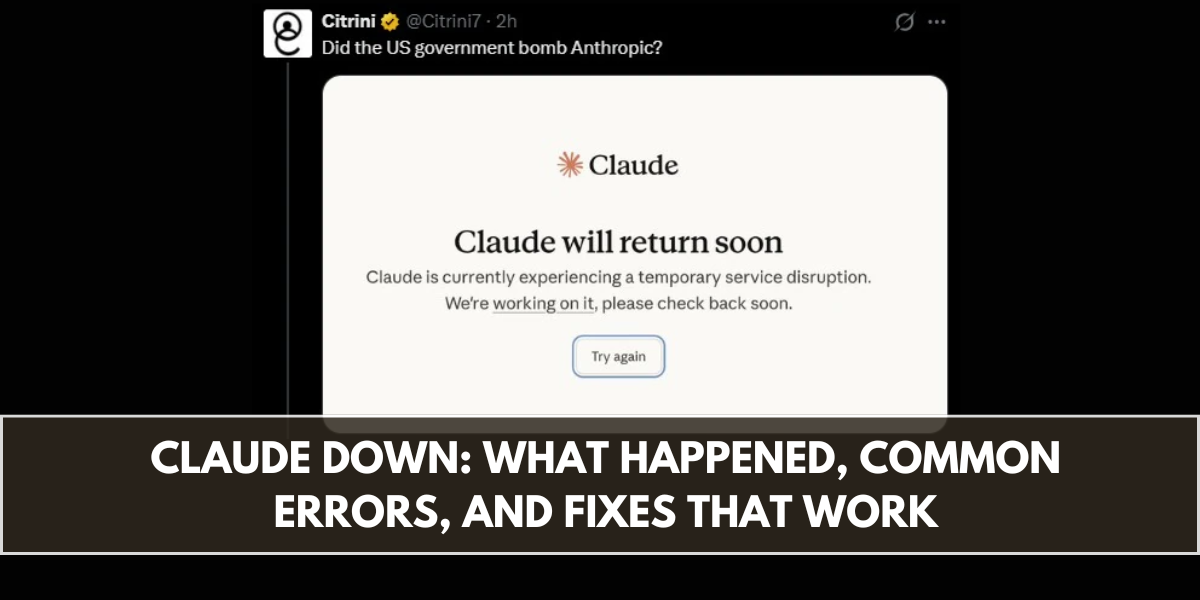
Searches for “Claude down” spike whenever users experience interruptions while accessing the AI assistant. Claude, developed by Anthropic, is widely used for writing assistance, coding support, research tasks, and productivity workflows. Because many professionals rely on it daily, even short outages quickly become visible across forums, developer communities, and social media platforms.
When AI services experience downtime, the cause is usually linked to infrastructure load, model deployment updates, or temporary system instability. Cloud-based AI platforms process millions of requests every day, and when server capacity or internal services encounter issues, users may see error messages instead of responses. These incidents often lead to temporary disruptions until system engineers stabilize backend services.

Common Claude Errors Users Reported
During outages, users typically encounter specific error codes that indicate where the failure occurred within the system. These codes help developers and users understand whether the problem is related to servers, network connectivity, or request processing.
| Error Code | What It Means | Typical Cause |
|---|---|---|
| Error 500 | Internal server error | Backend service failure |
| Error 529 | Service overloaded | Too many user requests |
| Timeout Error | Request not completed | Slow server response |
| Network Error | Connection lost | Internet or server routing issue |
Error 500 generally indicates that the server encountered an unexpected issue while processing a request. Error 529 often appears when demand exceeds available computing resources, which can happen during traffic spikes or system updates.
How Often AI Platforms Experience Outages
AI platforms operate on complex distributed infrastructure that must manage massive volumes of data and user queries. Even large cloud systems occasionally experience temporary instability. The table below shows typical causes of outages across major AI platforms.
| Cause of Outage | Frequency | Description |
|---|---|---|
| Traffic Surge | Common | Sudden spike in users overwhelms servers |
| System Update | Occasional | New model or feature deployment |
| Infrastructure Issue | Rare | Cloud or data center problems |
| API Misconfiguration | Occasional | Developer integration errors |
Most outages are resolved quickly once engineers identify the root cause and adjust server capacity or system configurations.
Practical Fixes Users Can Try
When Claude appears to be down, the issue is usually server-side, meaning users cannot fully fix it themselves. However, several simple steps can sometimes restore functionality if the problem is related to browser sessions or temporary connection issues.
Refreshing the browser page can help reload the session and reconnect to the service. Clearing browser cache or cookies can resolve problems caused by stored session data. Switching to a different browser or using an incognito window can also help eliminate conflicts caused by extensions.
Users who access Claude through integrations or APIs may also check whether the service endpoint is responding correctly. Monitoring official service status pages can provide confirmation if the issue is widespread rather than account-specific.
Alternative AI Tools During Outages
When an AI assistant becomes unavailable, many users temporarily switch to alternative tools to continue their work. Having access to multiple AI platforms can reduce workflow interruptions during outages.
| AI Tool | Typical Use | Platform |
|---|---|---|
| ChatGPT | Writing, coding, research | Web / App |
| Gemini | Google ecosystem AI tasks | Web |
| Perplexity | AI-powered search | Web |
| Copilot | Coding assistance | Developer tools |
Using alternative platforms ensures that productivity tasks such as content creation, debugging, and analysis can continue while the affected service stabilizes.
Why AI Downtime Matters to Businesses
AI tools have increasingly become part of daily workflows for developers, writers, marketers, and research professionals. When these services experience downtime, it can interrupt ongoing projects, delay deadlines, and create productivity bottlenecks.
Businesses that rely heavily on AI often adopt backup workflows to mitigate these risks. This might include using multiple AI providers, maintaining offline resources, or scheduling tasks that do not depend entirely on cloud-based tools.
Conclusion
The recent Claude outage reports highlight how critical AI services have become for modern digital workflows. Error codes such as 500 and 529 usually indicate server-side issues that occur during traffic spikes or infrastructure adjustments. While users cannot directly resolve backend problems, simple troubleshooting steps and temporary alternative tools can help maintain productivity.
As AI adoption continues to grow globally, occasional service disruptions are likely to remain part of the ecosystem. Monitoring official status updates and maintaining flexible workflows are the most effective strategies for managing these situations.
FAQs
Why is Claude not working today?
Claude may be temporarily unavailable due to server overload, system updates, or infrastructure issues affecting backend services.
What does Claude error 500 mean?
Error 500 indicates an internal server error, meaning the platform encountered an unexpected issue while processing a request.
What is Claude error 529?
Error 529 usually means the service is overloaded because too many users are sending requests at the same time.
Can users fix Claude outages themselves?
Most outages occur on the server side, so users cannot fully fix them. However, refreshing the page or clearing browser cache can sometimes resolve temporary session issues.
What can users do if Claude remains down?
Users can temporarily switch to other AI tools, check official service status pages, and wait for system engineers to restore normal operations.