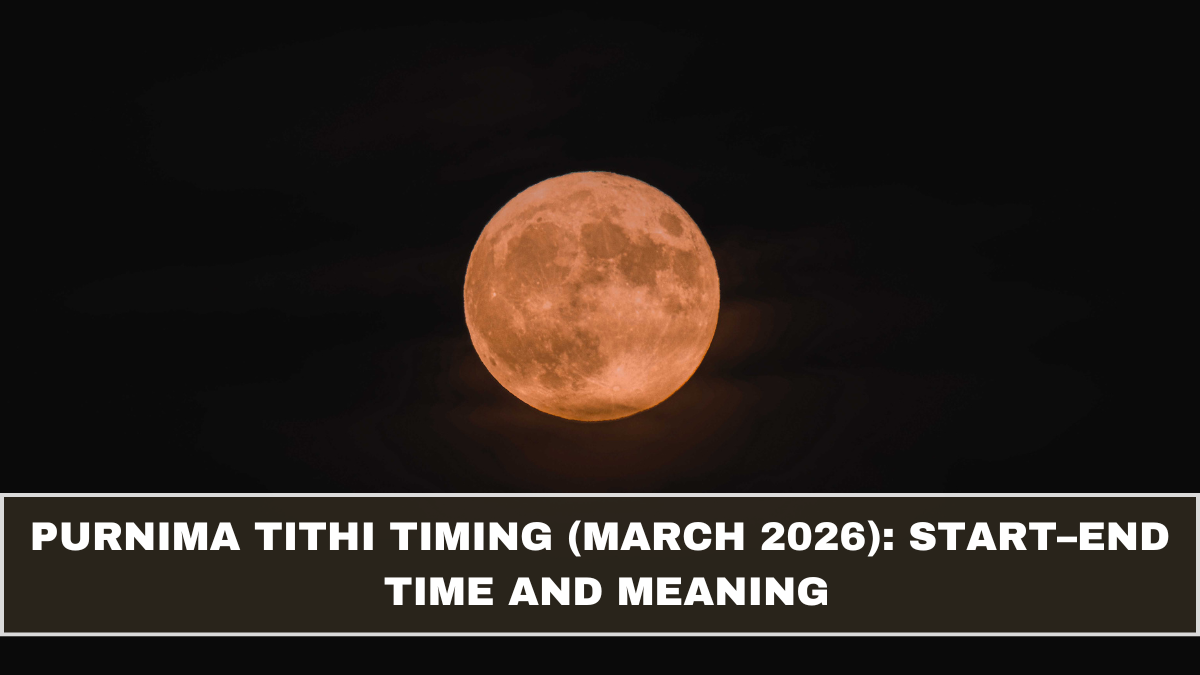
Purnima tithi refers to the full moon phase in the Hindu lunar calendar. In March 2026, this tithi is especially important because it determines the timing of Holika Dahan and the broader Holi festival schedule. Unlike fixed-date events in the Gregorian calendar, tithi timings are calculated using precise lunar movements and therefore begin and end at specific hours rather than lasting an entire calendar day.
Understanding the exact start and end timing of Purnima helps in planning rituals, religious observances, and festival ceremonies accurately.
What Is Purnima Tithi?
In the Hindu Panchang system, a tithi is a lunar day calculated based on the angular distance between the Sun and the Moon. Purnima occurs when the Moon is fully illuminated, marking the fifteenth tithi of the Shukla Paksha (waxing phase).
This phase is considered spiritually significant and is associated with many religious observances throughout the year. In March 2026, the Purnima of the Phalguna month is particularly important because it aligns with Holi celebrations.
Unlike a standard 24-hour date, a tithi can start at any time of the day or night and may not match sunrise-to-sunrise cycles.
Why March 2026 Purnima Timing Matters for Holika Dahan
Holika Dahan must be performed during the Purnima tithi and specifically after sunset, while also ensuring that the inauspicious Bhadra period is not active during the ritual.
Because of this, the exact start and end timing of Purnima in March 2026 directly affects when the bonfire ceremony can be conducted. If Purnima begins late in the evening or ends early in the day, the muhurat window changes accordingly.
This is why regional Panchang calculations are important, as lunar timings can slightly vary based on geographic location.
How Purnima Timing Is Calculated
Purnima timing is determined using astronomical calculations based on the Moon’s position relative to the Sun. Panchang makers use these calculations to define the precise moment when the full moon tithi begins and ends.
These timings are published in regional calendars and temple schedules. Since lunar movement is consistent worldwide but sunrise and sunset vary by city, local Panchangs provide the most relevant guidance.
It is important to rely on verified calendar sources rather than assumptions based on date alone.
Religious and Cultural Meaning of Purnima
Purnima is traditionally considered a spiritually powerful phase. Many devotees observe fasting, perform Satyanarayan puja, or visit temples on full moon days.
In the context of March 2026, the Purnima tithi carries additional significance because it marks the ceremonial beginning of Holi festivities. The full moon symbolizes completeness, renewal, and spiritual illumination.
The alignment of lunar timing with ritual practice reflects the deep connection between astronomy and tradition in the Hindu calendar system.
Common Confusion About Tithi vs Calendar Date
One common misunderstanding is assuming that Purnima lasts the entire calendar day labeled as “full moon.” In reality, the tithi may begin in the afternoon or end before sunset.
For festivals like Holika Dahan, what matters is whether Purnima is active during the prescribed evening muhurat. This distinction is critical for accurate festival planning.
Checking start and end timings instead of relying solely on the calendar date prevents confusion.
Conclusion
Purnima tithi in March 2026 plays a central role in determining the correct timing of Holika Dahan and Holi celebrations. Since a tithi is based on precise lunar calculations and does not follow a standard midnight-to-midnight format, understanding its start and end timing is essential for proper observance. Referring to accurate Panchang sources ensures that rituals are performed in alignment with traditional and astronomical guidance.
FAQs
What is Purnima tithi?
Purnima tithi is the full moon phase in the Hindu lunar calendar and marks the fifteenth day of the waxing lunar cycle.
Why is March 2026 Purnima important?
It determines the timing for Holika Dahan and Holi celebrations.
Does Purnima last the entire calendar day?
No. A tithi begins and ends based on lunar calculations and may start or finish at any time during the day or night.
How can I check exact Purnima timing?
Refer to a reliable regional Panchang or official temple calendar for precise start and end timings.
Why is sunset important for Holika Dahan?
Holika Dahan must be performed after sunset while Purnima tithi is active and outside the Bhadra period.