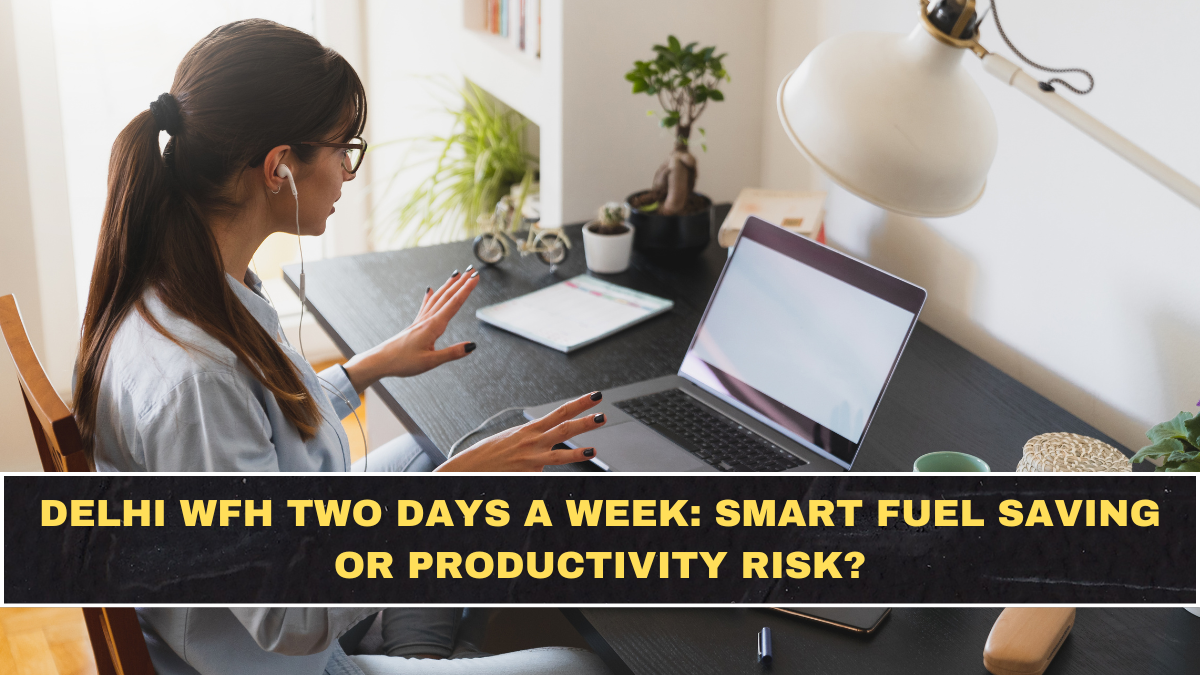
Delhi’s new two-day work-from-home move has instantly become more than an office policy. It is now a debate about fuel bills, traffic pressure, government productivity, public transport, and whether Indian cities can seriously change their commuting habits without waiting for a crisis. Chief Minister Rekha Gupta announced the measure for Delhi government offices after Prime Minister Narendra Modi’s appeal to reduce fuel consumption and avoid unnecessary spending.
The decision is expected to come into effect from May 15, 2026, and sits inside a wider fuel-saving campaign called “Mera Bharat, Mera Yogdaan.” The government has also linked this move with Metro use, online meetings, vehicle restrictions, and a push to reduce unnecessary road travel. That is why this is not just a normal WFH update; it is a test of whether Delhi can cut daily fuel use without slowing down public work.
What Has Delhi Announced?
The biggest announcement is simple: Delhi government employees will work from home for two days every week. Along with that, the government has said that 50% of official meetings will be held online, office timings for Delhi government and MCD offices will be changed, and official vehicle use will be reduced. India Today reported that petrol limits for officials have been cut by 20%, while the government will also avoid buying new vehicles for six months.
Here is the quick breakdown:
| Measure | What It Means | Possible Impact |
|---|---|---|
| Two-day WFH | Govt staff work remotely twice a week | Lower commute fuel use |
| Metro Day | Officials encouraged to use Metro | Less road congestion |
| No Car Day appeal | Citizens urged to skip cars weekly | Public participation |
| Online meetings | 50% meetings to go virtual | Less official travel |
| Fuel quota cut | Official petrol use reduced | Lower government fuel spend |
These steps look smart on paper, but execution will decide whether this becomes a real reform or just another announcement that fades after headlines.
Can This Actually Save Fuel?
Yes, it can save fuel, but only if the policy is followed seriously and not treated like a symbolic exercise. Delhi’s biggest daily fuel drain comes from repeated office commutes, government vehicle movement, private cars, and peak-hour traffic jams. Even a small reduction in vehicle movement across departments can create visible savings if implemented consistently.
The stronger part of the policy is that it does not depend only on WFH. The government is also pushing Metro travel, special buses for employees, reduced vehicle purchases, and lower petrol limits for officers. ABP Live reported that the plan also includes public transport incentives and a wider “No Vehicle Day” push.
Key areas where Delhi may benefit:
- Lower petrol and diesel use during office commute hours
- Less congestion around government offices and busy roads
- Better use of Metro, buses, and shared transport
- Reduced unnecessary official movement and meetings
- A behavioural shift among private offices and citizens
Where Can This Go Wrong?
The uncomfortable truth is that WFH only works when departments know exactly what work can be done remotely and what cannot. If files, approvals, citizen services, grievance redressal, and coordination slow down, people will quickly call this a productivity failure. Delhi cannot afford a system where fuel is saved but public service becomes slower.
There is also a fairness issue. Many workers cannot work from home at all, including field staff, transport workers, health workers, sanitation teams, and employees in public-facing offices. If the policy benefits only desk-based staff while others continue commuting daily, the government must communicate it clearly instead of pretending one model fits everyone.
Will Private Offices Follow?
For now, the strongest implementation is for government offices, while private companies and institutions are expected to receive an advisory. Business Today reported that private companies and institutions may also be advised to adopt two days of WFH, with monitoring expected through the Labour Department.
But private-sector adoption will depend on industry type. IT, consulting, digital operations, finance, back-office work, and customer support can adjust faster. Retail, manufacturing, logistics, healthcare, hospitality, and on-ground services cannot copy the same model. So the real solution is hybrid flexibility, not blind WFH pressure.
Conclusion
Delhi’s two-day WFH move is a bold and timely experiment, but calling it a guaranteed success would be premature. It can reduce fuel use, ease traffic, and push people toward Metro and public transport. But if departments become slower, citizens face delays, or enforcement remains weak, the policy will look good only in press conferences.
The smarter view is this: Delhi is testing whether fuel conservation can become a weekly habit instead of an emergency reaction. If the government tracks productivity, citizen service speed, fuel savings, and office attendance honestly, this could become a useful urban policy model. If not, it will become another headline that people forget within weeks.
FAQs
What is Delhi’s two-day WFH policy?
Delhi government offices will follow work from home for two days every week as part of a fuel-saving and efficiency campaign. The move is linked with reducing commute fuel use, increasing online meetings, encouraging Metro travel, and cutting unnecessary official vehicle movement across departments.
Is Delhi WFH policy for private companies too?
The main announcement applies to Delhi government offices, but private companies and institutions are expected to receive an advisory to consider two days of WFH. However, adoption may vary because many industries cannot operate remotely in the same way as IT or office-based roles.
What is Metro Day in Delhi?
Metro Day is part of the government’s public transport push, where ministers, officers, and employees are encouraged to use the Delhi Metro instead of official or private vehicles. The idea is to reduce road congestion, save fuel, and make public transport a more visible habit.
Can two days of WFH reduce Delhi traffic?
It can reduce traffic if implemented properly across departments and supported by Metro use, online meetings, carpooling, and reduced official vehicle movement. But the impact will depend on compliance, the number of employees covered, and whether private offices also participate.