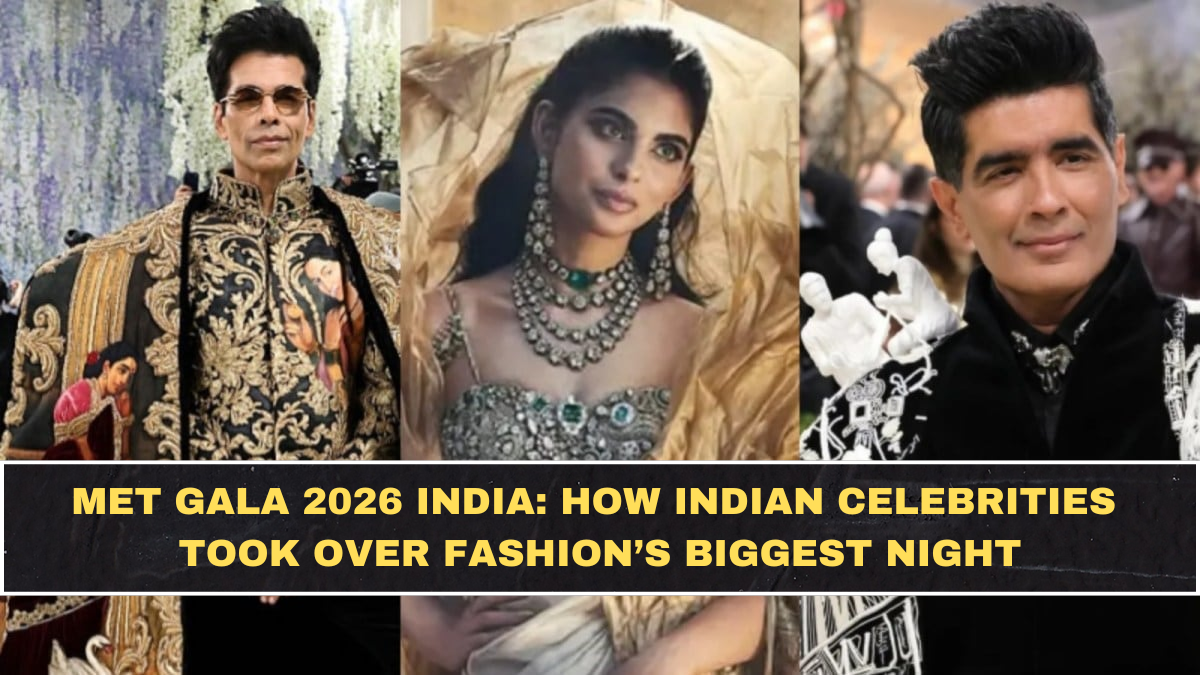
Met Gala 2026 turned into a major Indian fashion moment because the theme naturally suited India’s strongest style language: craft, heritage, jewellery and storytelling. The official exhibition was “Costume Art,” while the dress code was “Fashion Is Art,” inviting guests to treat clothing as an embodied art form. That gave Indian names a perfect opening to show sarees, handwork, jewels and cultural memory as more than just glamour.
The real reason India stood out was not only celebrity presence. It was the way Indian fashion translated art into wearable drama without looking forced. From Isha Ambani’s gold saree to Karan Johar’s Raja Ravi Varma-inspired debut, the red carpet became a global stage for Indian designers and visual culture. That is exactly why the Indian looks became search-worthy, meme-worthy and discussion-worthy within hours.
Why Did Isha Break The Internet?
Isha Ambani became one of the biggest Indian talking points of Met Gala 2026 with a custom Gaurav Gupta saree woven with gold threads. Her look included a sculptural cape, heavy jewellery, and sentimental family heirlooms from her and Nita Ambani’s collections. Reports highlighted that the outfit took over 1,200 hours and involved 25 artisans, making it less like a normal red-carpet outfit and more like wearable luxury art.
The most viral detail was the jewellery story. Some reports focused on more than 200 mine-cut diamonds on the bodice, while others highlighted over 1,800 carats of diamonds, emeralds, polki and kundan across the full look. The mango-inspired artistic accessory also added a sharp Indian cultural twist, making the look memorable beyond just diamonds and designer labels.
Was Karan’s Debut A Masterstroke?
Karan Johar’s Met Gala debut worked because it did what his cinema often does: mix drama, emotion and visual excess. His custom Manish Malhotra outfit was inspired by Raja Ravi Varma, one of India’s most iconic painters. The look reportedly featured hand-painted details and references to Ravi Varma’s famous works, turning Karan into a walking tribute to Indian art history.
This was a clever move because the theme was not asking celebrities to simply look expensive. It demanded interpretation, and Karan’s look had a clear concept. Instead of chasing a generic global fashion formula, he used Indian painting, couture and personal theatricality to create a moment that people could instantly understand, debate and share online.
Which Indian Looks Stood Out?
| Indian Name | Why It Got Attention | Style Message |
|---|---|---|
| Isha Ambani | Gold saree, diamonds, heirloom jewels | Indian luxury as wearable art |
| Karan Johar | Raja Ravi Varma-inspired debut | Indian painting meets couture |
| Sudha Reddy | Kalamkari-inspired Manish Malhotra look | Heritage craft on a global stage |
| Natasha Poonawalla | Marc Quinn orchid sculpture with couture | Fashion as literal sculpture |
| Manish Malhotra | Multiple Indian art-led moments | Designer as cultural storyteller |
Sudha Reddy also brought a strong heritage angle with a Manish Malhotra ensemble inspired by Kalamkari and the Tree of Life motif. Natasha Poonawalla took a more sculptural route, wearing a Marc Quinn orchid piece with a custom Dolce & Gabbana look. Together, these appearances showed that India’s Met Gala presence was not one-note; it moved between sarees, painting, sculpture, jewellery and textile memory.
Why Is Everyone Talking?
The Indian looks went viral because they had the three things red-carpet content needs: visual shock, cultural meaning and social media hooks. A gold saree with diamonds, a Raja Ravi Varma cape, a tanzanite necklace, and a sculptural orchid are not forgettable details. They are exactly the kind of fashion elements that make people stop scrolling.
What made the moment stronger was the emotional connection. Indian audiences were not just watching international celebrities; they were seeing Indian designers, Indian art forms and Indian jewellery traditions being discussed globally. That creates pride, debate and curiosity at the same time, which is why this topic has strong Google Discover potential.
What Made India’s Moment Powerful?
- Clear theme connection: Indian looks directly matched “Fashion Is Art” instead of loosely copying the trend.
- Strong cultural memory: Sarees, kalamkari, heirlooms and Raja Ravi Varma gave every look a deeper story.
- Luxury with emotion: The jewellery was not just expensive; several pieces carried family or heritage value.
- Visual shareability: Sculptural capes, orchids, diamonds and gold made the looks perfect for social media.
- Designer spotlight: Gaurav Gupta and Manish Malhotra showed how Indian couture can compete globally.
Could This Change Indian Fashion Globally?
Yes, but only if Indian fashion stops treating global approval as the final goal. The real win is not that Indian names attended the Met Gala. The bigger win is that they used Indian references confidently, without diluting them for Western acceptance. That is where the power of this year’s appearance really sits.
Met Gala 2026 showed that Indian fashion does not need to become less Indian to become global. In fact, the most talked-about Indian looks were the ones rooted most strongly in craft, family, memory and art. That should be the takeaway for celebrities, stylists and designers who want global attention without losing cultural identity.
What Is The Final Takeaway?
Met Gala 2026 became a strong India moment because the country’s fashion language matched the theme almost naturally. Isha Ambani brought luxury and heirloom emotion, Karan Johar brought Indian painting to the carpet, while Sudha Reddy and Natasha Poonawalla expanded the conversation through craft and sculpture.
The night proved that Indian fashion is no longer appearing on global carpets as a side story. It is becoming part of the main conversation, especially when the look carries a sharp idea behind the glamour. If this momentum continues, India’s Met Gala presence may only get louder, bolder and more influential in the coming years.
Why was India trending at Met Gala 2026?
India was trending because several Indian names used the “Fashion Is Art” theme to showcase sarees, jewels, paintings, craft and sculptural fashion. The looks were visually strong and culturally rich, which made them perfect for online discussion. Isha Ambani and Karan Johar especially became major talking points because their outfits carried clear Indian art and heritage references.
What did Isha Ambani wear at Met Gala 2026?
Isha Ambani wore a custom gold saree by Gaurav Gupta with a sculptural cape and heavy jewellery. Her look included heirloom pieces connected to her personal and family collection, including jewels associated with Nita Ambani. Reports also highlighted diamonds, emeralds, polki and kundan details, making it one of the most luxurious Indian appearances of the night.
Why did Karan Johar’s Met Gala debut go viral?
Karan Johar’s debut went viral because his Manish Malhotra outfit was inspired by Raja Ravi Varma. The look combined Indian painting, hand-crafted fashion and Karan’s naturally dramatic style. Since the theme focused on fashion as art, his outfit felt relevant, bold and easy for Indian audiences to connect with emotionally.
Which Indian designers stood out at Met Gala 2026?
Gaurav Gupta and Manish Malhotra stood out strongly because their designs connected Indian fashion with global red-carpet storytelling. Gaurav Gupta’s gold saree for Isha Ambani became a luxury-art moment, while Manish Malhotra’s work brought Indian painting and kalamkari-inspired craft into the spotlight. Both designers helped make India’s presence feel serious, stylish and culturally confident.