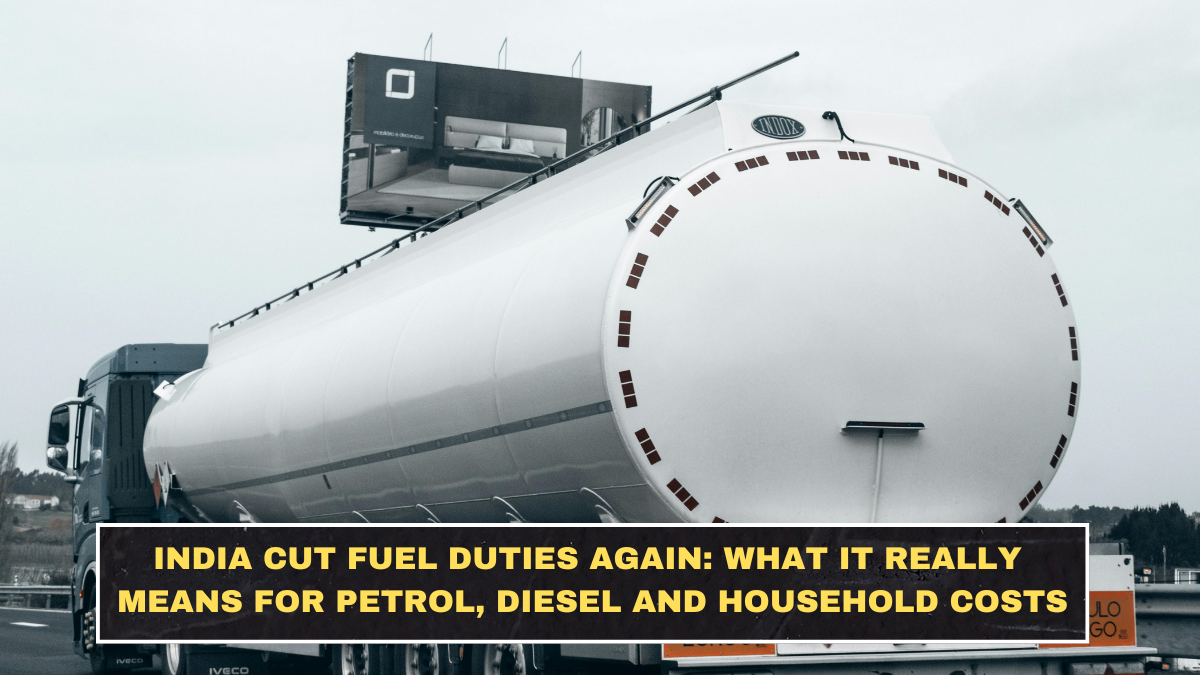
India’s latest fuel-duty move looks simple on the surface, but the real picture is more complicated. The Centre cut the special excise duty on petrol to ₹3 per litre from ₹13 and on diesel to zero from ₹10 on March 27, 2026, after global oil prices surged during the latest West Asia shock. The goal was to reduce pressure on consumers and contain inflation, but that does not automatically mean a visible cut at the pump everywhere.
What matters for households is not just the headline tax cut, but whether oil companies pass that relief through into retail prices. That is the part many people miss. India’s fuel pricing is formally deregulated, yet state-run oil companies still do not always fully pass global price swings to consumers in real time. In this case, the tax cut has also been used to reduce pressure on oil marketing companies that were absorbing large under-recoveries as crude prices rose sharply.
What exactly changed in March 2026
The Centre cut only one part of the excise structure: the special additional excise duty. Reuters reported that petrol duty was reduced to ₹3 per litre from ₹13, while diesel’s special excise duty was cut to zero from ₹10. At the same time, the government imposed a windfall tax of ₹21.5 per litre on diesel exports and ₹29.5 per litre on aviation turbine fuel exports to recover part of the revenue loss.
That is the first blind spot people keep ignoring: “duty cut” does not mean all central taxes disappeared. Other components of excise and state-level levies still remain. Reporting from Mumbai showed that even after the revision, total excise on petrol was still about ₹11.90 per litre and on diesel about ₹7.80 per litre because multiple components continued unchanged.
Why the government moved now
The timing was not random. Global oil prices jumped above $100 per barrel after disruptions linked to the Iran war and stress around the Strait of Hormuz, a route tied to a large share of India’s crude flows. Reuters reported that India cut duties to protect consumers and reduce a possible inflation spike as imported energy costs surged. The same report said oil companies were facing losses of roughly ₹24 per litre on petrol and ₹30 per litre on diesel at prevailing international prices.
India is exposed because it still depends heavily on imported crude. Recent Reuters reporting said the country had previously sourced over 40% of its oil imports from the Middle East, even though it has now widened procurement across more than 41 suppliers. That import dependence is exactly why any global oil shock quickly becomes a domestic inflation problem.
What consumers should understand right now
Most readers make the lazy assumption that a ₹10 tax cut should mean petrol and diesel become ₹10 cheaper the next day. That is not how this works. In Mumbai, prices did not fall immediately because the lower excise was offset by a simultaneous increase in the base depot price, according to local reporting. Petrol there stayed around ₹103.45 per litre despite the headline cut.
Here is the simpler breakdown:
| Item | What happened | Why it matters |
|---|---|---|
| Petrol special excise duty | Cut from ₹13/litre to ₹3/litre | Helps reduce pressure from rising crude costs |
| Diesel special excise duty | Cut from ₹10/litre to ₹0/litre | Supports diesel pricing and transport cost stability |
| Diesel export tax | Set at ₹21.5/litre | Helps recover part of the government’s revenue loss |
| ATF export tax | Set at ₹29.5/litre | Limits fiscal damage from the duty cut |
| Retail price effect | Not guaranteed immediately | Oil companies and unchanged state taxes still matter |
The real benefit is partly indirect. Even where pump prices do not fall right away, the move can stop a sharper rise that might otherwise have hit transport, logistics, food distribution, and household budgets. That is still relief, just not the kind most people expected.
Who benefits the most
Consumers benefit, but not in the clean, immediate way headlines suggest. The biggest short-term relief goes to oil marketing companies because they were absorbing heavy losses while retail fuel prices stayed relatively controlled. Reuters reported combined daily under-recoveries of ₹24 billion at current crude levels. Reducing that burden lowers the chance of a sudden retail spike later.
Households benefit next, especially if the move prevents further cost escalation in transport-heavy spending. Diesel matters more than many urban readers realize because it shapes freight costs, bus operations, agriculture-linked transport, and supply chains. When diesel pressure rises, it eventually leaks into grocery prices and other essentials. So even if your local petrol signboard does not move much, your cost of living can still be affected by this decision.
Why retail prices still need watching
The government has said there is no shortage of petrol or diesel, and Reuters reported India has stocks sufficient for about 60 days of demand, with total storage capacity of 74 days. That helps supply security, but supply security is not the same as price stability. If global crude stays elevated, the system still faces pressure.
That is the uncomfortable truth: this duty cut is a cushion, not a permanent solution. It can soften the blow, but it cannot fully neutralize a prolonged oil shock. If crude remains high, either government revenues take a hit, oil companies absorb losses, or consumers eventually pay more. There is no magical fourth option, no matter how politicians package it.
What households should do now
The practical takeaway is simple. Watch local retail prices, not just national headlines. If your city has not seen a visible reduction, do not assume the announcement was fake; it may simply have been used to absorb upstream pressure first. Track commuting costs, delivery charges, and airline pricing over the next few weeks because those often reveal the broader inflation effect faster than political press releases do.
Conclusion
India’s March 2026 fuel-duty cut is real, but the public reading of it has been sloppy. The Centre reduced special excise on petrol and diesel to contain inflation and protect the system from a global oil shock. That helps, but it does not guarantee an immediate or equal retail price cut in every city. The smarter view is this: the move buys time, supports oil companies, and may reduce future price pain, but households still need to watch what happens at the pump and across daily living costs.
FAQs
Did petrol and diesel prices immediately fall after the duty cut?
Not everywhere. In Mumbai, prices did not immediately decline because the cut was offset by changes in the base depot price, while other tax components and state levies remained in place.
Was excise duty on diesel fully removed?
Only the special additional excise duty on diesel was cut to zero. Other excise components still remained, so saying diesel tax became completely zero is misleading.
Why did India cut fuel duties in March 2026?
The move followed a sharp rise in global oil prices linked to disruptions in West Asia and the Strait of Hormuz. The government’s aim was to reduce inflation pressure and protect consumers and oil companies from a stronger cost shock.
Does this move help households even if prices do not fall immediately?
Yes, because it can reduce the pressure for a bigger price increase later. It also matters for diesel-linked transport and logistics costs, which affect broader household expenses beyond fuel purchases alone.
Is India facing a fuel shortage right now?
Recent government-linked reporting cited by Reuters said India had secured enough oil and fuel stocks for about 60 days of demand, so the immediate issue is more about price pressure than physical shortage.