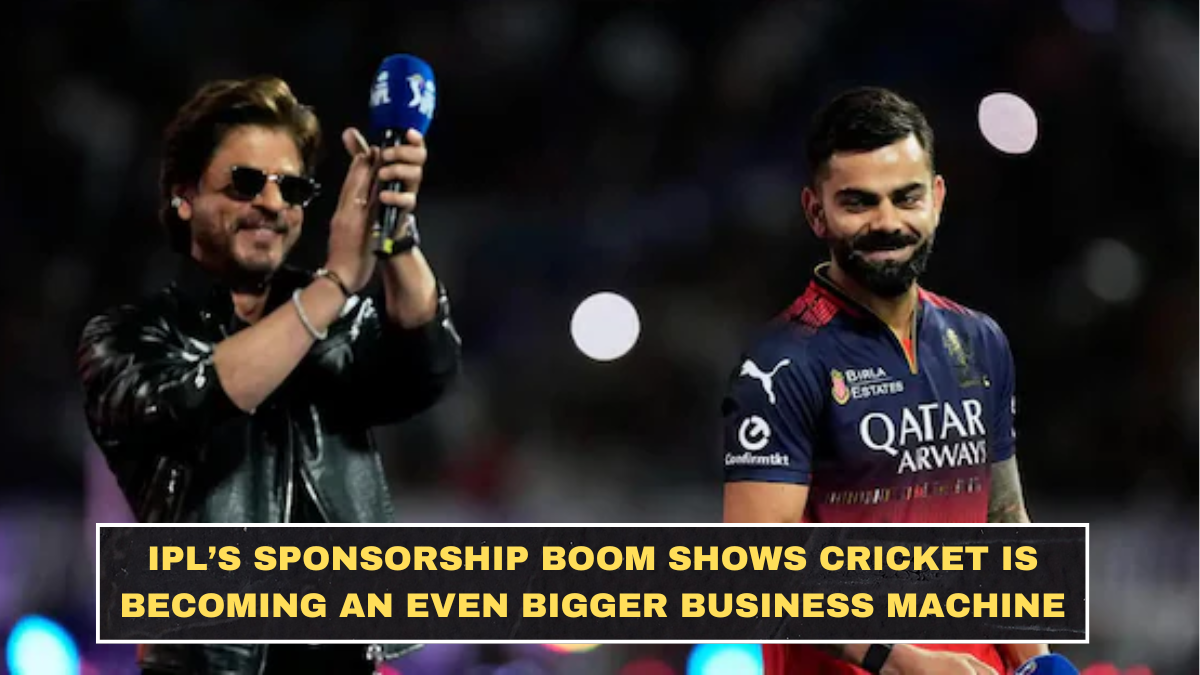
IPL is not just getting bigger on the field. The money around it is getting harder to ignore. Reuters reported in March 2026 that Royal Challengers Bengaluru was sold for $1.78 billion, while Rajasthan Royals was valued at $1.6 billion, showing how aggressively investors now value IPL franchises. Reuters also noted that IPL media-rights values had already doubled to more than $6 billion in the 2022 cycle, which helps explain why team sponsorships, brand deals, and franchise valuations keep climbing.
That is the real story behind the “sponsorship boom.” It is not just that brands want visibility. It is that IPL has become a stronger commercial machine with richer media money, more investor interest, and more ways for teams to sell fan attention.
What the Latest Sponsorship Pattern Shows
The advertiser mix is changing, but demand is still heavy. Exchange4media reported this week that Gujarat Titans have signed more than 37 sponsors and Mumbai Indians around 30 for IPL 2026. The same report highlighted deals such as Etihad Airways with CSK, Waaree Energies with RR, Shree Cement with SRH, Birla Estates with Gujarat Titans, Lauritz Knudsen with Mumbai Indians, and Vida with KKR. That matters because it shows IPL sponsorship is no longer concentrated in a few obvious consumer brands. Core-economy sectors, aviation, energy, cement, real estate, and EV brands are all using the tournament to buy attention.
Mumbai Indians’ own official site backs that up. Their 2026 team pages list Lauritz Knudsen as a principal partner, Malaysia Airlines and Skechers as associate partners, and a broader official-partner mix that includes Plum, Oaksmith, Campa, Colgate Total, Google Gemini, Google Search, Amul Protein, Cadbury, Udemy, Grew Solar, Pokémon, Reliance Digital and others. That is not a small sponsor board. It is a layered commercial stack.
The Numbers Readers Should Focus On
| Metric | Latest figure | Why it matters |
|---|---|---|
| RCB sale valuation | $1.78 billion | Shows how expensive top IPL assets have become. |
| Rajasthan Royals reported valuation | $1.6 billion | Confirms strong franchise pricing beyond one team. |
| IPL title sponsorship deal | $300 million for 2024–28 | Shows league-level commercial demand remains huge. |
| GT sponsor count | 37+ sponsors | Reflects how deep team-level partner monetisation has become. |
| MI sponsor count | Around 30 sponsors | Shows even legacy teams keep adding commercial layers. |
| MI estimated brand value | $242 million | Indicates brand equity beyond match revenue alone. |
Why Mumbai Indians Matter in This Story
Mumbai Indians are useful because they show how IPL monetisation now works in practice. This is not only about one giant front-of-shirt sponsor. MI’s official ecosystem includes:
- principal partners
- associate partners
- official partners
- merchandise partners and licensees
That structure matters because it allows teams to sell different layers of access to brands. Some buy prime logo placement. Some buy category exclusivity. Some buy digital fan engagement. Mumbai Indians’ March 2026 announcement with Plum explicitly described the brand as a digital partner and official skincare partner, which shows how category-specific and platform-specific these deals have become.
Why This Is Bigger Than Advertising
A lot of people still talk about sponsorship like it is just logo placement. That is outdated. Reuters reported in February 2026 that private equity interest in IPL teams has surged, with CVC’s Gujarat Titans investment delivering a return of more than 350% in dollar terms in just four years and valuing the team at $900 million in that transaction. That tells you IPL assets are now being treated as serious investment vehicles, not just sports properties.
So the boom means three things at once:
- brands want fan reach
- teams want diversified commercial income
- investors now see IPL franchises as scalable assets
What This Says About Sports Business in India
The blunt conclusion is simple: cricket in India is becoming even more commercial, and IPL is the clearest proof. Team values are rising, sponsor boards are getting deeper, and categories that once stayed outside sport are now spending to get in. This does not mean every deal is equally smart. It means the IPL attention economy is strong enough that brands and investors still believe they can extract long-term value from it. That belief is what matters most.
Conclusion
IPL’s sponsorship boom matters because it shows the league is no longer just a cricket event with advertisers attached. It is a full commercial engine. The evidence is already there: $1.78 billion franchise sales, $300 million title sponsorship, sponsor boards running to 30-plus partners, and investor returns strong enough to keep private capital interested. If someone still thinks IPL is only about cricket, they are years behind reality.
FAQs
How many sponsors do IPL teams have in 2026?
Exchange4media reported that Gujarat Titans have over 37 sponsors and Mumbai Indians around 30 in IPL 2026.
What are some current Mumbai Indians partnerships?
Mumbai Indians’ official site lists Lauritz Knudsen, Malaysia Airlines, Skechers, Plum, Oaksmith, Campa, Colgate Total, Google Gemini, Google Search, Amul Protein, Cadbury, Udemy and more among their 2026 partners.
Why are IPL franchise valuations rising so much?
Reuters linked the rise to stronger media-rights economics, revenue sharing, and intense investor interest, with RCB sold at $1.78 billion in March 2026.
Is IPL now more of a business machine than just a sports tournament?
Yes. The sponsorship depth, franchise valuations, title-rights money, and private-equity interest all show IPL now functions as a major sports-business platform, not just a cricket competition.