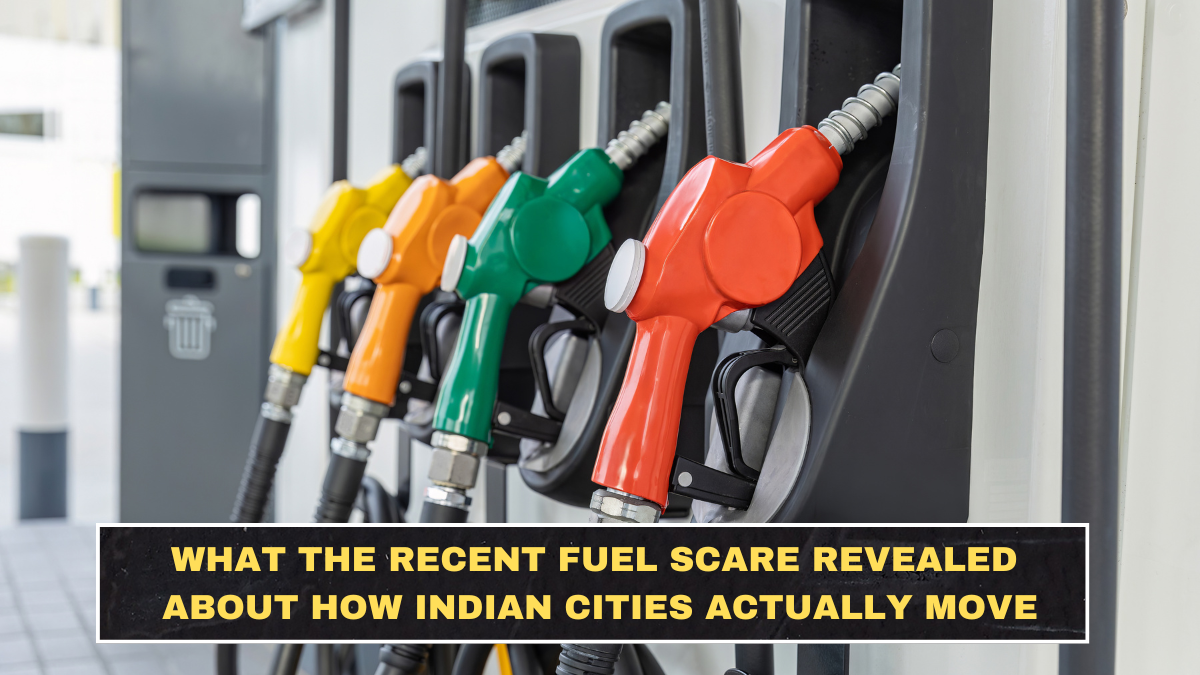
India’s recent fuel scare exposed something obvious that cities still pretend not to understand: when fuel access becomes uncertain, people do not suddenly “adapt” with private vehicles. They rush to buses and metro systems. In Nagpur, the shift was immediate. One day of fuel disruption pushed combined Metro and Aapli Bus ridership above 3 lakh, with Metro at 1,17,798 and Aapli Bus at about 1.85 lakh. That is not a mood swing. That is hard evidence of what people choose when petrol pumps become unreliable.
What happened during the fuel scare
Nagpur gave the clearest recent example. As queues grew at petrol pumps and fuel availability became uncertain, Metro ridership rose sharply. On March 25, Metro traffic reached about 1.13 lakh by 9 pm, up 6,375 from the previous day. Bus ridership also climbed from around 1.69 lakh the previous week to 1.78 lakh, and then to roughly 1.85 lakh on the peak day reported later. This is the kind of behavior data that matters more than lazy commentary about “changing commuter attitudes.” People switched because public transport was the reliable fallback.
The rise was not just in passenger count. Aapli Bus also reported stronger earnings per kilometre, moving from ₹26.88 to ₹29 in one report and later to ₹30.81, showing that higher ridership improved operational efficiency too. That matters because critics constantly claim public transport is only a subsidy burden. In reality, demand spikes can improve network economics when systems are available and frequent enough.
What this says about commuter behavior
The lesson is blunt. Many urban commuters still use private vehicles out of convenience, not because buses and metros are irrelevant. The moment fuel supply becomes uncertain or private mobility becomes stressful, commuters move fast toward high-capacity public systems. That means Indian cities are more dependent on transit than political rhetoric often admits. Delhi Metro alone recorded 2,358.03 million passenger journeys in 2025, or about 64.6 lakh daily passenger journeys, which shows just how central mass transit already is in one of India’s largest urban regions.
There is another uncomfortable truth here: buses still carry the real weight in most Indian cities. Metro gets the headlines, but buses absorb broader, flexible daily movement across ordinary routes. In Nagpur, bus ridership remained higher than Metro during the fuel scare. That fits wider evidence that bus systems remain the backbone of urban mobility, especially where metro coverage is limited or absent.
The bigger weakness Indian cities are still ignoring
This surge also exposed how fragile many transport systems remain. In Kolkata, nearly 400 government buses were taken off the road because of expired fitness certificates right in the middle of fuel-related disruption. That worsened commuter stress instead of helping absorb it. So the problem is not just whether people are willing to use public transport. They clearly are. The problem is whether cities have kept those systems functional, safe, and ready for sudden demand.
Experts have already warned that bus supply is inadequate in Indian cities. A CEEW analysis noted that most mega-cities, excluding Bengaluru, have only around 200 to 400 buses per million people. That is a thin cushion for cities that claim to be serious about resilience. When a fuel scare, heatwave, strike, or traffic shock hits, weak fleets are exposed immediately.
What the data shows in simple terms
| Indicator | Verified number | What it reveals |
|---|---|---|
| Nagpur Metro ridership during scare | 1,17,798 in a day | Metro becomes immediate fallback during fuel stress |
| Nagpur Aapli Bus ridership during scare | About 1.85 lakh in a day | Buses still carry more daily urban demand than Metro |
| Combined Nagpur ridership | Over 3 lakh in one day | Public transport absorbs sudden commuter shifts fast |
| Delhi Metro 2025 passenger journeys | 235.8 crore | High-capacity transit is already central to city movement |
| Bus availability in many mega-cities | 200–400 buses per million | Many cities still lack strong transit depth |
What cities should learn from this
A few conclusions are hard to avoid:
- Fuel uncertainty does not reduce travel demand; it shifts that demand onto public transport.
- Bus systems matter more than cities often admit because they handle larger flexible passenger volumes.
- Transit resilience is not just about building metro lines. It is also about keeping bus fleets roadworthy and available.
- If cities want fewer private vehicles, they need dependable service before the next disruption, not speeches after it.
Conclusion
The recent fuel scare revealed that Indian cities still move on public transport when pressure rises. Nagpur’s numbers made that clear in real time, and Delhi’s scale shows this is not some local anomaly. The real failure is not commuter behavior. It is city planning that still underinvests in the very systems people depend on the moment private mobility becomes unstable.
FAQs
Did the fuel scare actually increase public transport ridership?
Yes. In Nagpur, the fuel scare pushed combined Metro and Aapli Bus usage above 3 lakh in a single day.
Which gained more during the disruption, Metro or buses?
Buses carried more passengers. Aapli Bus handled about 1.85 lakh riders versus Metro’s 1,17,798 on the reported peak day.
Does this mean people prefer public transport?
It means many commuters will use public transport quickly when private vehicle use becomes difficult or unreliable. That is a stronger signal than opinion surveys.
What is the biggest policy lesson?
Cities need stronger, better-maintained bus and metro systems before the next disruption hits. Otherwise every fuel or traffic shock turns into a commuter crisis.
Click here to know more