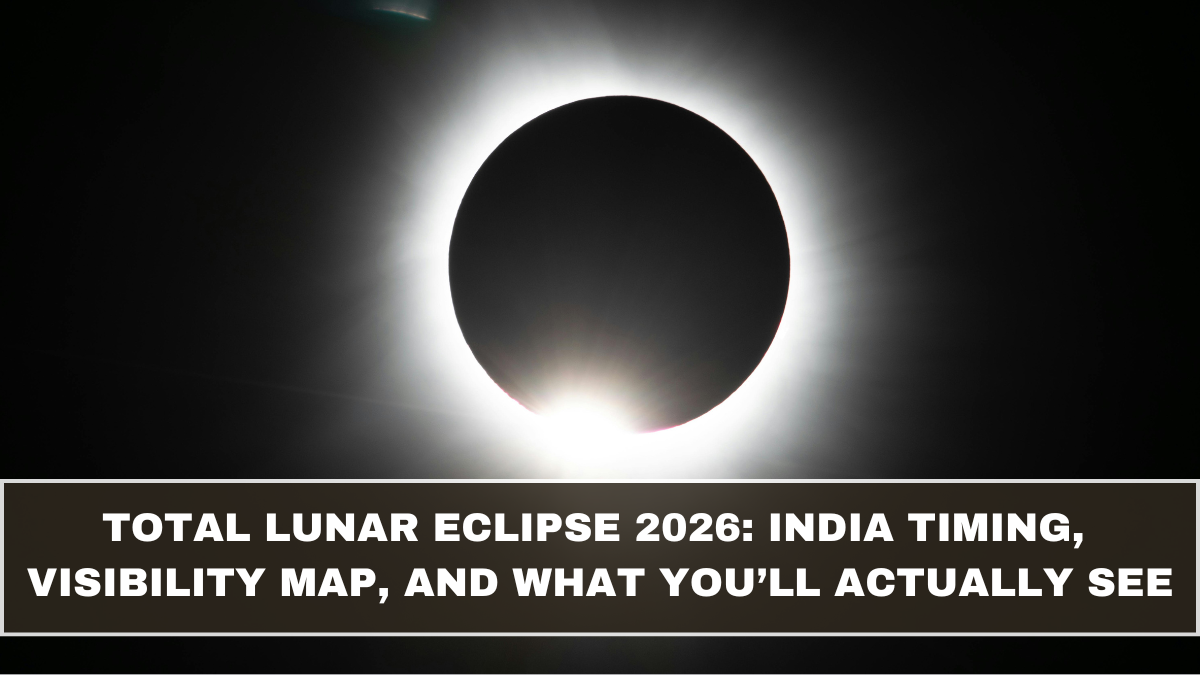
The night sky in March 2026 will deliver one of the most dramatic celestial events of the decade — a Total Lunar Eclipse, where the Moon slowly darkens and then turns a deep copper-red. Unlike a solar eclipse, this event is completely safe to watch and can be enjoyed with naked eyes from rooftops, balconies, and open grounds across India.
If you’re searching for:
• Total lunar eclipse 2026 date
• Exact India timing (IST)
• Whether it will be visible in your city
• What the “Blood Moon” will actually look like
This guide explains everything clearly with data and timing tables.
What Is a Total Lunar Eclipse?
A total lunar eclipse occurs when Earth moves directly between the Sun and the Moon, casting its shadow on the Moon.
solarsystemsolar systemsolarsystem
When the Moon fully enters Earth’s umbra (dark central shadow), it does not disappear. Instead, it turns reddish because Earth’s atmosphere bends red sunlight onto the Moon’s surface.
Total Lunar Eclipse 2026 – Confirmed Date
Astronomical calculations confirm a Total Lunar Eclipse on 3 March 2026 (UTC).
In Indian Standard Time (IST), the eclipse will occur during the late night of 3 March and early hours of 4 March 2026.
India Timing (IST) – Phase Wise Breakdown
| Eclipse Phase | Approx IST Time | What You’ll See |
|---|---|---|
| Penumbral Begins | ~8:50 PM | Slight dimming (hard to notice) |
| Partial Begins | ~10:00 PM | Dark shadow appears on Moon |
| Total Eclipse Begins | ~11:30 PM | Moon turns reddish |
| Maximum Eclipse | ~12:15 AM | Deepest red color |
| Total Eclipse Ends | ~1:00 AM | Red glow fades |
| Partial Ends | ~2:30 AM | Shadow leaves Moon |
Exact minutes may vary slightly based on astronomical refinements closer to the event.
Will Total Lunar Eclipse 2026 Be Visible in India?
Yes. The March 2026 total lunar eclipse will be clearly visible from most parts of India, weather permitting.
| Region | Visibility |
|---|---|
| North India | Excellent |
| South India | Excellent |
| East India | Very Good |
| West India | Very Good |
| Northeast | Good |
Since the event occurs during night hours, the entire totality phase is expected to be observable.
Why Does the Moon Turn Red?
During totality, sunlight passes through Earth’s atmosphere before reaching the Moon.
criticalanglesinerelationcritical angle sine relationcriticalanglesinerelation
Shorter blue wavelengths scatter, while longer red wavelengths bend toward the Moon. This atmospheric filtering creates the famous “Blood Moon” effect.
Scientific Data Snapshot
| Feature | Data |
|---|---|
| Eclipse Type | Total Lunar Eclipse |
| Date (UTC) | 3 March 2026 |
| India Date | Night of 3–4 March 2026 |
| Safe to View? | Yes |
| Equipment Needed | None |
| Totality Duration | ~1 hour |
Can You Watch It With Naked Eyes?
Yes — 100% safe.
Unlike solar eclipses, lunar eclipses do not require protective glasses. You can also use:
• Binoculars for crater detail
• DSLR camera with tripod
• 200mm+ zoom lens for close shots
Cultural Significance in India
In India, a lunar eclipse is called Chandra Grahan. Some people observe:
• Fasting during eclipse period
• Avoiding cooking
• Taking ritual bath after eclipse ends
Scientifically, however, it is purely an astronomical alignment event.
Best Time to Watch in India
The most visually dramatic period will be between:
11:30 PM to 1:00 AM IST (Totality phase)
This is when the Moon will appear fully red.
Conclusion
The Total Lunar Eclipse 2026 will be one of the most beautiful and easily observable sky events visible from India. It requires no equipment, poses no health risk, and offers a rare opportunity to witness the Moon glowing red in the midnight sky.
Mark your calendar for the night of 3–4 March 2026, check local weather conditions, and step outside during totality for the best view.
FAQs
Is the total lunar eclipse 2026 visible in India?
Yes, the full totality phase will be visible across most of India if skies are clear.
What time is the blood moon in India?
The red “Blood Moon” phase is expected around midnight, roughly 11:30 PM to 1:00 AM IST.
Do we need special glasses?
No, lunar eclipses are completely safe to view with naked eyes.
How long will the total phase last?
Approximately one hour.
What causes the red color?
Earth’s atmosphere bends red sunlight onto the Moon during totality.