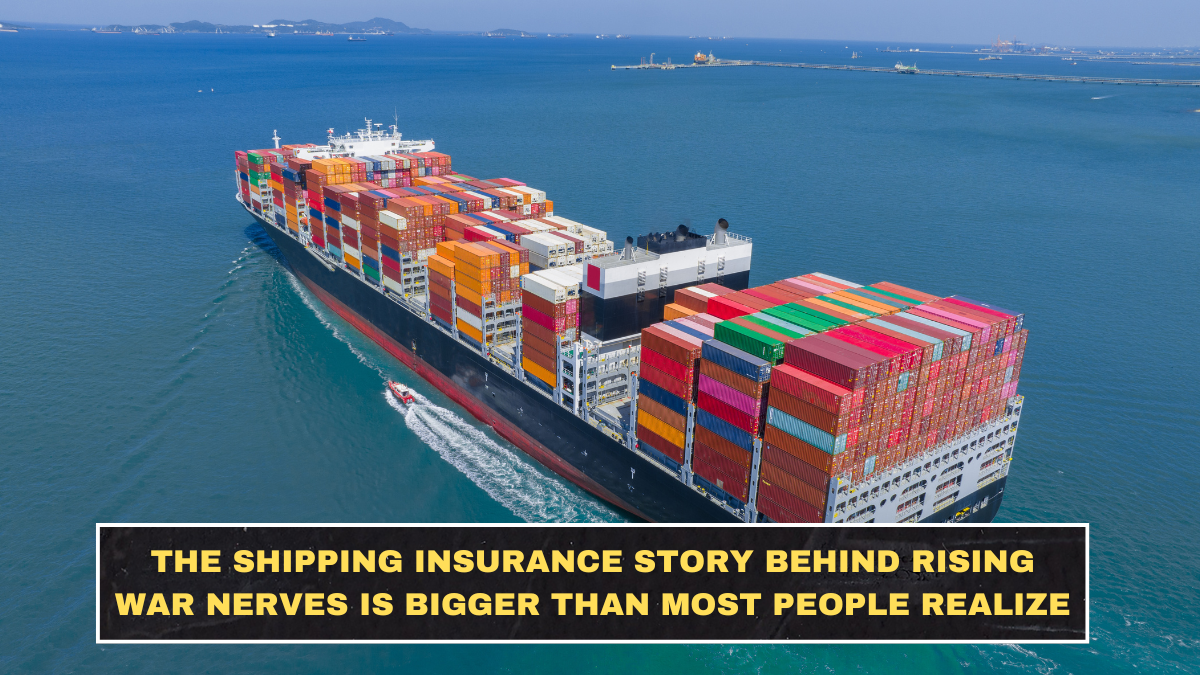
Shipping insurance sounds like a niche industry problem until war risk suddenly gets repriced. Then it becomes everybody’s problem. Reuters reported in March that maritime war-risk premiums in the Gulf had surged by more than 1,000% in some cases, with coverage quotes jumping from around 0.25% of a ship’s value to as high as 3% per voyage. When premiums move that violently, shipping costs rise fast, trade routes get disrupted, and import prices start climbing well beyond the ports.
Why insurers are repricing so aggressively
Insurers are not doing this out of panic alone. Reuters reported that after the Iran conflict widened, at least three tankers were damaged, one seafarer was killed, and about 150 ships were stranded near the Strait of Hormuz. When the physical threat to vessels rises that sharply, insurers either charge much more, restrict coverage, or pull cover entirely. That is exactly what happened.
What “war risk premium” actually means
War-risk insurance is a special layer of marine cover that protects against damage caused by conflict, missile strikes, terrorism, or similar hostile events. In calmer periods, it can be a manageable cost. In an active conflict zone, it can become a deal-breaker. Reuters reported that some brokers had to quote coverage on a per-voyage basis rather than under normal arrangements because the risk environment had changed too quickly. That matters because one expensive voyage repeated across many cargoes turns into a wider inflation story.
Why the effect goes beyond the maritime sector
The blind spot most people have is thinking this only hurts shipowners. It does not. Reuters reported that Hapag-Lloyd was facing $40 million to $50 million in extra weekly costs from the Middle East conflict, driven by fuel, insurance, and storage. The company made clear those costs are too large to simply absorb. In plain English, that means customers eventually pay. Retailers, manufacturers, importers, and consumers end up carrying part of the bill.
How these costs reach ordinary consumers
The pass-through happens in layers:
- higher insurance costs per vessel
- higher freight and fuel surcharges
- rerouted cargo with longer transit times
- more expensive imported goods and industrial inputs
Reuters reported that major carriers rerouting around Africa were adding 10 to 14 days to journeys and imposing surcharges of roughly $1,500 to $4,000 per container. That kind of increase does not stay on a spreadsheet. It ends up in food prices, factory costs, and consumer goods.
The numbers that matter most
| Indicator | Reported figure | Why it matters |
|---|---|---|
| War-risk premium jump | From ~0.25% to as high as 3% | Shows how sharply risk pricing changed |
| Premium surge | More than 1,000% in some cases | Indicates an insurance shock, not a routine adjustment |
| Ships stranded near Hormuz | About 150 | Confirms operational disruption |
| Hapag-Lloyd extra weekly costs | $40M–$50M | Shows the scale of pass-through pressure |
| Route detour around Africa | 10–14 extra days | Raises time, fuel, and freight costs |
| Container surcharges | $1,500–$4,000 | Direct hit to import costs |
These numbers matter because they show a chain reaction: conflict raises risk, insurers reprice it, carriers raise charges, and the rest of the economy absorbs the shock.
Why Red Sea and Gulf risks now overlap
The danger is bigger because this is not just one route under stress. Reuters reported that Houthi leaders signaled they were ready to target the Red Sea again if needed, adding to the existing Gulf disruption. That means shipping companies are not choosing between one bad route and one normal route. They are navigating multiple pressure points at once. When both the Gulf and Red Sea look risky, insurance markets harden even faster.
What readers should watch next
The smartest signals are not speeches from politicians. Watch these instead:
- war-risk premium changes on Gulf-bound voyages
- new carrier surcharges and detour notices
- tanker movement through Hormuz
- freight cost increases on energy and container routes
If those indicators keep worsening, the inflation effect will widen. If they ease, the insurance shock may start fading before it embeds itself deeper into supply chains.
Conclusion
The shipping insurance story matters because it reveals how fast geopolitical risk becomes an everyday economic cost. Once insurers start charging war-zone prices, shipping stops being a normal logistics function and starts behaving like crisis infrastructure. That raises costs for carriers, importers, and finally consumers. So no, this is not just a maritime-sector footnote. It is one of the clearest ways conflict pressure leaks into the real economy.
FAQs
Why are shipping insurance premiums rising so sharply?
Because vessel damage, stranded ships, and active conflict risk have made Gulf routes much more dangerous, forcing insurers to charge far more for war-risk cover.
What is war-risk insurance?
It is a type of marine insurance that covers losses linked to war, missile attacks, terrorism, and related conflict events.
Do higher insurance costs really affect consumers?
Yes. Those costs are passed through freight rates, fuel surcharges, and higher prices for imported goods and industrial materials.
Why does rerouting matter so much?
Because longer routes mean more fuel use, longer delivery times, higher crew and vessel costs, and extra surcharges per container.
Click here to know more