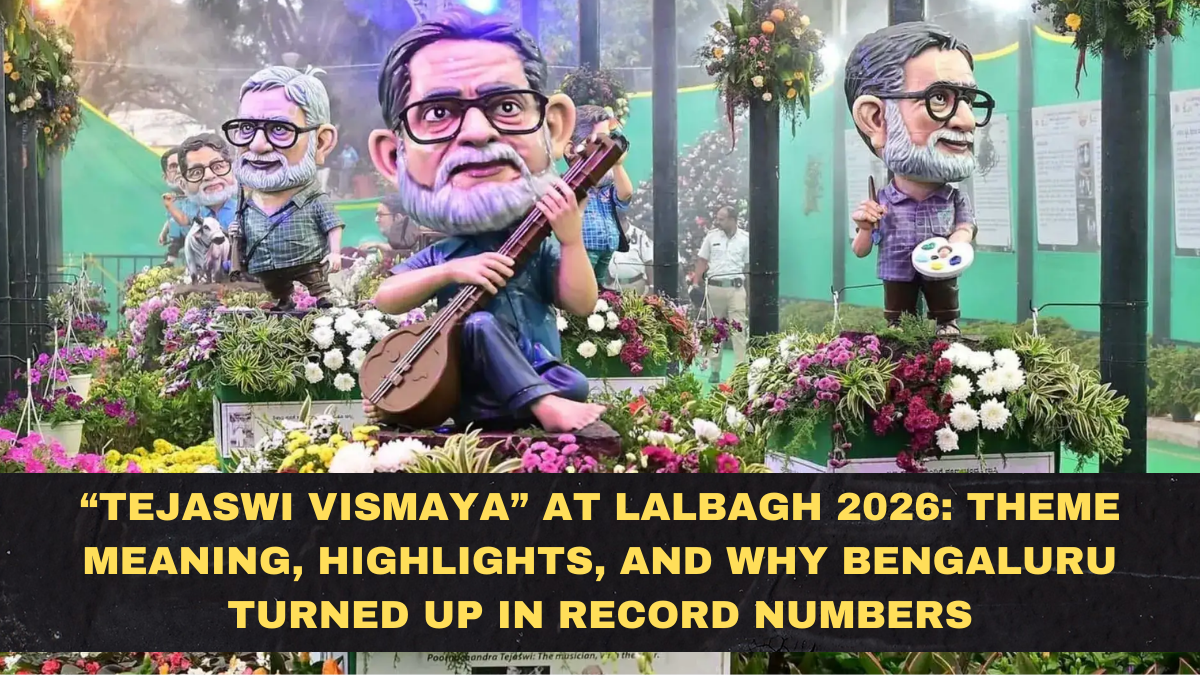
If you walked into Lalbagh this year and felt that the crowd energy was different, you weren’t imagining it. The 2026 edition of the Lalbagh Flower Show wasn’t just busy. It was emotionally charged. People weren’t coming only to see flowers. They were coming to experience something familiar, cultural, and deeply local.
That reaction was driven almost entirely by one decision: choosing “Tejaswi Vismaya” as the central theme.
For many visitors, especially Kannadigas, this wasn’t just another decorative concept. It was a cultural signal. A statement that this year’s show was about celebrating Karnataka’s literary soul, not just visual spectacle.
This article explains what “Tejaswi Vismaya” actually means, why KP Poornachandra Tejaswi was chosen as the inspiration, what visitors saw inside Lalbagh, and why this theme quietly turned the 2026 flower show into one of the most talked-about local events in Bengaluru.
What “Tejaswi Vismaya” Actually Means
“Tejaswi Vismaya” roughly translates to “The Wonder of Tejaswi.”
It is a tribute theme dedicated to the life, imagination, and literary legacy of KP Poornachandra Tejaswi, one of Karnataka’s most loved writers and thinkers.
Tejaswi wasn’t just a novelist or short-story writer. He was a cultural symbol. A storyteller who wrote about forests, science, rural Karnataka, curiosity, rational thinking, and human eccentricity long before those topics became fashionable.
So when Lalbagh announced “Tejaswi Vismaya” as the theme, it wasn’t about building a statue out of flowers.
It was about using floral art to recreate the emotional world of a man whose stories shaped how many Kannadigas think about nature, society, and imagination.
That’s why the theme resonated so strongly. It felt personal, not performative.
Why KP Poornachandra Tejaswi Was Chosen as the Theme
Choosing Tejaswi was not an accident or a random cultural pick.
In recent years, there has been a quiet cultural push in Karnataka to bring literary figures back into mainstream public memory, especially for younger audiences who mostly know influencers, actors, and startup founders.
Tejaswi represents something different.
He represents curiosity over conformity. Rational thought over blind belief. Nature over urban vanity. Substance over spectacle.
From a cultural-branding perspective, this was a smart move.
It gave the flower show moral weight, not just visual beauty.
It also allowed Lalbagh to tap into deep nostalgia among older visitors while introducing younger people to a writer they may only have heard about vaguely in school.
How the Theme Was Brought to Life Inside Lalbagh
This is where “Tejaswi Vismaya” stopped being a slogan and became an experience.
The central floral installation recreated key visual motifs associated with Tejaswi’s life and writing. Instead of generic arches and domes, visitors saw nature-centric structures that reflected forests, village life, and organic landscapes.
The design language was intentionally earthy, not flashy.
Muted colors. Natural textures. Flowing layouts instead of rigid symmetry.
Several zones inside Lalbagh reflected:
-
Forest-inspired floral corridors
-
Rural Karnataka-style installations
-
Sculptural elements representing curiosity, science, and storytelling
-
Quiet reading-corner-style spaces with quotes and visual tributes
For many visitors, this created a slower, calmer emotional experience compared to previous years’ high-drama themes.
People weren’t just taking selfies. They were reading. Talking. Explaining the theme to their children.
That behavioral shift is exactly why the theme worked.
Why the Theme Connected So Strongly With Local Visitors
Most theme-based exhibitions fail because they feel artificial.
“Tejaswi Vismaya” didn’t.
Here’s why it landed emotionally.
First, Tejaswi is not a distant historical figure. He feels recent. Familiar. Local.
Second, his work is deeply connected to Karnataka’s landscape, language, and everyday life.
Third, his personality represents values that people still admire: rationality, humility, intellectual curiosity, and resistance to shallow trends.
So when people walked into Lalbagh and saw a floral tribute to Tejaswi, they didn’t feel like they were attending a government event.
They felt like they were participating in a cultural memory.
That emotional alignment is what drove repeat visits, long queues, and unusually high word-of-mouth sharing.
What Families and Tourists Found Most Interesting
For families, especially those visiting with children, the theme added an educational layer to the outing.
Parents weren’t just pointing at flowers.
They were telling stories.
They were explaining who Tejaswi was, why he mattered, and what his stories were about.
For tourists from outside Karnataka, the theme acted like a cultural introduction.
It gave context.
It turned Lalbagh from a garden visit into a cultural experience.
The most talked-about highlights included:
-
The central Tejaswi tribute structure
-
Forest-themed floral walkways
-
Quote installations integrated into gardens
-
Photo zones that blended literature and nature
-
Calm zones designed for sitting and observing
This combination of beauty and meaning is rare in public exhibitions, which is why the response was so intense.
Why This Theme Drove Record Footfall
From a crowd-behavior perspective, “Tejaswi Vismaya” had three things going for it.
First, strong local emotional relevance.
Second, uniqueness compared to past themes that focused on monuments or generic concepts.
Third, social media shareability combined with cultural respectability.
People felt proud sharing photos from this year’s show.
That’s a powerful psychological driver.
When an event gives people social capital, footfall explodes.
That’s exactly what happened here.
What This Signals About Bengaluru’s Cultural Direction
This theme quietly revealed something important.
Bengaluru is tired of shallow spectacle.
There is a growing appetite for cultural depth, regional pride, and intellectual nostalgia.
“Tejaswi Vismaya” succeeded not because it was grand, but because it was grounded.
It shows that future Lalbagh themes and city exhibitions will likely move more toward:
-
Regional icons
-
Cultural storytelling
-
Literary and scientific tributes
-
Emotion-driven design
-
Slower, reflective visitor experiences
That’s a meaningful shift in how public culture is being curated in Karnataka.
Conclusion: Why “Tejaswi Vismaya” Was More Than a Theme
“Tejaswi Vismaya” wasn’t just the name of a floral installation.
It was a cultural moment.
It reminded people of who KP Poornachandra Tejaswi was, what he stood for, and why his ideas still matter.
It turned a routine flower show into a deeply local emotional experience.
And it proved something important: when exhibitions respect culture instead of exploiting it, people show up in record numbers.
That’s why “Tejaswi Vismaya” will be remembered as one of the most meaningful Lalbagh themes in recent history.
FAQs
What does “Tejaswi Vismaya” mean?
It means “The Wonder of Tejaswi,” a tribute to writer KP Poornachandra Tejaswi and his cultural legacy.
Who was KP Poornachandra Tejaswi?
He was a celebrated Kannada writer, thinker, and storyteller known for his work on nature, science, rural life, and rational thought.
Why was Tejaswi chosen as the Lalbagh theme in 2026?
To celebrate Karnataka’s literary heritage and create a culturally meaningful theme that resonated with local audiences.
What were the main highlights of the Tejaswi Vismaya theme?
Forest-inspired installations, literary tributes, quote zones, rural-style floral designs, and calm reflective spaces.
Why did this year’s Lalbagh Flower Show see record crowds?
Because the theme had strong emotional relevance, cultural pride value, and high social-sharing appeal.
Is the Tejaswi Vismaya theme relevant for tourists too?
Yes. It offered tourists a cultural introduction to Karnataka’s literary identity along with visual beauty.