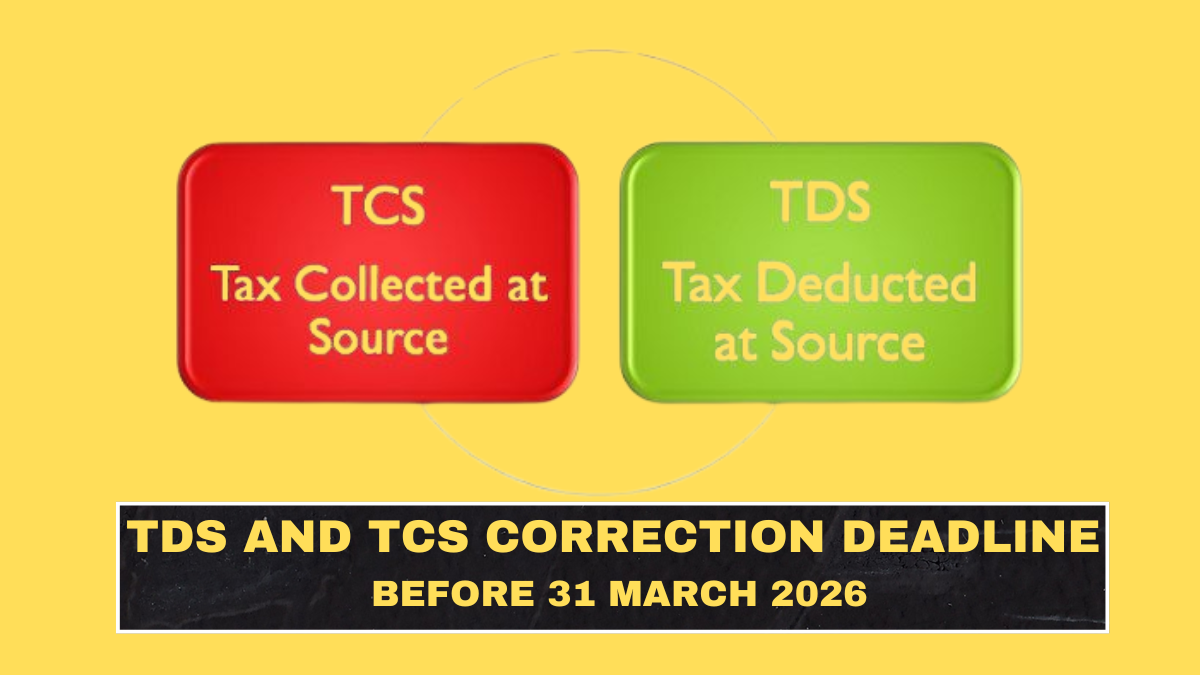
Most businesses ignore TDS and TCS corrections until a vendor chases them, a deductee sees missing credit in Form 26AS, or the accounts team suddenly realizes an old PAN, challan, or amount mismatch is still sitting unrepaired. That lazy approach is about to get expensive. The Income Tax Department has put a specific alert on the portal saying deductors and collectors must submit TDS and TCS correction statements for FY 2018-19 Q4 to FY 2023-24 Q3 by 31 March 2026, and from 1 April 2026 those filings become time-barred because of the repeal of the Income-tax Act, 1961.
This is not random portal noise. The six-year cap on correction statements was introduced to stop endless revisions and to bring finality to TDS and TCS reporting. The Budget memorandum explained that there was previously no time limit for filing correction statements, which allowed repeated revisions indefinitely and created problems for deductees and collectees. The amendment therefore imposed a six-year outer limit, effective from 1 April 2025.
What the 31 March 2026 deadline actually means
The practical meaning is simple. If you still need to correct old TDS or TCS statements falling in the portal’s flagged window, the correction must be filed on or before 31 March 2026. After that, those old corrections are treated as time-barred and the portal warning says they will not be accepted from 1 April 2026. That means businesses sitting on old errors are running out of road, whether the mistake is a wrong PAN, wrong challan mapping, wrong amount, wrong section, or an omitted entry that affects somebody’s tax credit.
The reason these years are being highlighted is tied to the six-year limit. The Department’s TDS and TCS guidance now says correction statements must be filed within six years from the end of the financial year in which the original TDS or TCS statement was required to be furnished, and this rule applies from 1 April 2025. That is the legal logic behind the deadline window now being pushed on the portal.
Which old statements are affected
The portal alert specifically names the period from FY 2018-19 Q4 to FY 2023-24 Q3. So if your business has any pending correction for that block, this is not a “maybe later” task. It is a closing window. If you are dealing with old vendor mismatches, invalid PAN cases, late booked invoices, or TDS/TCS figures that do not reconcile with challans, those cases should be reviewed now instead of being dumped into the usual year-end mess.
To make this easier, here is the official range the portal has flagged:
| Correction window flagged by portal | Status | Why it matters |
|---|---|---|
| FY 2018-19 Q4 | Must be corrected by 31 March 2026 | Portal says filings become time-barred from 1 April 2026 |
| FY 2019-20 Q1 to Q4 | Must be corrected by 31 March 2026 | Six-year correction cap now applies |
| FY 2020-21 Q1 to Q4 | Must be corrected by 31 March 2026 | Old mismatches can still hurt deductee credit and notices |
| FY 2021-22 Q1 to Q4 | Must be corrected by 31 March 2026 | Corrections will not stay open forever anymore |
| FY 2022-23 Q1 to Q4 | Must be corrected by 31 March 2026 | Same outer-limit rule applies |
| FY 2023-24 Q1 to Q3 | Must be corrected by 31 March 2026 | Portal specifically includes these quarters |
What kinds of errors businesses usually need to correct
Most correction statements are not about exotic tax law issues. They are basic operational failures. The common mess includes wrong PAN of the deductee, challan mismatch, short deduction, wrong section code, incorrect amount of payment or tax deducted, wrong date, duplicate row, or a missed deductee record that causes the credit not to reflect properly. These errors sound small, but they create downstream pain for both the business and the taxpayer whose credit or collection record gets distorted. The entire point of the six-year cap was to stop this correction process from dragging on forever.
The dirty truth is that many businesses do not have a tax problem first. They have a process problem. The finance team files the quarterly statement, assumes the job is done, and then ignores reconciliation until someone complains. By that point, Form 26AS mismatches, return processing issues, interest exposure, and follow-up notices start appearing. The Department’s memorandum explicitly noted that delayed or missing TDS/TCS statements inconvenience deductees and collectees by causing mismatches during return processing and even raising unnecessary demands.
Why waiting till the last week is a bad idea
If you leave this work to the final week of March 2026, you are behaving like most non-serious compliance teams. Correction statements are rarely a one-click cleanup. You usually need original statement data, challan details, deductee records, PAN validation, internal ledger confirmation, and sometimes vendor communication. In many cases, the first version of the correction still fails because the underlying data was wrong in the books to begin with. So the real bottleneck is not the filing screen. It is your own messy records.
There is also a transition issue businesses should not miss. The transition FAQ under the new law says revised or correction TDS returns relating to periods governed by the Income-tax Act, 1961 must continue to be filed under the old Act framework even if the revision happens after 1 April 2026. But the portal has separately warned that the old flagged periods become time-barred from 1 April 2026. In other words, the legal framework for old-period corrections may survive in principle, but the correction window for the specified time-barred periods is not something you should gamble on.
The compliance risk if you ignore it
Ignoring correction work does not always create an instant dramatic penalty, but that is exactly why many businesses stay careless. The real damage often shows up through credit mismatch, notices, vendor disputes, and classification as assessee-in-default in more serious cases. The Income Tax Department’s TDS guidance says failure to deduct or failure to deposit can trigger interest, disallowance of expenditure, penalty, and even prosecution in severe deposit-default situations. The transition FAQ also says TDS default proceedings can still be initiated after 1 April 2026 for matters governed by the old law through the saving provisions in the new Act.
Here is the simpler view businesses should actually use:
| Problem | What it causes | Why correction matters |
|---|---|---|
| Wrong PAN or missing deductee details | Credit may not reflect properly to the taxpayer | Leads to complaints, reconciliation issues, and return mismatch |
| Wrong challan mapping | Deposit exists but does not match the statement cleanly | Can trigger unresolved mismatch in reporting |
| Wrong amount or wrong section | TDS/TCS shown incorrectly | May distort liability, credit, and compliance trail |
| Delayed cleanup of old quarters | Becomes time-barred after 31 March 2026 for the portal-flagged periods | Old mistakes may get frozen without easy correction |
What businesses should do before 31 March 2026
Start with a quarter-wise reconciliation of all old TDS and TCS statements in the flagged window. Compare filed returns with challans, deductee ledgers, vendor master data, and the records actually reported to the tax system. Do not just ask your accountant whether “everything is okay.” That question is useless. Ask for a list of open mismatches by quarter, by PAN, by challan, and by section. That is how competent teams work.
Then prioritize the corrections that affect tax credit visibility and reconciliation. If a vendor or employee cannot see proper credit, that issue deserves early action. If the books and challans do not tie, fix that before attempting the correction upload. And if your filings span multiple entities or branches, centralize the review instead of letting each team quietly hide its own backlog. The deadline is fixed. Your internal excuses are not.
Simple checklist before filing a correction statement
A practical business checklist is more useful than motivational nonsense. Before filing a correction statement, confirm the original quarter and form, verify the challan details, validate PAN entries, check that deductee-level values match your books, and review whether the correction is actually solving the root mismatch rather than just re-uploading bad data. Businesses that rush this step usually end up filing one more broken correction to fix the previous broken correction.
Also keep in mind the standard due dates for original quarterly filings because they help you understand the correction timeline logic. For TDS, the Department lists due dates as 31 July, 31 October, 31 January, and 31 May for the four quarters. For TCS, the due dates are 15 July, 15 October, 15 January, and 15 May. The six-year correction cap runs from the end of the financial year in which the statement was required to be furnished, not from the day your team finally wakes up to the mistake.
Conclusion
The 31 March 2026 TDS and TCS correction deadline is not a minor compliance footnote. It is a hard stop for old correction opportunities that many businesses have been casually postponing. The Department has explicitly told deductors and collectors to submit correction statements for FY 2018-19 Q4 through FY 2023-24 Q3 by that date, and from 1 April 2026 those flagged filings become time-barred.
The smart move is obvious. Stop pretending old TDS and TCS errors are harmless because they are “only reporting issues.” Reporting errors become tax credit disputes, compliance friction, and operational embarrassment. Pull the old quarters now, identify real mismatches, and fix them while the door is still open. Waiting until the last minute is not strategy. It is negligence dressed up as busyness.
FAQs
What is the TDS and TCS correction deadline mentioned by the Income Tax Department?
The portal alert says deductors and collectors should submit TDS and TCS correction statements for FY 2018-19 Q4 to FY 2023-24 Q3 by 31 March 2026. It also says that from 1 April 2026 these filings will be time-barred.
Why is 31 March 2026 important for old correction statements?
It matters because the Department now applies a six-year time limit for TDS and TCS correction statements, effective from 1 April 2025. The Budget memorandum said this was introduced to stop indefinite revisions and to bring certainty to the filing process.
Which periods are specifically flagged for correction before the deadline?
The portal specifically flags FY 2018-19 Q4 through FY 2023-24 Q3. That is the range businesses should review immediately instead of assuming older errors can always be fixed later.
What kind of mistakes can a correction statement fix?
A correction statement is generally used to rectify mistakes or add, delete, or update information furnished in the original TDS or TCS statement. In practice, this often involves PAN errors, challan mismatches, wrong section reporting, wrong amounts, or missing deductee entries.
Can old-period TDS corrections still relate to the old law after 1 April 2026?
Yes, the transition FAQ says revised or correction TDS returns for periods governed by the old Act must continue under the old Act framework even if filed after 1 April 2026. But that does not override the portal’s separate warning that the specified old correction filings become time-barred from 1 April 2026, so relying on delay here is reckless.