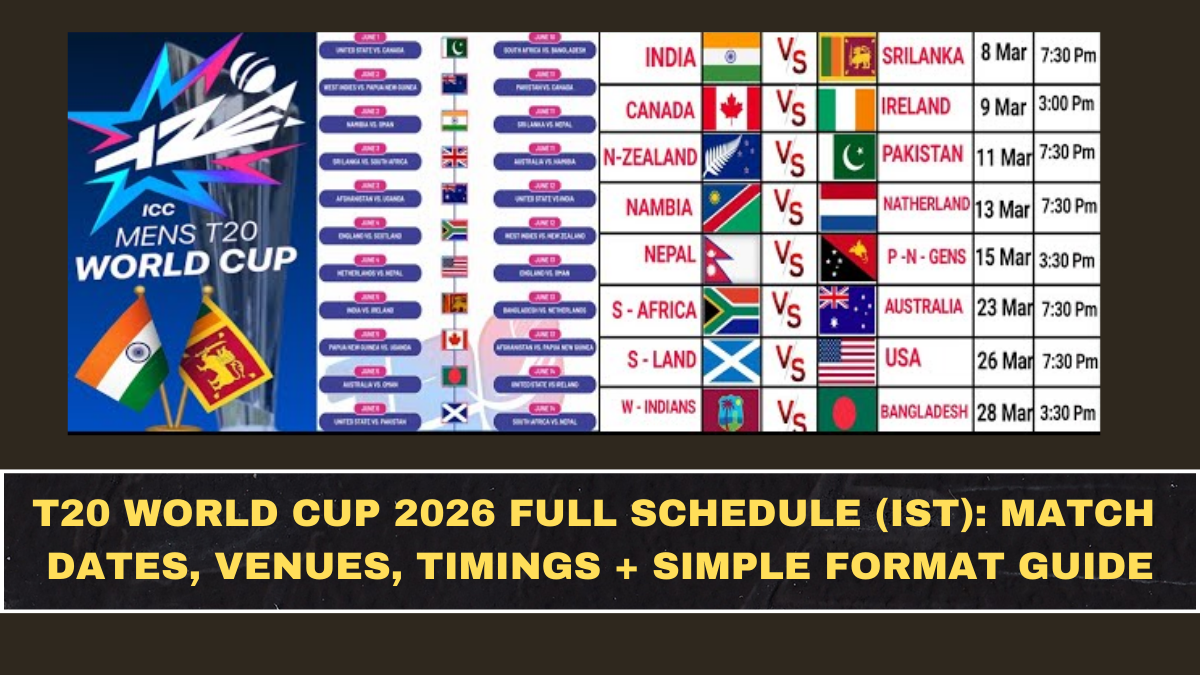
The T20 World Cup 2026 is shaping up to be one of the most followed cricket events of the decade, especially for Indian fans who plan their days around match timings. With India and Sri Lanka hosting the tournament, the excitement is not just about teams and players, but also about how matches fit into daily routines, work schedules, and late-night viewing habits. That is why understanding the full schedule in Indian Standard Time matters as much as knowing who is playing whom.
Unlike earlier tournaments where fans waited until the last moment to figure out timings, the T20 World Cup 2026 schedule has been designed with clarity in mind. Match phases, time slots, and venue rotations follow a predictable pattern, making it easier for viewers in India to plan ahead. This guide breaks down the schedule in a simple, realistic way without overwhelming you with confusing tables or unnecessary speculation.
T20 World Cup 2026 Host Countries and Overall Structure
The T20 World Cup 2026 is hosted jointly by India and Sri Lanka, which plays a major role in how the schedule is arranged. Matches are split across multiple cities in both countries to balance travel, crowd management, and broadcast timing. This co-hosting model also ensures that fans across regions get access to live stadium action.
The tournament follows a structured progression starting with the group stage, moving into the Super stage, and then into knockouts. Each phase is clearly separated by rest days to manage player workload and travel logistics. From a viewer’s perspective, this structure makes it easier to follow the tournament without losing track of where things stand.
Group Stage Match Schedule in IST
The group stage forms the bulk of the T20 World Cup 2026 schedule and runs over multiple days with matches almost every day. Teams are divided into groups, and each group match is scheduled in fixed time slots to maintain consistency for broadcasters and fans.
For Indian viewers, most matches fall into two familiar windows. Day matches usually start in the afternoon IST, while evening matches begin at prime-time hours. This allows fans to catch games after work or school without sacrificing sleep, especially for matches played in Indian venues.
Matches hosted in Sri Lanka follow similar IST-friendly timings, with only minor adjustments. This consistency is intentional and helps fans avoid confusion when switching between venues and match days.
Super Stage and Points Qualification Timeline
After the group stage, the tournament moves into the Super stage, where the competition intensifies and every match starts to matter more. The schedule becomes slightly tighter here, with fewer rest days and higher stakes.
Super stage matches are largely scheduled in evening slots to maximize viewership, especially for high-profile clashes. This is the phase where points calculations, net run rate discussions, and qualification scenarios dominate conversations.
For viewers, this part of the schedule is easier to track because matches are fewer and spaced more strategically. Each game directly impacts the semifinal race, making timing clarity even more important.
Knockout Matches: Semifinals and Final Timings
The knockout phase includes the semifinals and the final, which are scheduled to avoid overlap and viewer fatigue. These matches are typically placed in prime evening slots in IST to ensure maximum audience participation across the country.
Semifinals are usually played on separate days, allowing fans to focus on each match individually. The final is scheduled with additional buffer time for ceremonies and presentation, which slightly extends the broadcast window.
For Indian fans, these matches are expected to start at comfortable evening times, reducing the need for late-night viewing or early-morning alarms.
Venue Rotation and City-Based Match Planning
One key feature of the T20 World Cup 2026 schedule is the careful rotation of venues. High-capacity stadiums are reserved for marquee matches, while other venues host balanced fixtures to distribute crowds evenly.
This rotation also affects match timings. Cities with higher humidity or extreme daytime heat tend to host more evening matches. This not only improves playing conditions but also enhances the viewing experience for fans in stadiums and at home.
Understanding venue rotation helps fans predict match intensity and plan travel or watch parties accordingly.
How to Read the T20 World Cup 2026 Schedule Easily
Many fans find official schedules confusing because they mix local times, venue details, and match numbers. The easiest way to follow the T20 World Cup 2026 schedule is to focus on three things: match date, IST start time, and tournament phase.
Once you know whether a match is group stage, Super stage, or knockout, the importance becomes clear instantly. Adding venue context helps anticipate crowd energy and match atmosphere.
In 2026, schedule readability has improved, but fans still benefit from breaking it down logically rather than trying to memorize everything at once.
Why IST Timing Matters More Than Ever
With work-from-home routines fading and structured schedules returning, IST match timing has become a deciding factor in how many matches fans actually watch live. Afternoon matches suit weekend viewing, while evening matches dominate weekdays.
The T20 World Cup 2026 schedule reflects this reality by prioritizing prime-time slots for key games. This approach keeps fan engagement high throughout the tournament rather than only during knockouts.
For Indian audiences, this makes the viewing experience smoother, predictable, and less disruptive to daily life.
Conclusion: Planning Your T20 World Cup 2026 Viewing
The T20 World Cup 2026 full schedule in IST is designed for clarity, consistency, and maximum fan engagement. With India and Sri Lanka as hosts, match timings remain largely viewer-friendly, reducing confusion and late-night fatigue.
By understanding the tournament structure, phase-wise timing, and venue logic, fans can plan their viewing well in advance. Whether you follow every match or only the big clashes, knowing the schedule format helps you stay connected without stress.
In 2026, cricket is not just about watching matches; it is about fitting them seamlessly into everyday life. The schedule reflects that shift perfectly.
FAQs
Where can I check the T20 World Cup 2026 schedule in IST?
The official schedule is released with match dates, venues, and start times already aligned to Indian Standard Time, making it easy for Indian viewers to follow without conversions.
Are all matches scheduled in IST-friendly timings?
Yes, most matches are planned in afternoon and evening IST slots, especially those involving major teams and knockout stages.
Will India and Sri Lanka have different match timings?
There may be minor differences, but overall timings remain consistent for Indian viewers due to similar time zones.
How long does the group stage last?
The group stage spans several days with daily matches, followed by a clearly defined Super stage and knockout phase.
When are the semifinals and final usually played?
Semifinals are scheduled on separate days in prime evening slots, while the final is placed in a high-visibility time window for maximum viewership.
Is it necessary to follow the full schedule to enjoy the tournament?
Not at all. Understanding the structure and key match days is enough for most fans to enjoy the tournament without tracking every fixture.