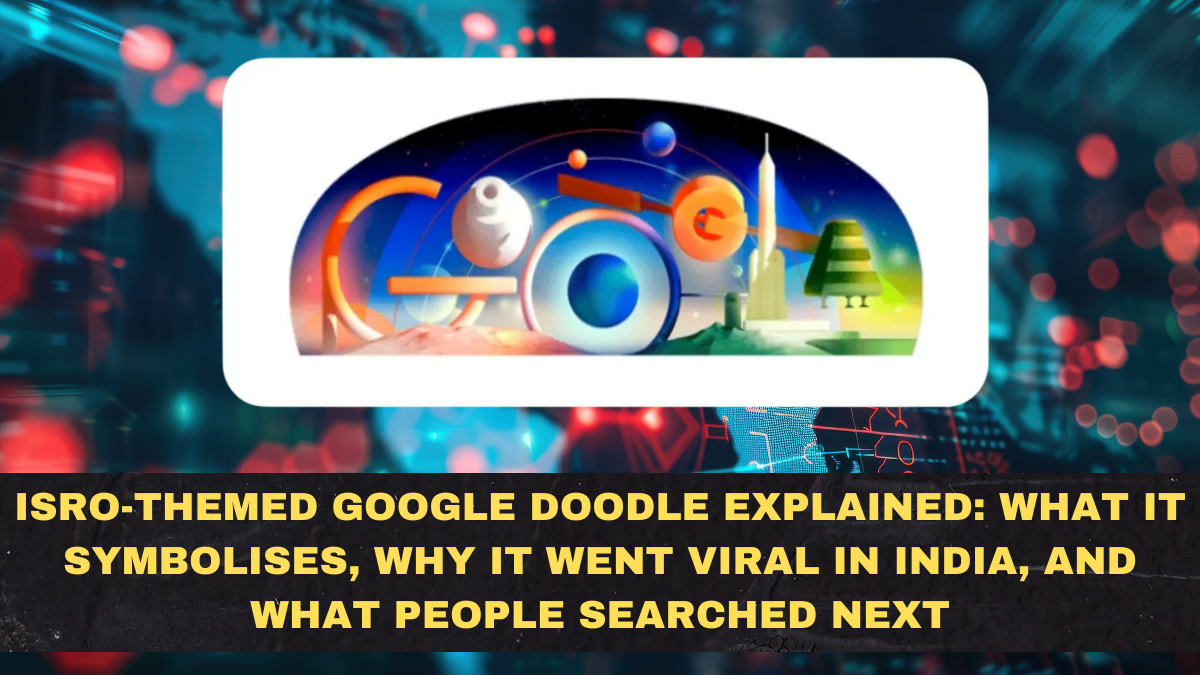
When Indians opened Google and saw an ISRO-themed doodle replacing the usual logo, the reaction was instant and emotional. Screenshots flooded social media. WhatsApp forwards started flying. Search queries spiked within minutes. For a brief moment, India’s space agency became the most visible symbol on the internet’s front door.
That reaction wasn’t accidental. It wasn’t just about design. It was about timing, symbolism, national mood, and a growing cultural obsession with space success stories.
The ISRO-themed Google doodle didn’t just decorate a homepage. It triggered a wave of curiosity-driven searches: “Why ISRO doodle today?”, “What does this doodle mean?”, “Why is ISRO trending?”, and “What did Google celebrate?”
This article explains what the doodle actually symbolised, why it went viral in India, what made it emotionally powerful in 2026, and what people were really searching for after seeing it.
What the ISRO-Themed Google Doodle Actually Showed
The doodle visually replaced the Google logo with a space-themed illustration inspired by India’s space program.
The dominant elements included:
-
A stylised rocket resembling India’s launch vehicles
-
Planetary or lunar imagery suggesting deep-space exploration
-
Satellite or orbital motifs
-
The Indian tricolour subtly integrated into the color palette
-
A futuristic yet warm visual tone
The design language wasn’t aggressive or hyper-technical. It was celebratory and accessible.
This mattered.
Google doodles work best when they balance symbolism with emotional clarity. This one didn’t require technical knowledge to understand. Even a school student could look at it and instantly think, “This is about India and space.”
That simplicity is exactly why it spread so fast.
What the Doodle Was Symbolising
The ISRO-themed Google doodle wasn’t tied to a random date or a single mission anniversary.
It symbolised something broader: India’s arrival as a serious, respected space power.
By 2026, ISRO is no longer seen domestically as a niche scientific institution. It is a mainstream national pride object, similar to how sports teams or major cultural icons function emotionally.
The doodle was Google’s way of acknowledging:
-
India’s sustained achievements in space science
-
The growing global relevance of ISRO
-
The public fascination with missions like Chandrayaan, Aditya, and Gaganyaan
-
India’s reputation for low-cost, high-impact space engineering
In cultural terms, the doodle wasn’t about rockets.
It was about recognition.
It signaled that India’s space story is now part of global pop culture, not just internal national news.
Why the Doodle Went Viral in India
The virality of the ISRO-themed Google doodle wasn’t driven by Google’s marketing.
It was driven by emotional alignment.
Three psychological forces were at play.
First, national pride momentum.
By 2026, ISRO missions are no longer rare events. But each success still reinforces a long-running national story: “We belong among the world’s top scientific nations.”
The doodle visually reinforced that story in a mainstream, global context.
Second, collective validation.
When Google highlights something, it feels like international recognition.
People didn’t just feel proud that ISRO exists.
They felt proud that the world was being reminded of ISRO.
That validation layer is what triggered mass sharing.
Third, algorithmic timing.
The doodle appeared during a period when space-related searches and discussions were already elevated due to recent missions, documentaries, and school curriculum buzz.
So the internet was already primed.
The doodle didn’t create interest.
It amplified existing interest.
Why It Hit Harder in 2026 Than It Would Have Earlier
If Google had released the same doodle ten years ago, the reaction would have been muted.
The timing in 2026 is everything.
Here’s why the emotional impact was unusually strong.
ISRO has crossed from “promising underdog” to “proven performer.”
Earlier, each mission felt like a gamble.
Now, success is expected.
That shift changes how people interpret symbolic gestures.
The doodle didn’t feel like encouragement.
It felt like acknowledgement of achievement.
Second, India’s youth culture is deeply invested in tech and science now.
Coding, startups, space tech, and AI are mainstream aspirations.
So an ISRO doodle didn’t just appeal to older generations.
It resonated strongly with students, creators, and early-career professionals.
Third, India’s global self-image has changed.
In 2026, there is a stronger cultural confidence about India’s place in global science and technology.
The doodle landed into that mindset perfectly.
What People Actually Searched After Seeing the Doodle
The search behavior after the doodle tells you what people really cared about.
The top intent clusters were not technical.
They were emotional and contextual.
People searched:
-
Why did Google show an ISRO doodle today
-
What does the ISRO Google doodle mean
-
Why is ISRO trending
-
What did Google celebrate with the ISRO doodle
-
Which ISRO mission is this doodle about
-
Is this for Republic Day
-
Did ISRO launch something today
This tells you something important.
People weren’t hunting for orbital mechanics.
They were hunting for meaning.
They wanted to understand why today mattered.
That’s exactly why this doodle became a Discover-friendly viral explainer topic.
Was the Doodle Linked to Republic Day or a Specific Mission
One of the most common misconceptions was that the doodle was for Republic Day or a fresh launch.
That confusion actually helped the doodle spread further.
People kept sharing it with captions like:
“ISRO doodle for Republic Day?”
“Did ISRO launch something new today?”
The reality is that the doodle functioned as a symbolic tribute, not a date-specific celebration.
Google often uses doodles to honor cultural or scientific significance rather than strict anniversaries.
In this case, the doodle celebrated the broader narrative of India’s space journey rather than a single event.
That ambiguity increased curiosity.
Which increased searches.
Which increased virality.
Why Google Chose ISRO as a Doodle Theme
Google doodles are cultural statements.
They don’t pick topics randomly.
ISRO met three strategic criteria.
First, global relevance.
India’s space missions are now covered internationally.
That makes ISRO a safe, globally legible symbol.
Second, positive brand association.
ISRO has a clean public image: scientific excellence, cost efficiency, national pride, and peaceful exploration.
There is no political toxicity attached to it.
Third, emotional storytelling power.
Space exploration naturally triggers awe, curiosity, and inspiration.
That emotional range makes it perfect doodle material.
In simple terms, ISRO was a low-risk, high-emotion choice.
What This Doodle Signals About India’s Cultural Position
This doodle quietly revealed something bigger.
India’s scientific institutions are now entering mainstream cultural symbolism.
For decades, doodles featured artists, freedom fighters, and historical leaders.
Now they are featuring scientists and space agencies.
That’s a cultural shift.
It signals that India’s identity narrative is expanding from heritage pride to scientific pride.
That matters deeply for how future generations think about success, ambition, and national identity.
Conclusion: Why the ISRO Google Doodle Mattered More Than It Looked
The ISRO-themed Google doodle wasn’t just a homepage decoration.
It was a cultural signal.
It symbolised recognition, pride, and India’s growing scientific confidence.
It went viral because it landed at the exact intersection of national mood, global validation, and emotional storytelling.
And it triggered massive curiosity because people wanted to know what it meant, not just what it showed.
In 2026, that doodle will be remembered as a moment when India’s space story crossed from science news into pop culture.
FAQs
What did the ISRO-themed Google doodle represent?
It symbolised India’s space achievements and global recognition of ISRO as a major space agency.
Why did the ISRO doodle go viral in India?
Because it triggered national pride, felt like international validation, and aligned perfectly with India’s space enthusiasm in 2026.
Was the doodle for Republic Day or a new ISRO mission?
No. It was a symbolic tribute to India’s space journey, not a specific date or launch event.
Why did people search so much after seeing the doodle?
Because they wanted to understand why it appeared that day and what it was celebrating.
Why does Google create doodles like this?
To honor culturally significant people, institutions, and achievements in a visually emotional way.
What does this doodle say about India’s global image?
It shows that India’s scientific institutions are now part of mainstream global cultural recognition.