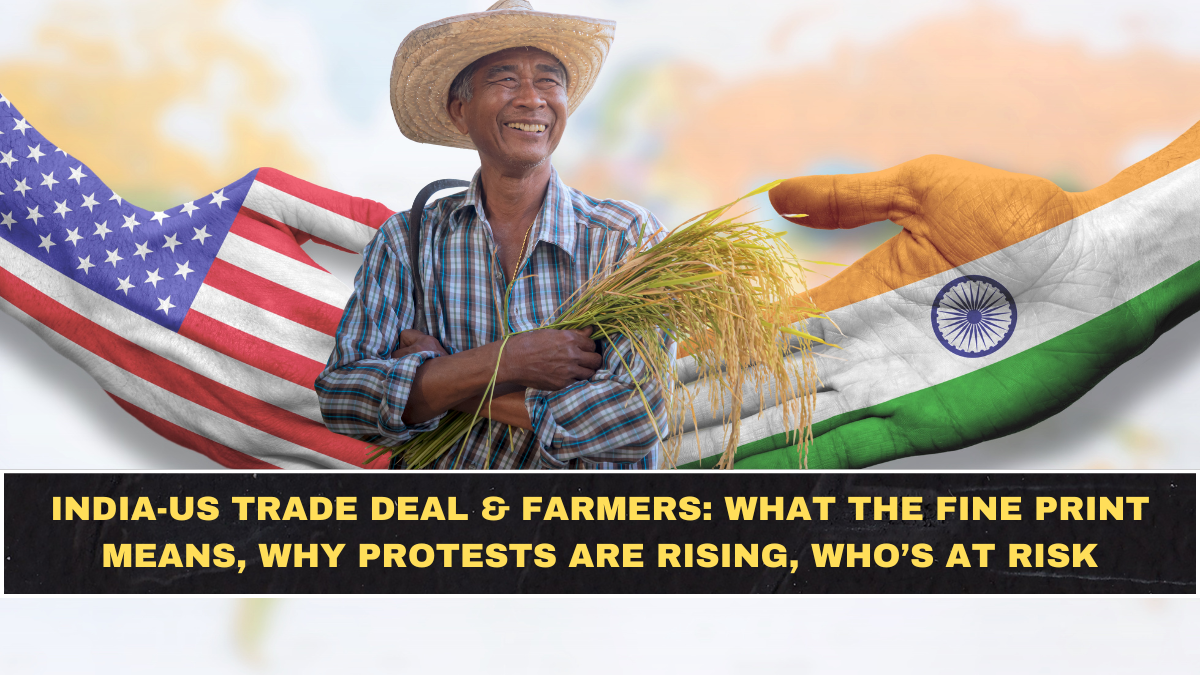
Agriculture sits at the most sensitive edge of any trade negotiation in India, and the India–US trade deal impact on farmers 2026 is being debated far more intensely than its impact on any other group. Farming in India is not just an economic activity; it is tied to food security, rural employment, and political stability. Even small changes in import access or pricing dynamics can ripple across millions of households, which is why farmers’ groups are closely scrutinising every clause linked to agriculture.
What worries many farmers is not a sudden flood of imports, but gradual pressure that builds quietly over time. Trade deals rarely change farm incomes overnight, but they can alter market signals, procurement behaviour, and price expectations. Understanding the India–US trade deal impact on farmers 2026 requires looking beyond headlines and focusing on how pricing, procurement, and policy responses interact on the ground.
Why Agriculture Became a Flashpoint in the Trade Deal
Agriculture has always been one of the most protected sectors in India’s trade policy. The reason is simple: Indian farming is dominated by small and marginal farmers who are highly vulnerable to price volatility. Opening markets too quickly exposes them to competition from large-scale, subsidised agricultural systems abroad.
In trade discussions with the US, agricultural access has been a recurring topic, especially around specific crops and processed food products. While India has resisted broad tariff reductions, even limited concessions raise concerns among farmer groups. The India–US trade deal impact on farmers 2026 is therefore less about what has been opened fully and more about what could gradually expand through quotas or future negotiations.
This sensitivity explains why agricultural clauses attract more public reaction than changes in industrial or services trade.
Impact on Crop Prices and Market Stability
One of the biggest fears surrounding the India–US trade deal impact on farmers 2026 is downward pressure on crop prices. When imported agricultural goods enter a market, even in limited volumes, they can influence benchmark prices and buyer behaviour. Traders may delay purchases, expecting cheaper alternatives, which affects domestic price discovery.
For farmers, price volatility is often more damaging than low prices alone. Uncertainty makes it harder to plan cropping cycles, input purchases, and debt repayment. Even rumours of increased imports can influence mandi prices before any actual shipment arrives.
This is why farmer organisations react strongly to trade signals. They understand that market psychology matters as much as physical supply.
Minimum Support Price and Policy Safeguards
A key factor moderating the India–US trade deal impact on farmers 2026 is India’s domestic support framework. Minimum Support Price mechanisms, procurement operations, and buffer stock policies continue to play a central role in stabilising farm incomes. These tools act as a shield against sudden external shocks.
However, farmers remain concerned about long-term policy direction. If trade commitments gradually expand, pressure may increase to align domestic procurement with global pricing trends. While no immediate change has been announced, farmers are watching closely for signals that MSP coverage or procurement intensity could be adjusted.
The tension lies not in current guarantees, but in future expectations shaped by trade policy language.
Why Protests and Opposition Are Increasing
Farmer protests linked to trade policy are not driven by a single clause, but by accumulated distrust. Past experiences have made farmers cautious of reforms that promise efficiency but expose them to market risks. The India–US trade deal impact on farmers 2026 is being viewed through this historical lens.
Many farmers feel they are asked to absorb adjustment costs while benefits accrue elsewhere in the economy. Export-oriented sectors gain opportunities, while farmers fear being the balancing factor. This perception fuels resistance, even when immediate changes are limited.
Protests also serve as a signal to policymakers that agricultural consent cannot be assumed in trade negotiations.
Who Is Most at Risk Among Farmers
Not all farmers face the same level of risk from trade-linked changes. Smallholders growing price-sensitive crops for local markets are the most vulnerable to import-driven price signals. Farmers without access to assured procurement or storage facilities feel the impact first.
On the other hand, producers linked to export-oriented value chains or diversified income sources are relatively insulated. The India–US trade deal impact on farmers 2026 is therefore uneven, affecting regions and crop types differently.
Understanding this variation is important, because policy responses must be targeted rather than uniform.
What Farmers and Policymakers Are Watching Next
Farmers are closely monitoring how future negotiations evolve rather than focusing only on current terms. Any expansion of quotas, changes in tariff structure, or alignment of standards is seen as a signal of direction. Communication from policymakers plays a crucial role in managing expectations.
Policymakers, meanwhile, are trying to balance international engagement with domestic stability. They are aware that agricultural disruption carries social and political costs that outweigh short-term trade gains.
This balancing act defines the real India–US trade deal impact on farmers 2026.
Conclusion: Why the Debate Will Continue
The India–US trade deal impact on farmers 2026 cannot be reduced to simple winners and losers. It is shaped by price signals, policy safeguards, market psychology, and trust between farmers and the state. While immediate changes remain limited, the long-term implications keep the debate alive.
For farmers, the concern is not just about today’s imports, but about tomorrow’s bargaining position. For policymakers, the challenge is to pursue trade engagement without undermining rural stability. This tension ensures that agriculture will remain the most closely watched and contested aspect of the India–US trade relationship in 2026.
FAQs
Why are farmers concerned about the India–US trade deal in 2026?
Farmers worry that even limited import access can affect prices, procurement behaviour, and long-term policy direction.
Does the trade deal remove protection for Indian agriculture?
No broad removal has occurred, but farmers are cautious about gradual or future concessions.
Will MSP be affected by the trade deal?
There is no announced change to MSP, but farmers monitor trade signals for future implications.
Are all farmers equally affected?
No, small and marginal farmers growing price-sensitive crops face higher risk than diversified producers.
Why are protests linked to trade policy increasing?
They reflect accumulated distrust and concern about who bears adjustment costs in economic reforms.