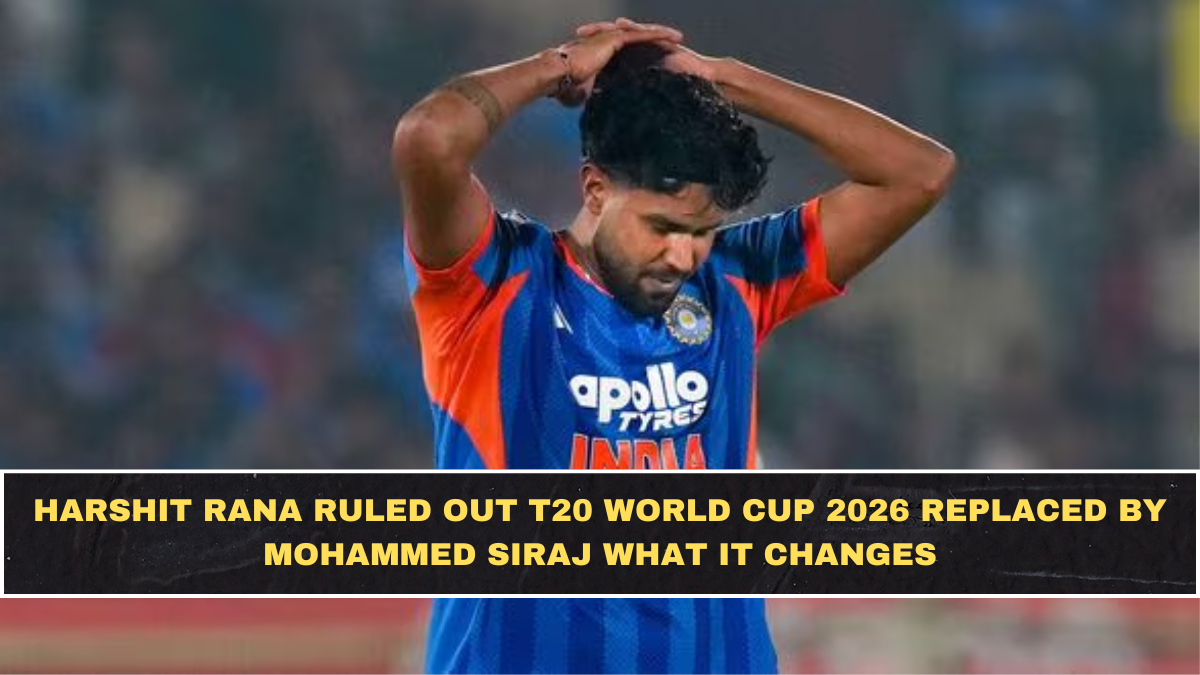
India’s T20 World Cup 2026 campaign has been forced into an early rethink after Harshit Rana was ruled out and Mohammed Siraj was approved as his replacement. Squad changes are not unusual in long tournaments, but this one carries tactical weight because it alters the balance of India’s pace attack rather than simply swapping like for like. The timing also matters, with matchups, conditions, and opponent styles already mapped by the team management.
For fans, the headline feels abrupt. For the team, it is a recalibration exercise that affects new-ball plans, death-over roles, and the mix of pace types India prefers against different opponents. Understanding what changes now requires looking beyond names and into how India intended to use Rana and how Siraj fits into that structure. The impact will be felt not in one match, but across multiple scenarios as the tournament unfolds.
What Happened and Why the Replacement Was Approved
The change follows Rana being ruled out on fitness grounds, with medical assessments determining that he would not be available for the remainder of the tournament window. Once that decision was taken, India moved quickly to seek approval for a replacement within the ICC’s tournament regulations. Siraj’s inclusion was cleared because he met eligibility requirements and was already in the wider selection ecosystem.
This is an important distinction. India did not reach outside its planning pool; it turned to a bowler who has been part of recent white-ball considerations and has extensive international experience. That reduces transition risk, even if it alters the bowling blueprint originally envisaged.
What India Loses With Harshit Rana Out
Rana’s appeal in T20 planning lay in his hit-the-deck pace and ability to extract bounce, especially useful on surfaces offering extra carry. He also provided India with a bowler comfortable operating in short bursts, allowing flexibility in overs allocation depending on match situations. In group games against aggressive top orders, that skill set had clear value.
With Rana unavailable, India loses a specific pace profile rather than raw speed alone. It narrows the range of angles and bounce variations the attack can deploy, particularly early in innings. That does not weaken the unit outright, but it does remove a tactical option the team had planned to use selectively.
What Mohammed Siraj Brings Into the Squad
Siraj’s strengths are different and well established. He thrives with the new ball, hits consistent lengths, and relies on seam movement and accuracy rather than surprise bounce. In T20s, that makes him especially useful in controlling the powerplay and building pressure through dot balls.
Another factor is experience. Siraj has operated under high-stakes conditions across formats and is comfortable executing plans against elite batters. That composure can be valuable in tournament moments where discipline matters more than experimentation. His presence also allows India to redistribute responsibilities among the other quicks more confidently.
How India’s Bowling Plan Likely Shifts Match by Match
The most immediate change is at the start of innings. With Siraj in the mix, India is more likely to lean on structured powerplay bowling rather than short, aggressive bursts aimed at forcing errors. That could mean prioritizing containment early and attacking later with variations.
At the death, Siraj’s role may be situational rather than fixed. India could pair him with specialists depending on opposition depth and ground dimensions. Against lineups vulnerable to swing or seam, Siraj becomes a control anchor. Against power-heavy middle orders, the team may rely more on other pace options while using Siraj strategically.
Impact on Team Balance and Selection Choices
This replacement also influences how India balances its XI. Siraj’s inclusion reduces the need to carry extra insurance for the new ball, which could open space for batting depth or spin variety depending on conditions. Team management gains predictability, even if it sacrifices a bit of surprise value.
The ripple effect extends to workload management. Siraj’s overs can be planned more conservatively across games, allowing rotation without disrupting rhythm. Over a long tournament, that predictability helps maintain bowling efficiency without overexposing any one skill set.
What This Means Against Different Opponents
Against teams that attack early, Siraj’s accuracy offers a stabilizing counter. He is less likely to leak runs through loose deliveries, forcing batters to take risks. Against sides that build innings patiently, his role shifts to creating pressure that others can exploit.
In matchups where bounce and steep lift would have been central to the plan, India will now adjust fields and bowling sequences rather than personnel. That is a manageable shift, but it requires precise execution to ensure the attack remains multidimensional.
Conclusion: A Change in Shape, Not in Strength
Harshit Rana being ruled out is a loss of a specific tactical option, but Mohammed Siraj’s inclusion keeps India’s bowling unit robust and adaptable. The change does not weaken the squad; it reshapes how India approaches different phases of the game. Experience replaces experimentation, and structure replaces surprise.
In a tournament where margins are thin, that trade-off can be advantageous. India’s success will depend on how well it integrates Siraj into match-specific plans and uses his strengths to compensate for what has been lost. The bowling strategy is evolving, not unraveling, and that distinction matters as the campaign progresses.
FAQs
Why was Harshit Rana ruled out of the T20 World Cup 2026?
He was ruled out after medical assessments determined he would not be fit to participate for the remainder of the tournament window, prompting India to seek a replacement.
Why did India choose Mohammed Siraj as the replacement?
Siraj was already part of India’s wider white-ball setup, meets ICC eligibility requirements, and offers proven experience under high-pressure conditions.
Does this change weaken India’s bowling attack?
It changes the balance rather than weakening it. India loses bounce-based pace options but gains control, experience, and new-ball reliability.
How will Siraj be used differently from Rana?
Siraj is more likely to be used for structured powerplay overs and pressure-building spells, while Rana was planned for shorter, impact-focused bursts.
Will India’s playing XI change because of this replacement?
The core XI may remain similar, but the team gains flexibility to adjust combinations based on conditions and opposition strengths.
Does this affect India’s chances in the tournament?
The impact depends on execution. With clear planning and role clarity, India can remain competitive and balanced despite the change.