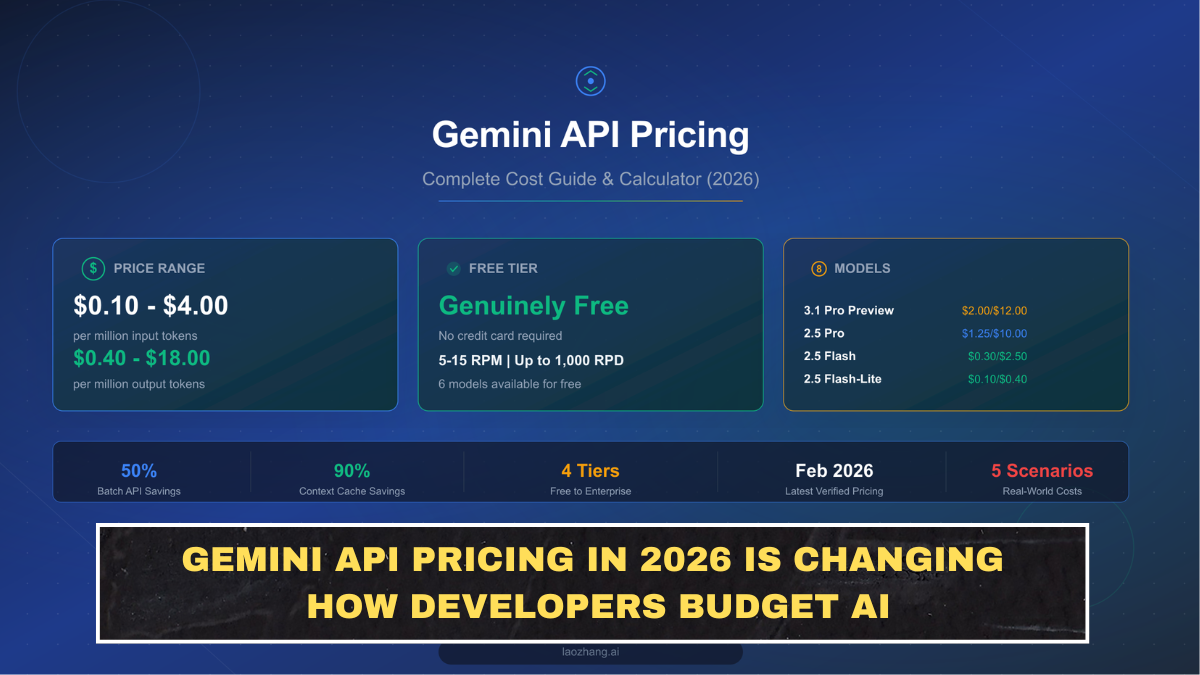
Gemini API pricing in 2026 is no longer just about choosing a model and counting tokens. Google has added more pricing paths, including Standard, Flex, Priority, Batch, and paid tier structures, which means budgeting now depends on latency needs, workload type, and traffic volume, not just model quality. That is good for serious teams, but confusing for lazy ones that still estimate cost with one flat number.
The biggest change arrived on April 1, 2026, when Google introduced Flex and Priority inference tiers. Flex is positioned as a cheaper option for background or sequential workloads, while Priority costs more in exchange for lower latency and stronger reliability. This matters because startups and product teams now have a real pricing trade-off between speed and cost instead of a single default lane.
What changed in Gemini API pricing in 2026?
Google’s pricing pages now split billing into Free, Paid, and Enterprise access levels. Paid access adds higher rate limits, context caching, Batch API access, and access to more advanced models, while Enterprise on Vertex AI adds features like provisioned throughput, compliance options, and potential volume discounts. On the billing side, new accounts start on Free, then move through paid usage tiers based on billing history and spend thresholds.
At the model level, pricing is also more layered. For example, Gemini 3.1 Pro Preview is priced at $2 per 1 million input tokens and $12 per 1 million output tokens for prompts up to 200,000 tokens, rising to $4 input and $18 output above that size. That alone shows why developers can no longer talk about “Gemini pricing” as one number. Prompt size and usage pattern now matter much more.
How do Standard, Flex, and Priority differ?
The simplest way to understand the new structure is this: Standard is the normal full-price path, Flex is the discounted path for workloads that can wait a bit, and Priority is the premium path for developers who care more about low latency and reliability. Google says Flex inference is priced at a 50% discount, with a target latency of roughly 1 to 15 minutes and best-effort reliability. Priority is priced at 75% to 100% more than Standard and is intended for lower-latency needs.
This is not a minor tweak. It changes how teams should architect products. A customer-facing feature that needs instant response may justify Priority. A background research job, evaluation workflow, or data enrichment pipeline probably should not. If you use the expensive lane for everything, that is not innovation. That is bad budgeting.
What does the new pricing structure mean for developers?
| Pricing path | Cost position | Best use case |
|---|---|---|
| Standard | Full price | Normal interactive apps |
| Flex | 50% cheaper | Background tasks, agent chains, non-urgent work |
| Priority | 75%–100% above Standard | Fast customer-facing workloads |
| Batch API | 50% cheaper | Large asynchronous jobs within 24 hours |
The table makes the real point obvious: cost control now depends on workload design. Google explicitly says Batch API provides a 50% cost reduction, and Flex is also discounted by 50%. That means teams willing to separate urgent traffic from non-urgent traffic can cut costs materially without switching providers.
Another important detail is that Google’s newer Gemini 3 series pricing already shows clear segmentation by capability. Gemini 3.1 Flash-Lite Preview is listed at $0.25 input and $1.50 output per 1 million tokens for text, image, and video inputs, while Gemini 3.1 Pro Preview sits much higher. So the budgeting conversation in 2026 is really two decisions, not one: which model, and which service tier.
How should startups and product teams budget now?
Teams should stop forecasting with one average token price across all features. A better model is to split use cases into fast-path, standard-path, and background-path workloads. Put urgent user-facing actions on Standard or Priority, and shift slower evaluation, enrichment, and internal workflows to Flex or Batch. That is where the savings are.
They should also pay attention to billing tiers and rate limits early. Google’s billing guide shows Tier 1, Tier 2, and Tier 3 thresholds tied to payment history and usage caps, so scale planning is now partly a finance and operations issue, not just an engineering issue.
Why does this pricing shift matter in 2026?
Gemini API pricing in 2026 is changing developer budgeting because Google is giving teams more control over the cost-speed trade-off. That is useful, but it also punishes sloppy planning. Developers who match the right model and inference tier to the right workload can save real money. Teams that ignore the new structure will overspend and then blame the model instead of their own design choices.
FAQs
Is Flex inference cheaper than Standard?
Yes. Google says Flex inference is priced at a 50% discount compared with Standard, but it comes with slower target latency and best-effort reliability.
Is Priority inference faster and more expensive?
Yes. Google says Priority inference is priced 75% to 100% above Standard and is designed for lower-latency, higher-reliability usage.
Does Gemini API still have a free tier?
Yes. Google lists a Free tier for developers and small projects, though access is limited to certain models and free-tier rate limits.
What is the biggest budgeting mistake teams make?
Treating all AI traffic the same. In 2026, teams that do not separate urgent traffic from background workloads are more likely to overpay.