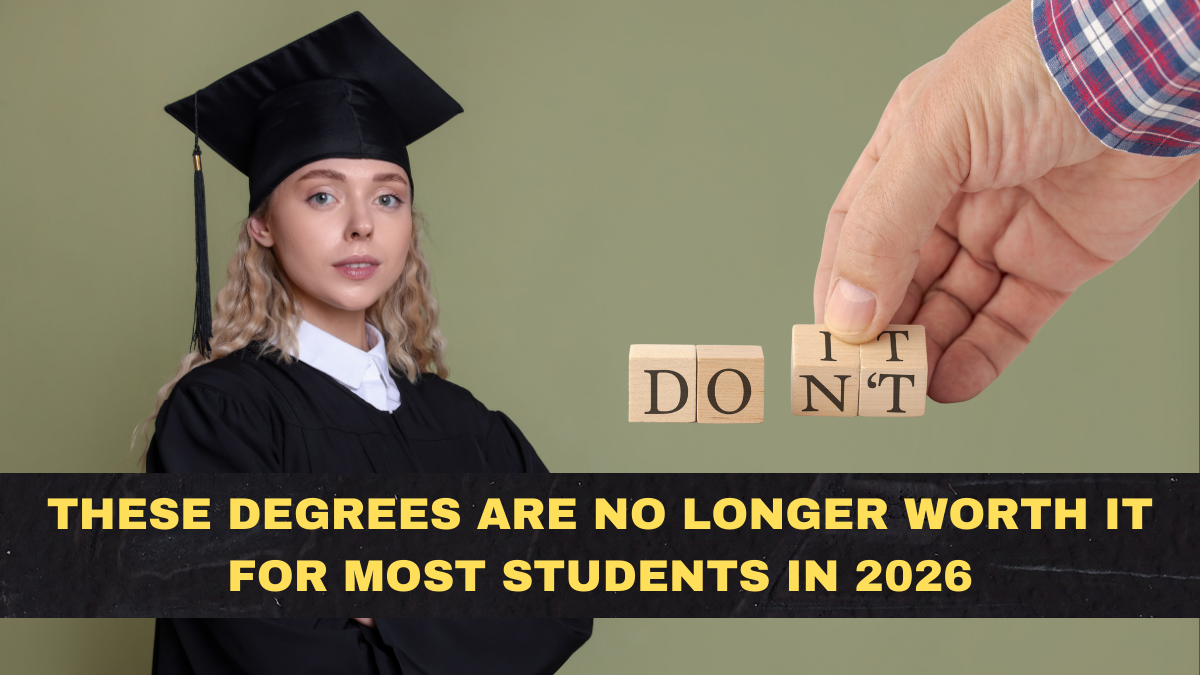
In 2026, higher education in India is facing an uncomfortable truth that many families are still unwilling to accept. Not all degrees deliver value anymore, even if they sound impressive or were considered safe in the past. Students are investing years of time, lakhs of money, and emotional energy into degrees that struggle to convert into stable or meaningful careers.
The biggest problem is not education itself, but outdated assumptions. Many degrees were designed for a job market that no longer exists. As industries evolve and hiring priorities shift, the return on investment for certain degrees has collapsed. Degree not worth it is no longer a provocative phrase in India; it has become a lived reality for a growing number of graduates.

Why Some Degrees Have Lost Their Value in 2026
The Indian job market has changed faster than universities could adapt. Technology, automation, and global competition have redefined what employers expect from fresh graduates. Degrees that once acted as entry tickets now function as basic filters, offering no competitive advantage on their own.
Another major factor is oversupply. When too many students graduate with identical qualifications, salaries stagnate and job quality declines. Employers can afford to be selective, while graduates compete intensely for limited roles.
In 2026, a degree alone no longer signals readiness. Skills, adaptability, and real-world exposure matter far more than the name of the course.
Degrees That Look Good but Deliver Poor Outcomes
Several degrees continue to attract students because of social prestige rather than actual outcomes. General arts degrees without specialization often struggle to translate into direct employment. Graduates frequently face low-paying roles unrelated to their field of study.
Basic science degrees, when pursued without a clear research or applied pathway, also leave many students uncertain. Without further specialization, these degrees rarely offer strong job security.
Generic management diplomas from low-tier institutions are another major concern. They promise corporate careers but often lead to roles with poor growth and limited learning.
These cases reinforce why many now describe such paths as a degree not worth it in practical terms.
The Salary Reality Nobody Talks About
One of the harshest shocks for graduates is salary stagnation. Many degrees lead to entry-level jobs that barely keep up with living costs, especially in urban areas.
In several fields, starting salaries have remained flat for years despite rising education costs. This creates a financial mismatch that traps graduates in long cycles of dissatisfaction and debt.
When a degree fails to justify its cost through income growth, regret becomes inevitable. In 2026, salary reality is forcing families to question long-held beliefs about education value.
Why Colleges Keep Selling These Degrees
Despite poor outcomes, colleges continue to market low-value degrees aggressively. Admissions brochures highlight infrastructure, rankings, and placement percentages without revealing salary distribution or job quality.
Colleges benefit from volume, not outcomes. As long as seats fill, there is little incentive to reform outdated curricula or provide transparent data.
Students and parents often realize the truth only after graduation, when reversing the decision becomes difficult. This is why the degree not worth it cycle continues year after year.
How Students Get Misled During Decision-Making
Most students choose degrees with limited exposure to real job markets. Career counseling is minimal, and advice often comes from relatives whose experience is outdated.
Entrance exams and cutoffs create the illusion of value. If something is difficult to enter, it is assumed to be worthwhile. In reality, difficulty does not guarantee relevance.
By the time students understand industry expectations, they are already deep into a degree that no longer serves them well.
Skills Are Replacing Degrees in Many Industries
In 2026, employers increasingly prioritize demonstrable skills over academic labels. Coding ability, design portfolios, analytical thinking, communication skills, and domain expertise often outweigh degree titles.
This shift does not mean degrees are useless, but it does mean they must be paired with practical capability. Degrees without skill integration are losing relevance rapidly.
Industries such as tech, media, marketing, and even finance now reward output and adaptability more than certificates.
When a Degree Still Makes Sense
Not all degrees have lost value. Degrees linked to regulated professions, deep specialization, or strong skill pipelines still deliver outcomes.
The key difference is clarity. Degrees that align clearly with job roles, industry demand, and continuous learning remain worthwhile.
In 2026, the question is not whether to pursue a degree, but whether that degree is worth it given your goals, resources, and risk tolerance.
What Students Should Do Before Choosing a Degree
Students must shift from prestige-based decisions to outcome-based evaluation. Understanding where graduates actually end up matters more than course names.
Talking to working professionals, checking average salary ranges, and understanding growth trajectories can prevent years of regret.
Choosing flexible degrees that allow skill layering reduces risk. A degree not worth it is usually one chosen without this due diligence.
Conclusion: Education Value Needs a Reality Check
The idea that any degree guarantees success is no longer true in India. In 2026, education must be judged by relevance, outcomes, and adaptability, not tradition.
Degrees that fail to translate into employability, growth, or financial stability are being questioned for good reason. Ignoring this shift only deepens frustration for students and families.
Choosing wisely now can save years of struggle later. Education should be an investment, not an emotional gamble driven by outdated beliefs.
FAQs
What does “degree not worth it” mean in 2026?
It refers to degrees that fail to provide reasonable career outcomes relative to time, cost, and effort invested.
Are all arts or science degrees useless now?
No, but general degrees without specialization or skill alignment often struggle to deliver strong job outcomes.
Why do salaries remain low for many graduates?
Oversupply of graduates and mismatch between education and industry needs suppress wage growth.
Should students avoid degrees completely?
No, degrees still matter, but they must be chosen strategically and paired with relevant skills.
How can students evaluate a degree’s value?
By checking real job outcomes, salary ranges, skill relevance, and long-term growth potential.
Is this problem getting worse in 2026?
Yes, rising education costs and stagnant salaries have made poor degree choices more visible and painful.