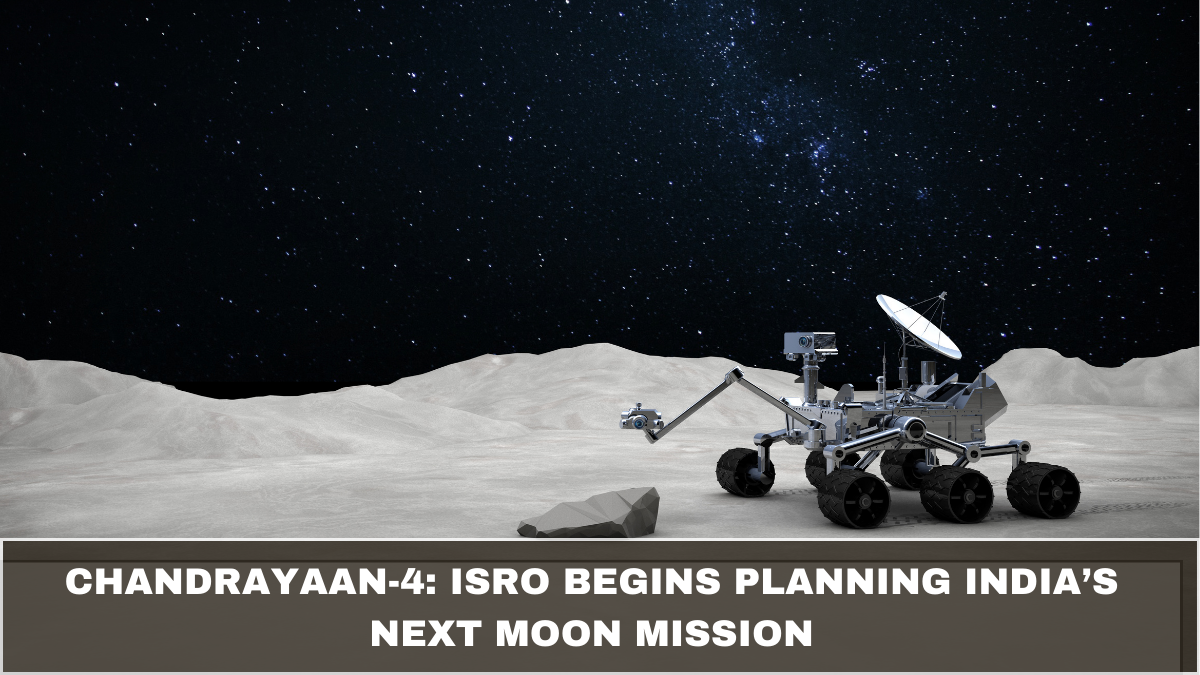
India’s space journey is preparing for its next ambitious chapter as ISRO officially begins the planning phase for Chandrayaan-4, the country’s next major lunar mission. After the global success of Chandrayaan-3 — which achieved a historic soft landing near the Moon’s south pole — expectations are higher than ever. This early planning marks a significant milestone as India aims to strengthen its position in deep-space exploration and scientific discovery.
The upcoming mission is not just a repeat of earlier lunar efforts. Chandrayaan-4 is expected to carry new scientific instruments, expanded exploration goals, and advanced technologies that build on the learnings of Chandrayaan-2 and Chandrayaan-3. ISRO’s latest updates show a clear focus: more robust hardware, enhanced landing systems, and deeper scientific analysis of the Moon’s surface, environment, and geological history.
What Sparked the Chandrayaan-4 Planning Phase
The successful landing of Vikram and the operations of Pragyan rover gave ISRO crucial insights into terrain navigation, payload efficiency, and autonomous landing systems. These achievements have accelerated confidence in attempting more complex lunar missions.
Key drivers behind the new mission include:
-
-
Deeper study of lunar minerals and water-ice
-
Testing new technologies for future human missions
-
Advanced rover mobility and longer mission duration
-
Strengthening India’s position in global space research
-
Expanding knowledge about the Moon’s polar regions
-
The planning phase will involve testing conceptual designs, evaluating possible launch configurations, identifying landing zones, and shortlisting scientific experiments.
New Scientific Objectives of Chandrayaan-4
ISRO has hinted that Chandrayaan-4 will expand the scientific agenda beyond what previous missions achieved. The mission will not only study the Moon’s surface but also investigate subsurface structures and potential lunar resources.
Likely scientific objectives include:
-
-
Mapping water-ice deposits more accurately
-
High-resolution imaging of polar terrains
-
Studying lunar soil composition and heat signatures
-
Investigating Moonquakes and seismic activity
-
Testing the feasibility of future resource extraction
-
These objectives aim to support long-term lunar exploration and future collaborations for space-based resource utilisation.
Technological Upgrades Expected in Chandrayaan-4
The Chandrayaan-4 planning phase will explore several technological enhancements. Safety and autonomous navigation remain top priorities, especially since the Moon’s south pole has rough terrain and unpredictable lighting conditions.
Possible upgrades include:
-
-
Stronger lander legs to withstand surface impact
-
Smarter autonomous landing navigation
-
Improved hazard detection cameras
-
More durable rover wheels for rocky terrains
-
Higher-energy solar panels for extended mission life
-
With global space agencies moving toward lunar bases and long-term human presence, Chandrayaan-4 is expected to play a crucial supporting role by testing technologies India will use in future missions.
How Chandrayaan-4 Builds on Chandrayaan-3
ISRO’s Chandrayaan missions follow a progressive learning approach. Chandrayaan-1 discovered traces of water on the Moon, Chandrayaan-2 provided orbital data and attempted soft landing, and Chandrayaan-3 proved India’s landing capabilities.
Now, Chandrayaan-4 aims to elevate the mission even further.
Improvements based on Chandrayaan-3 learnings:
-
-
Enhanced landing precision
-
Better hazard detection and avoidance
-
Stronger communication systems
-
Extended rover mobility range
-
Improved thermal systems to survive lunar nights
-
The mission may also include additional payloads from global partners, further enhancing India’s role in collaborative space science.
Mission Architecture: What ISRO Is Considering
While final mission details have not been announced, the planning phase includes studying multiple possible configurations.
Potential mission models ISRO may choose from:
-
-
Lander + Rover combination (like Chandrayaan-3)
-
Orbiter + Lander + Rover (like Chandrayaan-2)
-
A sample-return mission (most ambitious option)
-
Multi-lander mission to study different lunar areas
-
Advanced rover with drill systems for deeper exploration
-
ISRO scientists have already started internal discussions on feasibility, resource allocation, and payload combinations.
Landing Site Selection for Chandrayaan-4
The south pole region remains the most likely target because of its scientific value. The region contains permanently shadowed areas, extreme cold traps, and the highest chances of water-ice detection.
Criteria for selecting landing zones include:
-
-
Adequate sunlight for solar power
-
Minimal rocky obstacles
-
Potential resource-rich zones
-
High scientific importance
-
Safe terrain for rover mobility
-
ISRO is analysing high-resolution images from Chandrayaan-2’s orbiter to map suitable landing zones.
Global Interest and Collaborations
The planning phase of Chandrayaan-4 comes at a time when global interest in lunar exploration is rising. NASA’s Artemis missions, Japan’s SLIM, and China’s Chang’e missions highlight an international race toward lunar discovery. India’s consistent achievements make it a strong contender for collaboration.
Potential collaboration opportunities:
-
-
Shared scientific instruments
-
Joint analysis of lunar samples
-
Robotic exploration partnerships
-
Data-sharing agreements
-
Technology exchange for advanced propulsion and navigation
-
International agencies have already expressed interest in working with ISRO for future lunar goals.
How Chandrayaan-4 Supports India’s Long-Term Space Vision
Chandrayaan-4 is not a standalone effort. It is a part of India’s broader long-term ambitions such as:
-
-
Gaganyaan human spaceflight mission
-
Lunar surface human landing (future goal)
-
Space station plans
-
Deep-space exploration beyond the Moon
-
Scientific research leadership
-
By refining landing, mobility, and exploration capabilities, Chandrayaan-4 lays the foundation for more complex missions and future human presence on the Moon.
Challenges Ahead for ISRO
Every lunar mission comes with risks and engineering challenges. Chandrayaan-4 must overcome:
-
-
Extreme cold conditions
-
Rough lunar terrains
-
Communication delays
-
Power management during long lunar nights
-
Precision landing in shadowed areas
-
ISRO’s early planning aims to solve these issues using simulation testing, upgraded hardware, and continuous monitoring.
Conclusion
ISRO’s planning phase for Chandrayaan-4 marks a bold step toward the next era of India’s space exploration. The mission is expected to introduce enhanced technology, deeper scientific analysis, and more complex lunar operations. With global interest in lunar science rising rapidly, Chandrayaan-4 positions India as a dependable and innovative leader in space research. As ISRO finalises designs and mission plans, India’s next Moon mission promises to push boundaries, unlock new discoveries, and strengthen the nation’s role in global space exploration.
FAQs
What is the purpose of Chandrayaan-4?
Chandrayaan-4 aims to study the Moon’s surface, minerals, water-ice, geological activity, and test new space technologies.
How is Chandrayaan-4 different from Chandrayaan-3?
It will carry advanced scientific instruments, stronger lander systems, and potentially more complex mission architecture.
When will Chandrayaan-4 launch?
ISRO is currently in the planning stage. The launch timeline will be announced once mission designs are finalised.
Will Chandrayaan-4 explore the south pole of the Moon?
Most likely, as the region has high scientific value due to water-ice deposits and unique terrain features.
Will there be an international collaboration for Chandrayaan-4?
ISRO is exploring potential international partnerships for scientific instruments and data sharing.