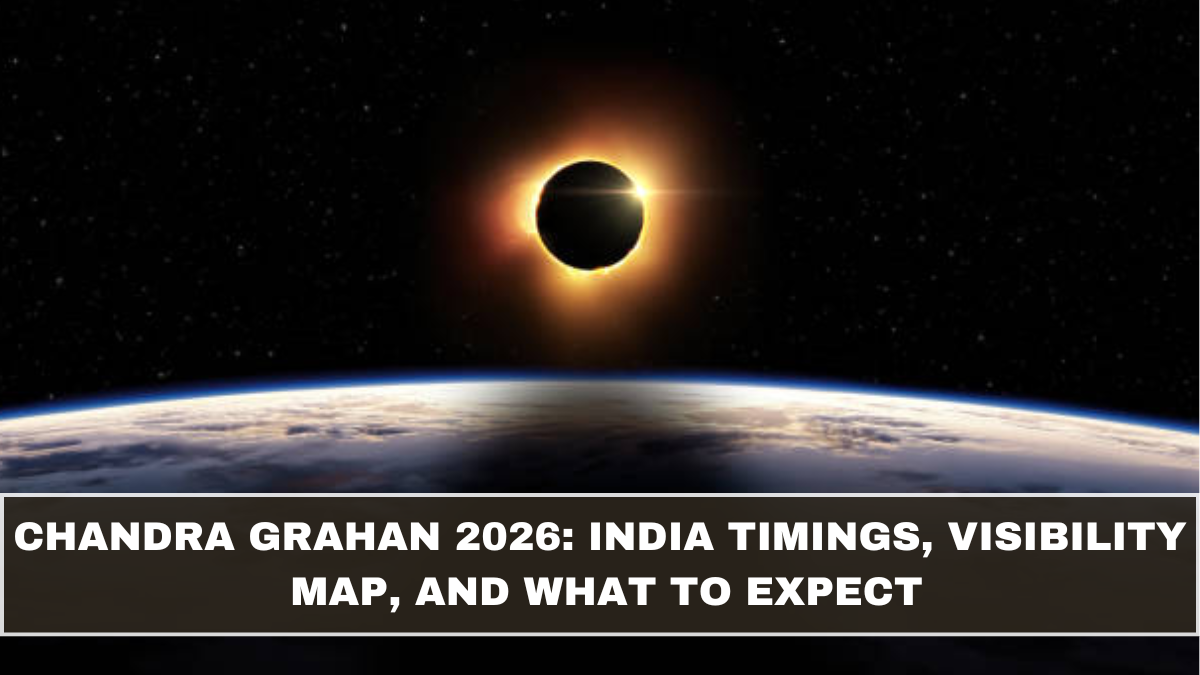
Chandra Grahan, or lunar eclipse, is an astronomical event that occurs when the Earth comes between the Sun and the Moon, causing the Earth’s shadow to fall on the Moon. In 2026, the lunar eclipse is expected to attract attention due to its visibility in several parts of the world, including regions of India depending on the eclipse phase.
Unlike solar eclipses, lunar eclipses can be viewed safely with the naked eye. Understanding the phases, visibility conditions, and official timing announcements helps observers follow the event accurately.
What Is Chandra Grahan?
A lunar eclipse happens when the Sun, Earth, and Moon align in a straight line during the full moon phase. As the Earth blocks sunlight from reaching the Moon, the Moon appears darker and may take on a reddish shade during certain phases.
This phenomenon occurs only on a full moon day and is categorized into three main types depending on how much of the Earth’s shadow covers the Moon.
The event is studied both scientifically and culturally, as it has astronomical importance and traditional relevance in many societies.
Types of Lunar Eclipse
A lunar eclipse may occur in different forms depending on the alignment of celestial bodies.
A total lunar eclipse occurs when the Moon moves completely into Earth’s shadow, often creating a reddish appearance known as a Blood Moon. A partial lunar eclipse happens when only part of the Moon enters the shadow. A penumbral lunar eclipse occurs when the Moon passes through the Earth’s outer shadow, causing subtle dimming.
The type of eclipse determines how clearly it can be observed from a particular region.
Chandra Grahan 2026 Visibility in India
The visibility of a lunar eclipse depends on geographic location and the timing of different eclipse phases. For India, visibility is determined by whether the eclipse occurs during nighttime hours when the Moon is above the horizon.
Astronomical organizations and observatories release official visibility maps and timing charts before the event. These charts indicate whether the eclipse will be fully visible, partially visible, or not visible from specific Indian cities.
Observers are advised to check official announcements from recognized astronomical institutions for confirmed local timings.
Phases of Lunar Eclipse
A lunar eclipse occurs in multiple stages that can be observed gradually.
The event begins with the penumbral phase, where the Moon enters Earth’s outer shadow and dimming becomes slightly visible. This is followed by the partial phase, when a portion of the Moon appears covered by a darker shadow. If alignment is complete, the total phase occurs, where the Moon may appear copper or red in color.
The eclipse ends as the Moon slowly exits the Earth’s shadow and returns to its normal brightness.
How to Watch Chandra Grahan Safely
Unlike solar eclipses, lunar eclipses do not require protective equipment for viewing. The event can be safely observed with the naked eye.
Using binoculars or telescopes can provide a clearer view of the Moon’s surface during different phases. Choosing a location with minimal light pollution improves visibility.
Clear sky conditions play a major role in observation, as cloud cover can obstruct the view regardless of eclipse timing.
Cultural Significance of Chandra Grahan in India
In addition to its scientific importance, Chandra Grahan holds cultural and traditional significance in India. Many people follow religious practices such as prayers or fasting during eclipse periods.
Some traditions include observing Sutak time, which refers to a period of restrictions followed by certain communities. Practices vary based on regional beliefs and personal faith.
The eclipse therefore carries both astronomical and cultural relevance.
Conclusion
Chandra Grahan 2026 is an important astronomical event that occurs when the Earth’s shadow covers the Moon during the full moon phase. The visibility in India depends on the timing of eclipse phases and local viewing conditions. Understanding the different stages of the lunar eclipse, checking official timing announcements, and choosing proper viewing conditions helps observers experience the event clearly and safely.
FAQs
What is Chandra Grahan?
Chandra Grahan is a lunar eclipse that occurs when the Earth blocks sunlight from reaching the Moon during a full moon phase.
Will Chandra Grahan 2026 be visible in India?
Visibility depends on eclipse timing and location. Official astronomical announcements provide confirmed details for Indian cities.
Is it safe to watch a lunar eclipse with the naked eye?
Yes, lunar eclipses can be safely observed without special eye protection.
Why does the Moon sometimes appear red during an eclipse?
The reddish appearance occurs when Earth’s atmosphere scatters sunlight, allowing red wavelengths to reach the Moon.
Where can I check official Chandra Grahan timings?
Official timing and visibility updates are released by astronomical observatories and recognized scientific institutions.