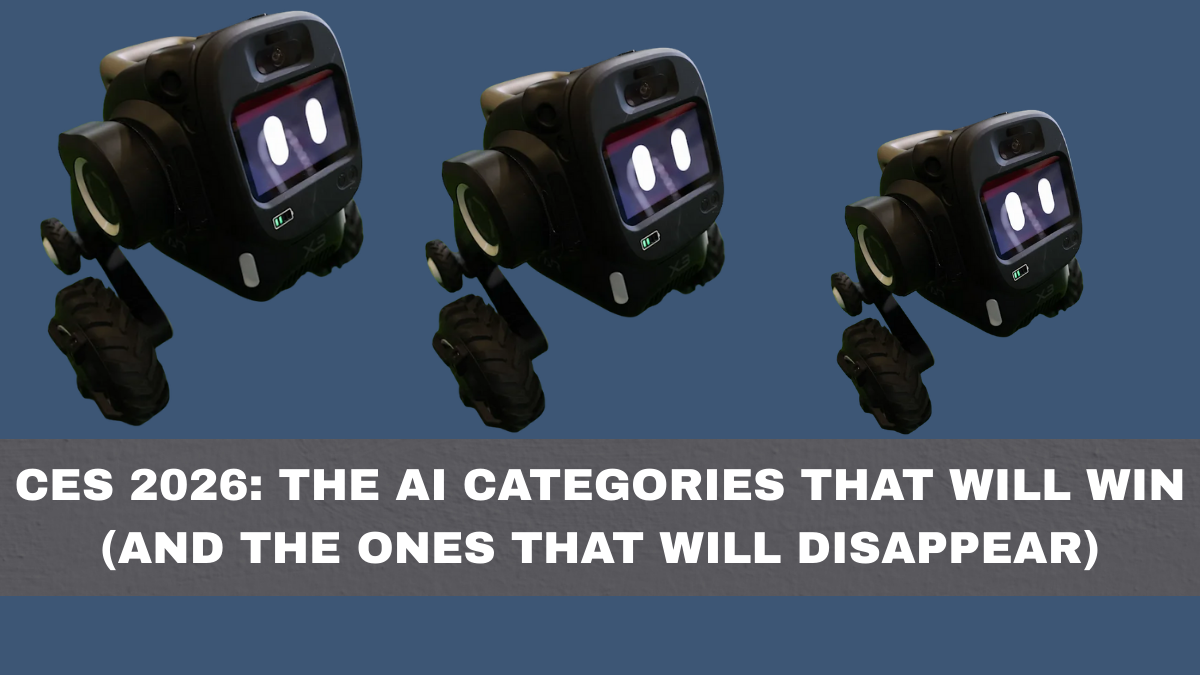
CES 2026 made one thing painfully clear: AI is no longer a category—it’s the default layer. Almost every booth, pitch, and product demo claimed some form of intelligence. That doesn’t mean everything mattered. In fact, the louder the AI claim, the more likely it was empty branding. The real signal was subtle: which categories showed repeatable use, clear value, and real-world deployment, not just flashy demos.
If CES once rewarded spectacle, CES 2026 rewarded restraint. The winners weren’t the products shouting “AI.” They were the ones quietly solving problems at scale.
Why CES 2026 Felt Like “AI Everywhere”
The phrase CES 2026 AI everything exists because AI wasn’t isolated to one hall. It cut across startups, appliances, vehicles, health tech, and consumer electronics.
Three forces drove this:
-
Cheaper inference made AI viable in more devices
-
Edge processing reduced cloud dependency
-
Consumers now expect automation by default
AI stopped being a feature and became infrastructure.
The AI Categories That Actually Won
Not all AI categories performed equally. Some showed maturity, not just ambition.
Clear winners at CES 2026:
-
Robots with narrow, repeatable tasks
-
Smart home systems focused on energy and security
-
Wearables tied to health insights, not raw data
-
Enterprise-facing startups solving boring problems
These categories demonstrated deployment logic, not concept videos.

Robots: Less Human, More Useful
The robots that impressed weren’t humanoid. They were specialized.
Winning robot traits:
-
Single-purpose functionality
-
Predictable environments
-
Clear ROI for buyers
Warehouse bots, cleaning units, and inspection robots outperformed “general assistant” robots that still struggle outside demos.
Smart Home AI Finally Got Practical
For years, smart homes chased novelty. CES 2026 shifted the focus.
What worked:
-
Energy optimization
-
Predictive maintenance
-
Quiet automation without voice commands
Consumers don’t want smarter homes—they want less thinking. AI that reduces decisions won.
Wearables That Focused on Insight, Not Data
Raw metrics are exhausted. CES 2026 wearables succeeded when they explained meaning.
Strong wearable trends included:
-
Stress and recovery interpretation
-
Health trend summaries
-
Minimal screens, more context
Wearables that just added sensors without insight blended into noise.
Startups That Stood Out (And Why)
The best AI startups avoided consumer hype altogether.
They focused on:
-
B2B workflows
-
Compliance and security
-
Automation inside existing systems
At CES 2026, boring sold better than bold.
The AI Categories That Felt Like Hype
Some areas looked impressive—but hollow.
High-risk categories:
-
Fully autonomous personal assistants
-
Emotion-reading consumer devices
-
Universal AI gadgets with vague use cases
These struggled to answer one question: why would someone pay for this today?
Why “AI Everything” Is a Dangerous Strategy
When everything is AI-powered, nothing is differentiated.
Problems with the CES 2026 AI everything approach:
-
Weak product identity
-
Overpromising capabilities
-
User trust erosion
AI that doesn’t clearly improve outcomes becomes invisible—or annoying.
What CES 2026 Signals for the Next Year
CES isn’t about what ships tomorrow. It’s about direction.
The direction is clear:
-
Narrow beats broad
-
Quiet beats flashy
-
Useful beats impressive
AI products that respect these rules will scale. The rest will disappear after the demo cycle.
How Buyers Should Interpret CES Announcements
Consumers should treat CES claims as prototypes, not promises.
Smart filters:
-
Look for shipping timelines
-
Check integration with existing tools
-
Ignore “revolutionary” language
-
Ask what problem disappears
If the problem still exists, the AI didn’t solve it.
Conclusion
CES 2026 didn’t prove that AI is everywhere—it proved that only disciplined AI survives. The winning categories focused on constraints, not ambition. The losers chased attention without execution. As AI becomes invisible infrastructure, success belongs to products that work quietly, repeatedly, and predictably.
Everything else will fade once the lights turn off.
FAQs
Why did CES 2026 feel overloaded with AI products?
Because AI has become cheap and expected, so nearly every product layer includes it.
Which AI categories performed best at CES 2026?
Robots with narrow tasks, practical smart home systems, and insight-driven wearables.
Which categories struggled the most?
Overgeneralized assistants and vague “do-everything” AI devices.
Should consumers buy based on CES announcements?
No. Treat CES as direction-setting, not confirmation of product readiness.
What’s the biggest takeaway from CES 2026?
AI wins when it’s useful, quiet, and constrained—not when it tries to do everything.