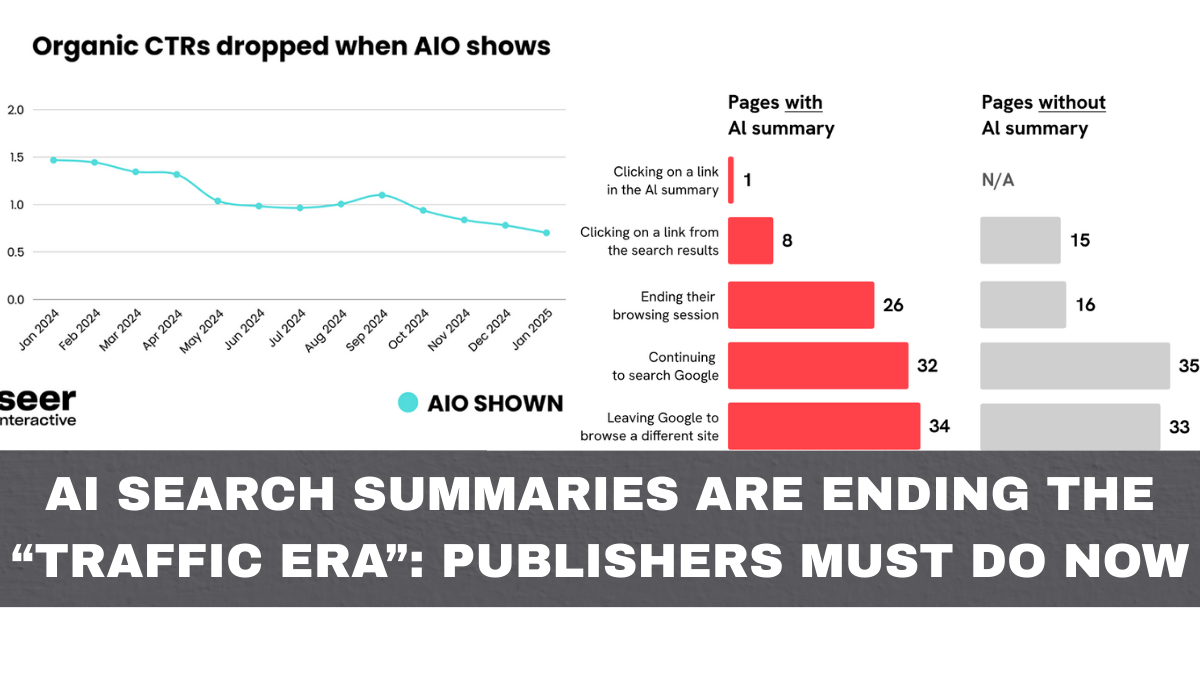
The AI search summaries traffic drop is no longer a theory—it’s showing up in analytics dashboards across the web. Publishers are watching impressions stay flat or even rise while clicks fall off a cliff. The emotional reaction is predictable: panic, blame, and rushed SEO changes. The practical reality is harsher. The traffic model that rewarded ranking alone is breaking, and it won’t bounce back.
This isn’t about one update or a temporary experiment. AI-generated answers are becoming the default way people consume information inside search. When users get “good enough” answers without clicking, zero-click behavior becomes rational, not accidental. That’s the shift publishers must confront—fast.
Why AI Search Summaries Are Causing a Traffic Drop
AI summaries compress multiple sources into a single response. From a user’s perspective, it’s efficient. From a publisher’s perspective, it’s a referral decline machine.
The mechanics are simple:
-
Search surfaces a synthesized answer
-
Users stop scrolling
-
Fewer outbound clicks are needed
-
Only extreme curiosity triggers a visit
This is why the AI search summaries traffic drop feels sudden. The habit of clicking links is being replaced by the habit of reading summaries.
Why Publishers Are Panicking (And Why Panic Won’t Help)
Publishers panic because their mental model is outdated. Many built businesses on:
-
Ranking for informational queries
-
Monetizing pageviews
-
Scaling content volume
AI summaries attack that model directly. The instinctive responses—publishing faster, optimizing harder, stuffing more keywords—don’t work because the problem isn’t ranking. It’s distribution.
If the answer is already on the results page, winning position one doesn’t guarantee a visit. That’s why publishers panic—their old levers no longer move outcomes.
Zero-Click Is Not a Bug—It’s the New Default
Calling this a “zero-click problem” misses the point. Zero-click is the product.
Search platforms are optimizing for:
-
Faster answers
-
Fewer steps
-
Higher user retention
In that environment, clicks are optional. The AI search summaries traffic drop is the consequence of a system designed to keep users inside the interface. Expecting it to reverse is denial.
What Types of Content Are Losing Traffic First
Not all content is hit equally. The biggest losses are happening where AI summaries are strongest.
High-risk categories include:
-
Definitions and explanations
-
How-to basics
-
Comparison tables
-
“What is” queries
-
General informational posts
These formats are easy to summarize. They invite zero-click outcomes by design.
What Still Gets Clicks (And Why)
Clicks haven’t vanished—they’ve become conditional. Users click when the summary isn’t enough.
Content that still attracts visits:
-
Deep analysis and opinion
-
Original reporting
-
First-hand experience
-
Tools, calculators, and data
-
Strong point-of-view content
The pattern is clear. When content offers value beyond an answer, users still visit. The AI search summaries traffic drop is selective, not universal.
Why Referral Decline Forces a Strategy Reset
A referral decline doesn’t just affect traffic—it breaks downstream systems:
-
Ad revenue weakens
-
Conversion funnels shrink
-
Subscriber growth slows
-
Brand discovery suffers
Treating this as an SEO issue understates the impact. It’s a business model issue. Relying on one channel—especially search referrals—is now structurally risky.
What Publishers Must Do Differently Now
Survival requires redistribution, not optimization.
Smart shifts include:
-
Designing content for capture, not clicks
-
Building email and community entry points
-
Creating formats AI can’t fully summarize
-
Using search as discovery, not delivery
The goal changes from “get the click” to “create a reason to follow.”
How to Use AI Summaries Without Losing Everything
Ignoring AI summaries is a mistake. Fighting them is worse. The smarter move is to co-exist.
Practical adaptations:
-
Write intros that tease depth, not summaries
-
Place strong POV hooks early
-
Reference original data and experiences
-
Offer downloadable or interactive assets
When AI summaries surface your brand, they can still function as awareness—if you give users a reason to seek more.
Why Brand Matters More Than Ever
When clicks disappear, brand recall replaces rankings.
Users who recognize a source:
-
Trust it faster
-
Search for it directly
-
Subscribe instead of bouncing
The AI search summaries traffic drop punishes anonymity. Publishers without a recognizable voice or angle are the first to fade.
What This Means for SEO Teams and Editors
SEO doesn’t die—but it changes roles.
New priorities:
-
Topic selection over volume
-
Intent depth over keyword breadth
-
Content differentiation over completeness
-
Distribution planning before publishing
SEO becomes a support function, not the growth engine.
Conclusion
The AI search summaries traffic drop marks the end of the passive traffic era. Waiting for clicks to return is wasted time. The winners won’t be those who optimize harder, but those who adapt faster—by building audiences, not chasing referrals.
Search still matters, but it’s no longer the destination. It’s the billboard. Publishers who accept that reality can rebuild. Those who don’t will keep watching charts fall and calling it “temporary.”
FAQs
Why are AI search summaries reducing website traffic?
Because users get complete answers directly in search, reducing the need to click external links.
Is this traffic drop temporary?
No. It reflects a structural shift toward zero-click behavior powered by AI summaries.
What types of publishers are most affected?
Sites relying heavily on basic informational content and search referrals.
Can publishers still benefit from search traffic?
Yes, but mainly through brand discovery and content that offers depth beyond summaries.
What’s the safest strategy going forward?
Build direct channels like email, community, and subscriptions while treating search as awareness—not dependency.