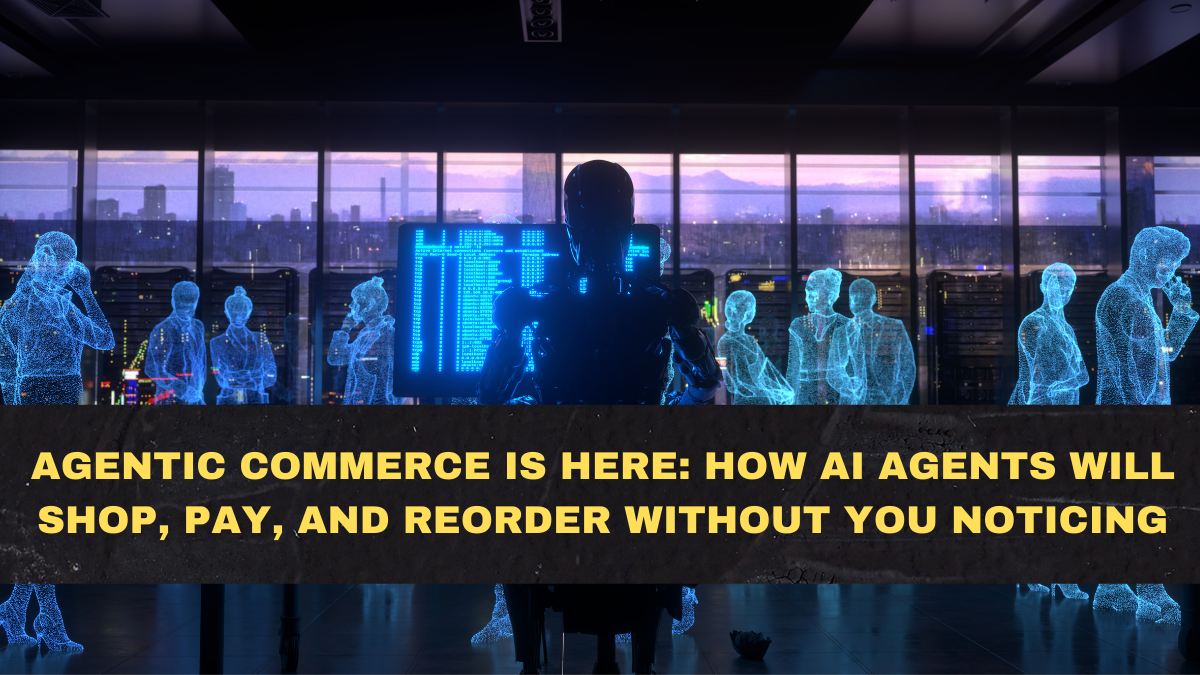
Agentic commerce payments are quietly reshaping how people buy things online. Most consumers still think shopping means browsing, comparing, adding to cart, and checking out. That mental model is already breaking. In 2026, AI agents are starting to handle those steps automatically—often without the user even opening an app or website.
This shift isn’t about better recommendations or smarter ads. It’s about automated purchasing becoming normal. Your AI assistant notices you’re running low on coffee pods, compares prices across retailers, checks delivery time, applies loyalty credits, and completes the purchase using stored credentials. You get a notification saying: “Reordered your usual coffee. Delivery tomorrow.” No checkout page. No payment friction. No decision fatigue.
That’s the real meaning of agentic commerce payments: payments becoming invisible because AI agents checkout on your behalf.
What Agentic Commerce Actually Means
Agentic commerce refers to commerce driven by autonomous or semi-autonomous AI agents that act on user-defined preferences and rules. These agents don’t just recommend products—they execute transactions.
In practical terms, this means:
• AI agents monitor usage patterns and inventory
• They predict when you need something
• They choose where to buy it
• They complete checkout and payment
• They handle reorders automatically
The user stays in control at a rules level (“never spend over ₹2,000 without asking me”), but not at a transaction level. That’s a fundamental shift in how buying works.
Why Payments Are Becoming Invisible
Agentic commerce payments work only if payment friction disappears. Traditional checkout flows were built for humans. AI agents need machine-friendly, permission-based payment systems.
That’s why the industry is moving toward:
• Stored payment credentials with tokenization
• Pre-authorized spending limits
• Identity-linked wallets
• Rule-based approvals
• Context-aware fraud checks
When an AI agent can authenticate itself, prove user permission, and pass fraud checks in milliseconds, the idea of “checking out” becomes obsolete.
This is not theoretical. It’s already happening in early forms through voice assistants, auto-replenishment features, and smart home integrations.
How AI Agents Checkout Without You Touching a Button
The technical backbone of AI agents checkout is built on three pillars: identity, authorization, and orchestration.
Here’s what happens behind the scenes:
• Your AI agent detects a purchase trigger (low inventory, scheduled reorder, usage pattern)
• It queries approved merchants or marketplaces
• It selects the best option based on your rules
• It initiates payment using stored credentials or a digital wallet
• The transaction is approved automatically
• You receive a confirmation message
To you, it feels like magic. In reality, it’s a tightly controlled automation stack.
Where Automated Purchasing Makes the Most Sense First
Not all shopping categories will shift to agentic commerce at the same speed.
The first categories being transformed include:
• Groceries and household essentials
• Pet food and supplies
• Personal care products
• Office supplies
• Subscription-like physical goods
These are predictable, repeatable, low-emotion purchases. That’s exactly where automated purchasing creates the most value.
No one enjoys reordering toilet paper. Letting an AI agent handle it is a relief, not a loss of control.
What Changes for Consumers
For consumers, agentic commerce payments change behavior more than technology.
Key shifts include:
• Less time spent browsing
• Fewer impulse purchases
• Lower decision fatigue
• More predictable spending
• Higher reliance on rules and defaults
Instead of asking “What should I buy today?”, users start asking “What rules should my AI follow when buying for me?”
That’s a subtle but powerful psychological shift.
What Changes for Merchants and Brands
For brands, this is an uncomfortable transition.
When AI agents checkout instead of humans:
• Branding matters less at the moment of purchase
• Price, availability, and reliability matter more
• Loyalty programs must integrate into agent logic
• Product data quality becomes critical
• Checkout optimization becomes invisible
You’re no longer marketing to a human. You’re competing inside an algorithm’s decision framework.
That’s why brands are racing to become “agent-preferred sellers.”
The Trust and Fraud Problem No One Can Ignore
Agentic commerce payments raise uncomfortable questions about fraud and misuse.
If an AI agent can spend money:
• What happens if it’s compromised?
• What if it misinterprets user intent?
• Who is liable for wrong purchases?
• How do you stop silent financial abuse?
That’s why fraud prevention and digital identity are becoming core to agentic commerce.
Security controls being rolled out include:
• Spending caps per category
• Transaction-level approvals
• Real-time fraud scoring
• Kill switches for AI agents
• Mandatory audit logs
Without these safeguards, automated purchasing becomes a nightmare scenario.
Why Consumers Will Accept This Anyway
Despite the risks, consumers are moving toward agentic commerce payments because the convenience payoff is enormous.
People already trust:
• Autopay for bills
• Subscription renewals
• Ride-hailing charges
• App store payments
Agentic commerce just extends that trust to everyday shopping.
Once users experience:
• Never running out of essentials
• Never dealing with checkout forms
• Never comparing prices manually
There’s no going back.
Who Controls the Rules Matters More Than Who Builds the AI
The most important battle in agentic commerce isn’t about model quality. It’s about rule ownership.
The winner will be whoever controls:
• Spending rules
• Merchant preferences
• Budget limits
• Product exclusions
• Approval thresholds
If platforms control those rules, consumers lose autonomy. If users control them, agentic commerce becomes empowering instead of creepy.
Conclusion
Agentic commerce payments are not a futuristic idea anymore. They are a structural shift in how money moves. AI agents checkout on your behalf. Automated purchasing becomes default. Payments disappear into the background.
This doesn’t eliminate human choice—it relocates it. You stop choosing products manually and start choosing rules instead.
That’s the real transformation happening in 2026.
FAQs
What are agentic commerce payments?
They refer to payments executed automatically by AI agents that browse, select, and purchase products on a user’s behalf.
Is automated purchasing safe?
It can be, if strong rules, spending limits, fraud detection, and identity verification systems are in place.
Will AI agents replace traditional checkout?
For repeat and routine purchases, yes. Manual checkout will remain for high-value or emotional purchases.
Can users control what AI agents buy?
Yes. Most systems rely on user-defined rules, budgets, approvals, and merchant preferences.
What’s the biggest risk of agentic commerce?
Unauthorized spending, fraud, and loss of control if safeguards and transparency are weak.
Click here to know more.