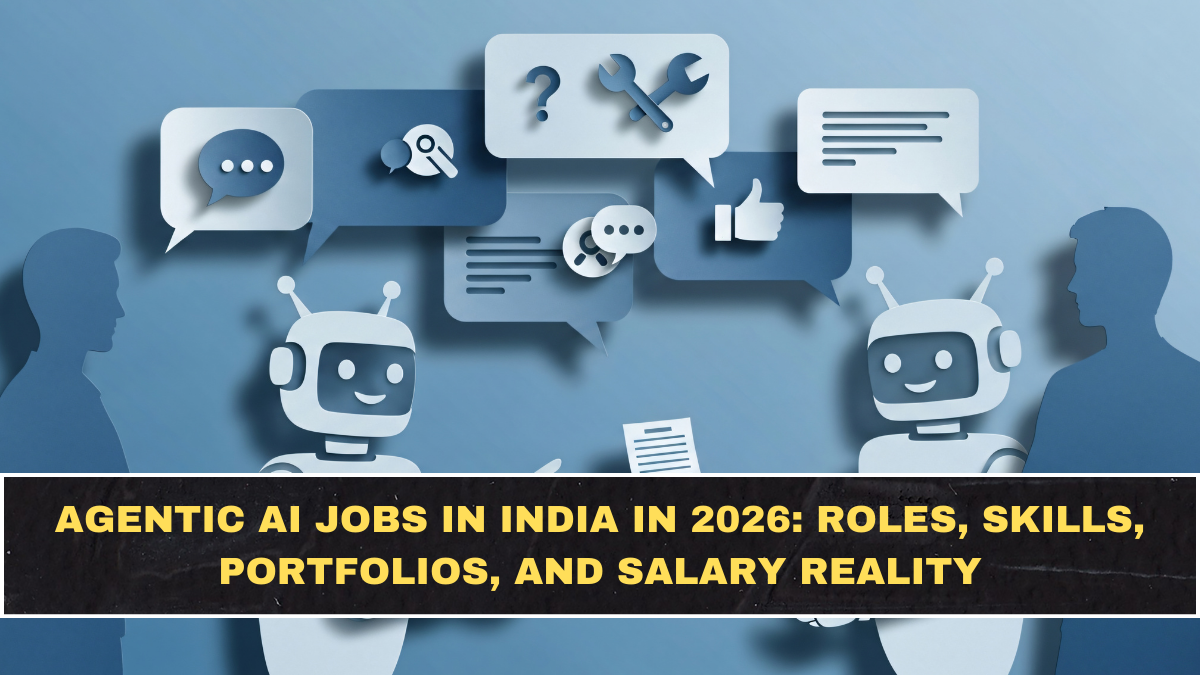
Agentic AI is no longer a buzzword reserved for research labs or conference demos. In 2026, Indian companies are actively experimenting with and deploying AI systems that can plan, decide, use tools, and execute multi-step tasks with limited human input. This shift is quietly changing how AI teams are structured and, more importantly, what kinds of jobs are being created. Traditional “model-only” roles are giving way to roles that focus on building systems around models.
The rise of agentic AI jobs in India is not driven by hype alone. It is driven by real operational pressure. Companies want AI systems that do more than answer questions. They want systems that can pull data, trigger workflows, coordinate APIs, handle failures, and operate within constraints. This demand is reshaping hiring expectations across startups, enterprises, and Global Capability Centers.
What Agentic AI Actually Means in Real Jobs
Agentic AI refers to AI systems designed to act toward goals rather than respond to single prompts. These systems can reason over steps, call tools, store memory, and adapt actions based on outcomes. In job terms, this means engineers are no longer hired just to fine-tune prompts or train models.
In practical roles, agentic AI shows up as internal copilots, automation agents, research assistants, ops bots, and decision-support systems. These agents sit inside real workflows like customer support, analytics, finance, compliance, or engineering productivity.
For hiring managers, “agentic” signals system thinking. It means the candidate understands how models interact with tools, data, guardrails, and business logic rather than treating the model as magic.
Why India Is Seeing Real Demand for Agentic AI Jobs
India’s demand for agentic AI jobs is tightly linked to scale. Indian teams often operate large volumes of processes with tight cost constraints. Agentic systems promise automation beyond simple scripts without hiring massive human teams.
Another driver is enterprise adoption. Indian banks, IT services firms, SaaS companies, and GCCs are building internal GenAI tools for employees rather than public-facing chatbots. These tools need reliability, traceability, and control, which agentic designs support better than free-form prompting.
In 2026, companies are less impressed by demos and more focused on systems that run daily without breaking. That is why agentic AI skills are translating into real job openings rather than experimental internships.
Common Agentic AI Roles Hiring Teams Are Creating
Agentic AI jobs in India do not always come with clean titles. Many roles are embedded inside broader engineering or data teams, but the work is clearly agentic in nature.
Some common role patterns include AI application engineer roles focused on building multi-step workflows, automation engineers working on AI-driven ops, and platform engineers adding agent layers to internal tools.
There are also emerging roles around AI orchestration, AI reliability, and AI safety operations. These roles exist because agentic systems can fail in new ways, and companies need people who understand those failure modes deeply.
Skills Employers Actually Expect in 2026
Employers hiring for agentic AI jobs in India are not looking for deep model training expertise in most cases. They are looking for people who can build around models.
Core expectations include understanding tool calling, function execution, API integration, and workflow orchestration. Candidates are expected to design systems that can retry, log actions, and handle partial failures gracefully.
Memory design, context management, and constraint handling are also increasingly important. Companies want agents that behave predictably, not creatively at the wrong time.
Just as critical is evaluation. Candidates who can explain how they test agent behavior, detect regressions, and prevent unsafe actions stand out sharply in interviews.
Portfolio Projects That Signal Real Agentic Ability
In 2026, resumes alone do not convince hiring teams for agentic AI jobs. Portfolios matter more than certificates or course lists.
Strong portfolios include projects like multi-tool research agents, internal ticket triage bots, automated report generators with validation steps, or ops agents that interact with real APIs.
What matters is not polish but clarity. Hiring teams want to see how decisions are made, how failures are handled, and how boundaries are enforced.
Projects that clearly show orchestration logic, error handling, and evaluation signals carry far more weight than generic chatbot demos.
Salary Reality for Agentic AI Jobs in India
Salaries for agentic AI jobs in India vary widely based on context. Startups often pay for impact, while enterprises pay for reliability and governance skills.
In general, roles that combine software engineering with agentic AI command higher compensation than prompt-only roles. Candidates who can deploy, monitor, and maintain agent systems are valued more than those who only design interactions.
However, expectations are also higher. Hiring teams expect production thinking, documentation, and accountability. Agentic AI roles are not shortcut careers; they are responsibility-heavy roles.
Who Should and Should Not Target These Roles
Agentic AI jobs in India are well suited for software engineers, data engineers, automation specialists, and platform engineers willing to learn GenAI systems thinking.
They are less suitable for candidates looking for low-effort transitions or purely creative AI work. These roles demand debugging, systems reasoning, and long-term ownership.
In 2026, agentic AI is not an entry-level shortcut. It rewards candidates who are comfortable operating at the intersection of engineering, logic, and product constraints.
Conclusion: Agentic AI Is a Career Shift, Not a Trend
Agentic AI jobs in India represent a deeper shift in how AI is used at work. The focus has moved from model novelty to system reliability and business integration. This shift is creating durable roles, not temporary hype positions.
For candidates, the opportunity is real but demanding. Success depends on building skills that go beyond prompts and demos into architecture, evaluation, and control.
In 2026, those who treat agentic AI as a systems discipline rather than a shortcut will find the strongest career outcomes.
FAQs
What are agentic AI jobs in India?
Agentic AI jobs focus on building AI systems that can plan, use tools, and execute multi-step tasks within real workflows rather than responding to single prompts.
Do I need deep machine learning expertise for agentic AI roles?
Most roles do not require training models from scratch. They require strong software engineering, system design, and AI integration skills.
Are agentic AI jobs only in startups?
No. Enterprises, GCCs, banks, and SaaS companies in India are actively hiring for agentic AI capabilities in internal tools and automation.
What kind of portfolio helps for agentic AI jobs?
Projects showing orchestration, tool use, error handling, and evaluation logic are far more valuable than simple chatbot demos.
Is agentic AI a stable career path in 2026?
Yes, because it aligns with how companies are actually deploying GenAI in production rather than experimental use cases.
Can non-AI engineers transition into agentic AI roles?
Yes, especially software and automation engineers who build real projects and demonstrate system-level thinking.