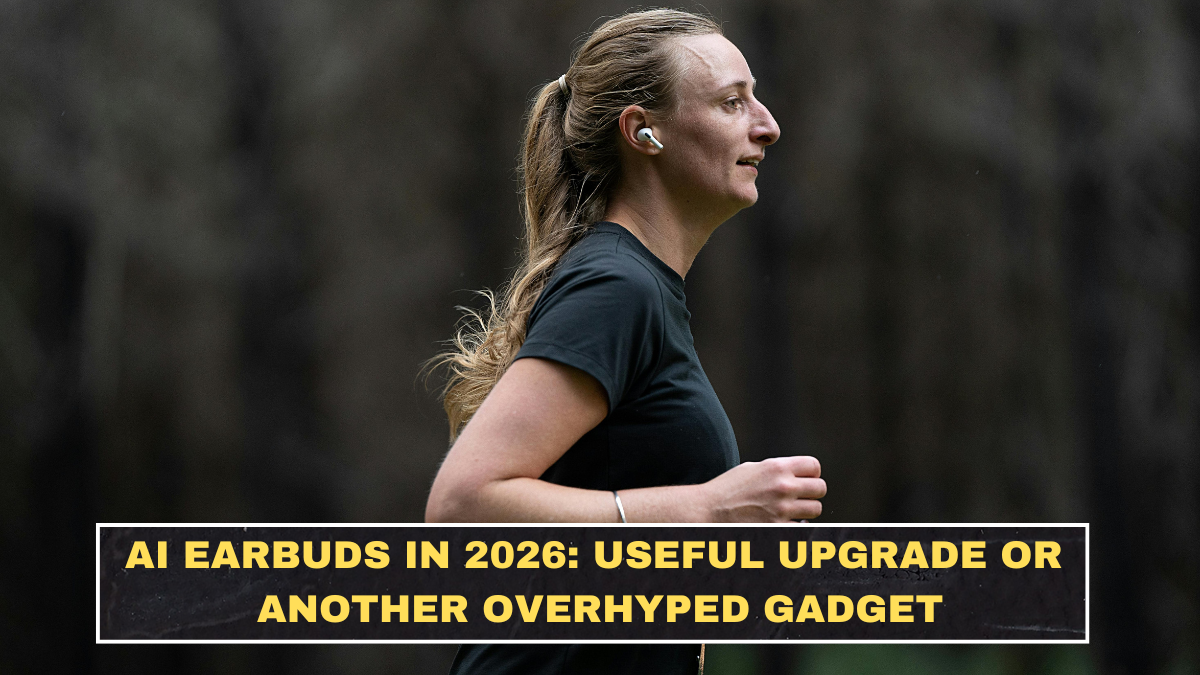
AI earbuds are getting attention because they finally have a clearer purpose than “wireless earbuds, but smarter.” For years, brands kept attaching vague AI promises to audio devices without giving buyers a reason to care. In 2026, that is changing because the features are more practical: live translation, transcription support, note capture, and hands-free access to AI tools through the phone ecosystem. That shift matters because buyers do not pay for “AI.” They pay when a gadget removes friction from something they already do, like talking, traveling, attending meetings, or listening on the move.
There is also a market reason this category is getting louder. The global earphones and headphones market was estimated at $81.78 billion in 2025 and is projected to keep growing strongly through 2033, which gives brands every incentive to repackage earbuds as productivity devices instead of just audio accessories. When a market gets crowded, companies look for a new story to justify upgrades, and AI has become that story. The real question is whether the features are useful enough to survive after the launch buzz fades.

What can AI earbuds actually do well right now?
The most useful feature is live translation, because that is a real problem with a clear payoff. Samsung says Interpreter can deliver real-time translations as audio through Galaxy Buds while also showing text on the phone, and Apple says Apple Intelligence enables Live Translation with AirPods for in-person conversations, calls, FaceTime, and Messages. That is not theoretical anymore. It means translation earbuds are moving from travel curiosity to something that can genuinely help in multilingual conversations, lectures, and meetings.
The second real use case is note and transcript support, though most of the heavy lifting still happens on the connected phone, not inside the earbuds themselves. Samsung’s recent AI documentation highlights voice memo transcription, summaries, and note translation on Galaxy devices. Timekettle is pushing even harder into the meeting use case, claiming its W4 Pro earbuds can translate online meetings, display subtitles, and help capture meeting notes. That makes AI earbuds more believable when paired with work, travel, and study rather than sold as a vague everyday assistant.
Which features are genuinely useful, and which are mostly marketing?
The genuinely useful features are the ones with immediate payoff. Live conversation translation is useful. Listening to a lecture or speech and getting translated audio plus text is useful. Turning long recordings into transcripts and summaries is useful, especially when the user is already working inside a phone ecosystem that supports it. These are concrete outcomes, not abstract AI branding.
The overhyped side starts when brands imply the earbuds themselves are some kind of independent AI worker. In reality, many of these features depend on a connected smartphone, specific apps, supported languages, and compatible hardware. Samsung’s support pages repeatedly tie Galaxy AI features to select phones, tablets, One UI versions, and downloaded language packs. That means the earbud may be the delivery device, but the intelligence often lives elsewhere. So yes, the feature may work, but the “AI earbuds” label sometimes overstates where the capability actually comes from.
How do AI earbuds compare across the most important use cases?
| Use case | What AI earbuds do well | Where they still fall short |
|---|---|---|
| Live translation | Real-time translated audio and text can reduce language friction | Accuracy varies by language, accent, and noise |
| Meetings and lectures | Can support listening, subtitles, transcripts, and summaries | Often depend on phone apps and specific ecosystems |
| Calls | Helpful for translated calls in supported setups | Not universal across all devices and platforms |
| Everyday assistance | Fast access to audio AI experiences is convenient | Still weaker than full phone-based assistants |
| Note capture | Good for recording and reviewing spoken content | “Smart notes” often happen on the phone, not in-ear |
That table shows the category clearly. AI earbuds are strongest when speech is already the center of the task. They are much weaker when brands try to position them as all-purpose AI companions. Buyers need to stop romanticizing the category. These are audio-first tools with some AI functions attached, not a replacement for a phone, laptop, or proper recorder.
Who should actually care about AI earbuds?
These earbuds make the most sense for travelers, multilingual users, students, and professionals who spend a lot of time in spoken conversations or meetings. If you regularly deal with language barriers, need quick review of spoken content, or want less friction in mobile work, the category makes sense. Timekettle’s entire positioning around business communication, online meetings, and multilingual collaboration reflects that. This is not a mass-market “everyone needs one now” device. It is much more targeted than the hype suggests.
For the average buyer who mainly wants music, calls, and noise cancellation, AI earbuds are not automatically worth paying more for. That buyer usually benefits more from strong audio quality, comfort, battery life, and reliable microphones than from a translation demo they will use twice. This is where people fool themselves with shiny product language. They think future-facing features equal value. Usually they do not. Value comes from repeated use, not impressive launch copy.
Are AI earbuds replacing other devices or just adding one more gadget?
Right now, they are mostly adding a layer to the phone rather than replacing anything. Apple’s and Samsung’s implementations both depend heavily on their wider device ecosystems. That means the earbud is becoming a delivery point for AI-powered speech features, but it is not replacing the smartphone as the main computing device. This matters because many buyers hear “AI earbuds” and imagine a standalone wearable future. That is not the current reality.
The smarter way to see the category is this: AI earbuds are becoming a more useful interface for listening and speaking tasks. That is real progress. But they are still accessories, not core computing products. Until they work more independently, more consistently, and across more ecosystems, they remain a meaningful upgrade for some people rather than a must-buy for everyone.
Conclusion
AI earbuds in 2026 are more useful than they were a year or two ago because the features are finally attached to real problems. Live translation is the strongest use case. Transcript and summary support is also becoming more practical, especially for lectures, calls, and meetings. Those are legitimate reasons for interest, and they show the category is moving beyond pure gimmick territory.
But the hype still outruns reality. Many of the smartest functions depend on the connected phone, specific software, compatible hardware, and supported languages. So the category is not fake, but it is not revolutionary in the way marketing wants you to believe. AI earbuds are worth considering when speech, translation, and spoken content are central to your life. For everyone else, they are still mostly an optional upgrade wrapped in futuristic language.
FAQs
Are AI earbuds actually good for live translation?
Yes, that is currently one of the most credible use cases. Apple and Samsung both now support translation-related features tied to AirPods or Galaxy Buds in supported scenarios, and specialist brands like Timekettle are built around this exact function.
Can AI earbuds take meeting notes by themselves?
Not really in the way most people imagine. They can help capture audio and support transcription or summaries, but a lot of the note-processing still happens through connected apps or phone-based AI systems.
Are AI earbuds worth buying for average users?
Usually only if you will genuinely use translation, transcription, or spoken-content features often. If your main priorities are music, calls, and comfort, standard premium earbuds may be the better buy.
What is the biggest weakness of AI earbuds in 2026?
Their biggest weakness is dependence on a broader device ecosystem. Many headline features work best only with specific phones, software versions, or language support, which limits how universal the experience really is.
Click here to know more