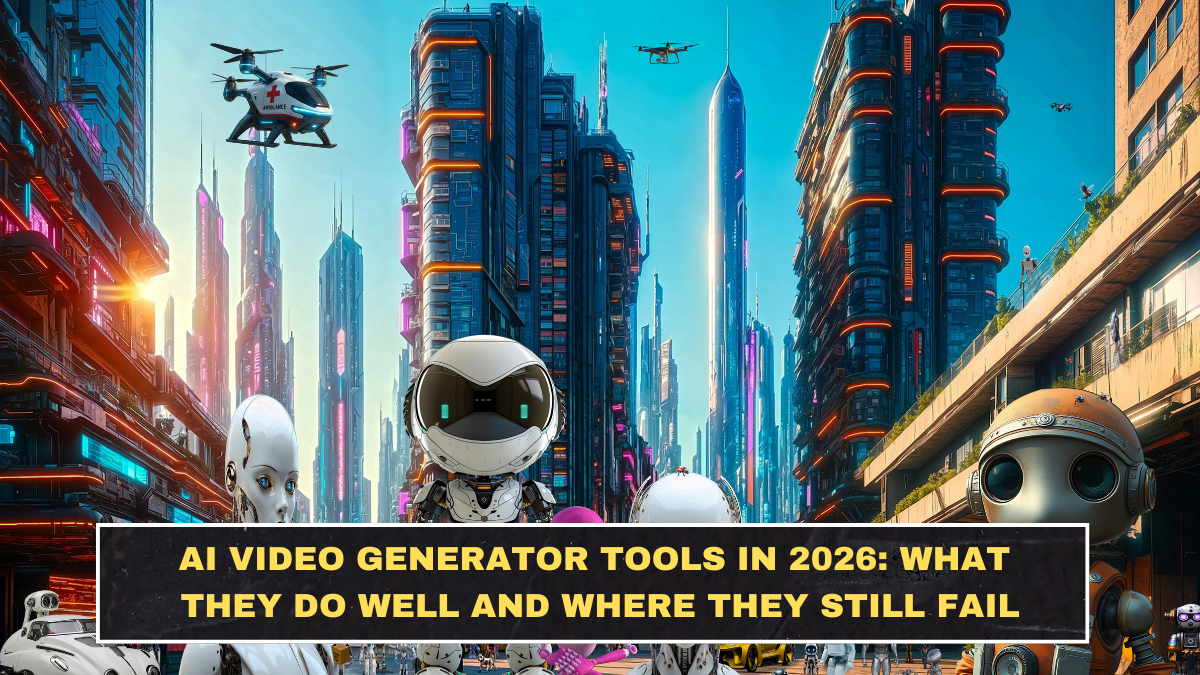
AI video generator tools have moved past gimmick status in 2026. They are now being used for ad concepts, product clips, social media videos, storyboards, explainer visuals, and short-form content production. Major platforms now offer better prompt adherence, stronger visual consistency, longer clips, and in some cases native audio generation. OpenAI says Sora can generate videos up to a minute long, while Google’s Veo 3 line pushes expanded controls and audio support, and Runway focuses heavily on cinematic control and scene consistency.
That sounds impressive, but most people still get fooled by demos. The truth is simpler. These tools are genuinely useful for speed, ideation, and certain production tasks, but they still break under precision, realism, and repeatability. If you expect one-click movie production, your expectation is the problem.
What do AI video generators actually do well in 2026?
They are strongest at fast first drafts. A creator can turn a rough text idea into a visual concept far faster than a traditional production workflow. Sora supports text-based generation and image-based creation, while Runway’s Gen-4 line emphasizes controllable scene building and consistent characters, objects, and environments across shots. Google’s Veo 3.1 also supports vertical video workflows and higher-resolution outputs, including 1080p and 4K in some use cases.
They also work well for businesses that need volume over perfection. Internal training clips, quick social ads, product mood videos, mock campaigns, and presentation visuals are now realistic use cases. Google recently positioned Veo 3.1 Lite as a lower-cost option for high-volume video applications, at less than half the cost of Veo 3.1 Fast. That matters because cost, not just quality, now decides which tool makes sense at scale.
Where do AI video tools still fail badly?
Consistency is still the weak point when the project gets more demanding. A demo clip may look great, but multi-scene narrative control, exact object placement, natural hand motion, believable physics, and repeatable character identity are still not fully solved. Companies are improving this, especially Runway with its consistency claims, but improvement is not the same as reliability.
Audio is another trap. Some tools now generate synchronized dialogue or native sound, but synthetic speech, emotional nuance, lip sync, and ambient realism still vary a lot by prompt and workflow. OpenAI’s Sora 2 introduced synchronized dialogue and sound effects, and Google highlights native audio in Veo 3, but that does not mean every output sounds production-ready.
Which strengths and weaknesses matter most?
| Area | What AI video generators do well | Where they still fail |
|---|---|---|
| Speed | Fast concept creation and rapid iteration | Final polish often still needs editing |
| Social content | Good for short clips and visual hooks | Weak long-form storytelling consistency |
| Character control | Better than before on repeated looks | Identity drift still happens |
| Audio | Some tools now add voice and sound | Dialogue quality remains uneven |
| Cost efficiency | Useful for high-volume content tests | Cheap outputs can still look cheap |
This is the real buying logic. Do not choose a tool because the homepage trailer looks cinematic. Choose it based on the type of mistake you can tolerate. If your business needs ten fast ad concepts, AI video is already valuable. If you need frame-accurate branded storytelling, human editing is still doing the heavy lifting.
How should you choose the right AI video generator?
Start with output type, not hype. If you need cinematic experimentation and stronger creative control, Runway is pushing hard in that direction. If you want broad ecosystem integration and scalable business use, Google’s Veo stack is becoming more relevant. If you want strong text-to-video generation with image input options and advanced prompting, Sora remains one of the most important tools in the category.
Then check three practical things. First, clip length and resolution. Second, how well the tool handles revisions. Third, total cost per usable result, not per generation. A cheap tool that produces five unusable outputs before one acceptable clip is not actually cheap. That is where many creators fool themselves.
Is AI video generation replacing video creators?
No. It is replacing some early-stage production work, not the whole craft. Prompting, scene selection, editing judgment, storytelling, brand taste, and post-production still matter. Even OpenAI’s developer documentation makes clear that model versions and APIs can change, which is a reminder that depending entirely on one model is risky.
The smarter view is this: AI video generators are force multipliers. They reduce time on rough production, help test ideas faster, and make certain visual tasks more accessible. But they still do not remove the need for direction, taste, and correction. Anyone claiming otherwise is either selling a tool or avoiding reality.
Conclusion?
AI video generator tools in 2026 are no longer a novelty. They are useful, commercially relevant, and improving fast. They do especially well at concept generation, short-form content, and scalable visual production. But they still struggle with exact control, narrative reliability, believable motion, and truly polished audio.
So the honest answer is this: these tools are worth using, but only when your expectations are disciplined. Use them to speed up creation, not to magically replace skill. That is the line many users still fail to understand.
FAQs
What is the best use case for an AI video generator in 2026?
The best use case is fast content ideation and short-form production. These tools are strongest when speed matters more than perfect control, such as ad testing, social clips, concept videos, or presentation visuals.
Are AI video generators good enough for professional work?
Yes, for some parts of professional work. They can support campaign testing, pre-visualization, and content volume production, but most polished commercial outputs still need human editing and creative direction.
Do AI video tools now include audio?
Some do. Google’s Veo 3 highlights native audio, and Sora 2 introduced synchronized dialogue and sound effects, but output quality still varies a lot.
Are AI video generators getting cheaper?
In some cases, yes. Google announced Veo 3.1 Lite at under 50% of the cost of Veo 3.1 Fast, which shows the market is moving toward cheaper high-volume generation options.
Click here to know more