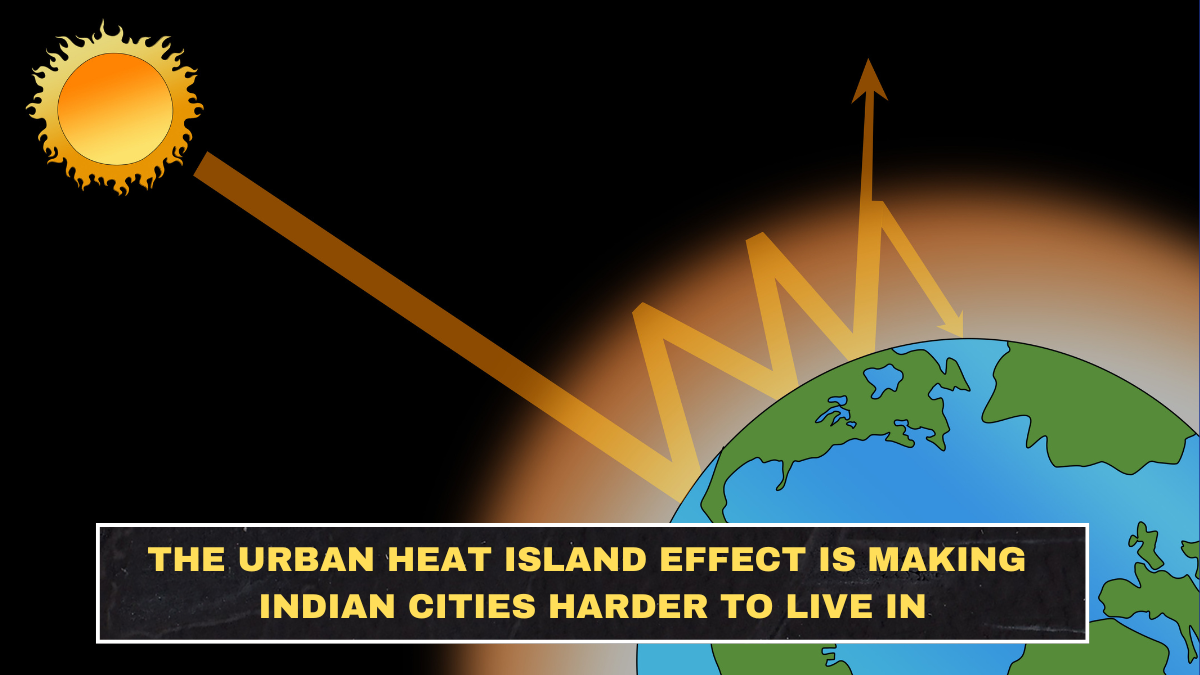
The urban heat island effect means cities stay hotter than nearby rural or less built-up areas because concrete, asphalt, dense buildings, traffic, and waste heat trap and re-release heat. This is not a buzzword people throw around to sound smart. It is one of the clearest reasons city summers feel more punishing than they used to, especially after sunset. The Centre for Science and Environment notes that urban areas can become several degrees warmer than surrounding areas, particularly at night, and that this extra warming can add about 2°C locally.
That night-time part is the real problem. Many people can tolerate a hot afternoon if the city cools later. But cities often do not cool properly anymore. A 2024 report highlighted that the number of warm nights in Indian cities jumped 32% over the last decade, and climate scientist Roxy Mathew Koll said the urban heat island effect is most visible in night temperatures because concrete-heavy urban form prevents heat from escaping easily.
Why Indian cities feel hotter than nearby areas
This happens because urban surfaces absorb solar heat during the day and release it slowly after dark. Trees, soil, wetlands, and open land cool more effectively, but paved neighborhoods do not. CSE also points to closely spaced buildings, reduced ventilation, heat-absorbing materials, and human activity as major reasons cities trap more heat. In plain language, when a city keeps replacing shade and open land with concrete and glass, it is building a heat-storage machine.
India-specific research keeps showing the same pattern. A recent Chennai report based on NIT Trichy research found that dense built-up zones such as Anna Nagar, Ambattur, and Koyambedu are persistent heat hotspots, especially at night, while greener and coastal areas stay cooler. The report said summer night-time land surface temperatures in hotspots exceeded 29°C, while greener areas stayed around 23.5°C.
Why this makes cities harder to live in
The effect is bigger than “feeling sweaty.” When nights remain hot, people sleep worse, cooling costs rise, and heat stress becomes more dangerous for older adults, children, workers, and people in poorly ventilated homes. CSE’s 2024 work on Indian cities warned that cities are not cooling down at night at the rate they used to, and that built-up expansion is a major reason. That means the urban heat problem is not only about climate change at a global level. It is also about bad local design choices.
This is where many city discussions become dishonest. People act as if hotter summers are unavoidable and urban planning has little to do with it. That is false. Climate change raises the baseline, but city design decides how brutal daily life becomes inside that baseline. A 2023 Scientific Reports paper noted that heat waves dominate India’s urban regions because of the urban heat island effect, anthropogenic influence, and climate change together.
What makes urban heat worse
- dense concrete and asphalt surfaces
- fewer trees and less green cover
- closely packed buildings that block airflow
- traffic, air conditioners, and other heat-generating activity
- shrinking water bodies and open spaces
- hotter nights that reduce recovery time
How the effect shows up in real life
| City condition | What happens | Why it matters |
|---|---|---|
| Concrete-heavy colonies | Heat gets stored all day | Evenings stay hot longer |
| Low tree cover | Less shade and cooling | Streets feel harsher |
| Dense building layout | Poor airflow | Homes cool down slowly |
| Hot nights | Less recovery during sleep | Fatigue and heat stress rise |
| More AC use | Higher electricity demand | Bills increase faster |
What cities need to do
The fix is not mysterious. Indian cities need more tree cover, protected water bodies, cooler roofing and paving choices, and planning that preserves airflow instead of suffocating neighborhoods with bad density. The World Bank’s recent urban resilience work for India also points to urban climate modeling and heat-risk planning as necessary for dealing with rising urban heat stress.
At the household level, people can use curtains, ventilation, shade, and roof treatments to reduce some heat. But let’s be blunt: personal hacks alone will not solve a structural city-design problem. If urban growth keeps replacing cooling surfaces with heat-trapping surfaces, cities will keep becoming harder to live in no matter how many table fans people buy.
Conclusion
The urban heat island effect is making Indian cities harder to live in because built-up areas trap heat, stay warmer at night, and intensify the human cost of summer. This is not abstract climate language. It affects sleep, health, electricity bills, and daily comfort right now. The cities that ignore this will become more exhausting, more expensive, and less livable year by year.
FAQs
What is the urban heat island effect in simple terms?
It means cities stay hotter than nearby rural areas because buildings, roads, and other man-made surfaces trap and release heat more slowly.
Why is the effect worse at night?
Because concrete and asphalt release stored daytime heat after sunset, which keeps urban temperatures elevated when people expect relief.
Is the urban heat island effect a real problem in India?
Yes. Multiple India-focused studies and reports show stronger heat stress, warmer nights, and hotter built-up zones across cities.
Can cities reduce urban heat island intensity?
Yes, but only with serious urban planning measures such as more green cover, better ventilation, cooler materials, and protection of natural cooling spaces.
Click here to know more