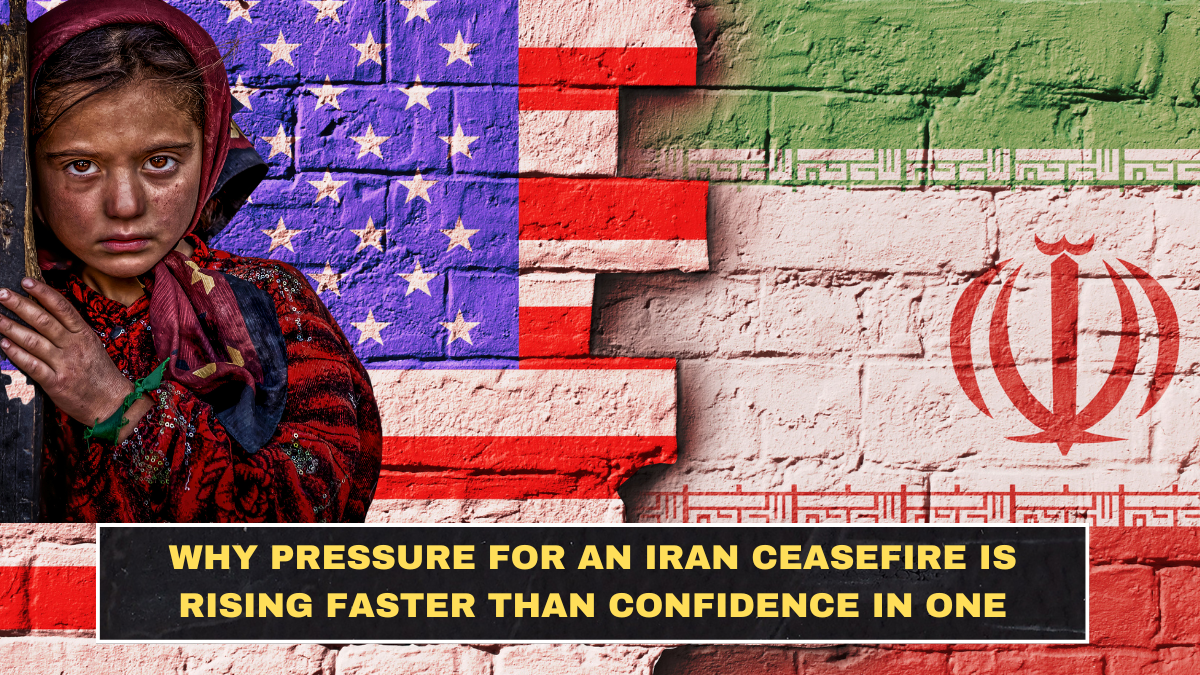
The pressure for some kind of Iran ceasefire is rising because the war is no longer just a military story. It is now a fuel-price story, a shipping story, a diplomacy story, and a political-risk story all at once. In the last few days, U.S. officials have signaled that they can “see a finish line,” while President Donald Trump has said the U.S. offensive could end within two to three weeks.
At the same time, attacks across the Gulf, pressure on shipping, and wider regional fallout are making governments push harder for an off-ramp. That does not mean a ceasefire is close. It means the costs of continuing are becoming harder to ignore.
Why ceasefire pressure is rising now
There are four obvious reasons the pressure has accelerated. First, the war has entered a phase where military operations are colliding with economic nerves, especially around oil and maritime security.
Second, outside powers such as China and Pakistan are now openly calling for an immediate ceasefire and peace talks, which raises diplomatic expectations even if it does not guarantee results.
Third, the humanitarian and regional spillover costs are growing, including strikes beyond Iran itself and broader instability in Lebanon and the Gulf.
Fourth, Washington itself is sending mixed but important signals that it does not necessarily want an endless campaign. Those are not signs of peace. They are signs of rising discomfort with the price of war.
The basic problem: pressure for talks is not the same as readiness for compromise
This is where a lot of coverage gets lazy. More calls for a ceasefire do not automatically mean the key actors are ready to give up core demands. Israel has said it is prepared to keep striking for “weeks to come.” Iran has dismissed U.S. outreach as messaging rather than serious diplomacy and has signaled that it does not trust the current process.
The Trump administration, meanwhile, has not presented a simple ceasefire-first approach; it has framed the war around crippling Iran’s capabilities, especially around nuclear and military capacity. That is why confidence in an actual pause remains weak. Everyone may want a way out, but not on the same terms.
What is forcing the diplomatic push
The biggest forcing mechanism is not idealism. It is cost. The conflict has already rattled oil markets, triggered fresh concern over the Strait of Hormuz, and widened pressure on consumer fuel prices. Reuters also reported that the European Union is preparing members for prolonged disruption in energy markets, including the possibility of reviving emergency-style measures first used during the 2022 energy crisis.
That matters because once conflict starts bleeding into transport, energy, insurance, and inflation expectations, ceasefire pressure stops being a regional issue and becomes a global one. Markets do not need full catastrophe to panic. They just need enough uncertainty to reprice risk.
The strongest reasons a ceasefire could still happen
A ceasefire remains plausible for practical reasons. The U.S. has publicly floated a relatively short runway for military action, and Secretary of State Marco Rubio has said communication with Iran continues, including the possibility of a direct meeting. China and Pakistan have gone further by proposing a five-point initiative built around an immediate ceasefire, peace talks, sovereignty protections, civilian safety, and restored navigation through Hormuz.
Even Pope Leo has urged Trump to find an “off-ramp,” which shows how broad the pressure coalition is becoming. None of that creates peace by itself, but it does create a clearer political landing zone if the main combatants decide the costs are high enough.
What is still blocking a ceasefire
The obstacles are brutal and obvious. Iran does not appear convinced that Washington is negotiating in good faith. Israel is still signaling that its operational window is open. The U.S. position also remains strategically ambitious, with an emphasis on degrading Iran’s capabilities rather than simply freezing the battlefield.
On top of that, the nuclear file makes everything harder. AP reported that securing Iran’s enriched uranium by force would be extremely risky and complex, while Reuters reported just before the war escalated that the IAEA wanted access to all Iranian nuclear sites and identified major concerns around highly enriched uranium and new enrichment activity.
In simple terms, the military problem and the nuclear problem are tied together, and that makes a clean ceasefire harder to design.
What the current situation really looks like
| Pressure point | Why it matters | What it does to ceasefire odds |
|---|---|---|
| U.S. talk of a short war window | Suggests Washington may want an exit before costs deepen | Raises chances of active diplomacy |
| Israel’s willingness to keep striking | Shows battlefield momentum still matters to decision-makers | Lowers odds of a quick pause |
| Iran’s distrust of U.S. outreach | Makes even indirect talks fragile | Lowers confidence in any early deal |
| China-Pakistan peace push | Adds outside diplomatic pressure and a possible framework | Improves the odds of talks starting |
| Oil and shipping risk | Expands the conflict’s economic cost globally | Increases pressure for de-escalation |
| Nuclear concerns | Makes any settlement more technically and politically difficult | Makes a durable ceasefire harder |
The table makes the reality plain: the forces pushing toward a ceasefire are real, but the forces blocking one are just as real. That is why the current moment feels contradictory. Pressure is rising faster than trust, and political urgency is rising faster than diplomatic clarity.
Why outside powers suddenly matter more
This is no longer a conflict that only Washington, Tehran, and Jerusalem can frame for themselves. China and Pakistan have moved into a more visible diplomatic role, partly because energy routes and regional stability are now directly at stake. France has also reportedly refused Israel use of its airspace for U.S.
weapons transfers tied to the war, which signals that even Western partners are not uniformly comfortable with how the conflict is evolving. These moves do not stop bombs. But they do shape the diplomatic environment by showing that support for continued escalation is not automatic or unlimited.
Why confidence remains low even if talks begin
Even if talks start soon, that would not mean a stable ceasefire is in place. A temporary halt could still be vulnerable to disagreements over verification, missile activity, nuclear access, regional proxy activity, or attacks on shipping. The war has already spread pressure across multiple fronts, including Lebanon, Gulf infrastructure, and maritime routes.
Once a conflict expands like that, the battlefield becomes crowded with actors, agendas, and red lines. That is why a pause may be easier to announce than to sustain. The hard part is not getting leaders to say the word “ceasefire.” The hard part is making them obey it.
What readers should actually watch next
The most important signals now are not speeches alone. Watch for evidence of direct U.S.-Iran contact, not just public messaging. Watch whether attacks on Gulf infrastructure and shipping ease or widen. Watch whether Israel changes its language from open-ended operations to defined military goals.
And watch oil-market behavior, because price action often reveals whether traders think de-escalation is real or just another headline burst. If those signals improve together, ceasefire odds rise. If they move in opposite directions, then the diplomatic noise is probably outrunning the actual reality.
Conclusion
Pressure for an Iran ceasefire is rising because the war is becoming too expensive, too wide, and too politically dangerous to treat as a contained military campaign. But confidence in a ceasefire remains low because the main players still appear far apart on aims, trust, and terms. That is the real story. Not “peace is near,” and not “war will obviously keep escalating forever.”
The real story is that the incentives to stop are getting stronger while the conditions needed to stop are still weak. That gap is exactly why this moment looks more hopeful in headlines than it does in reality.
FAQs
Why is ceasefire pressure rising in the Iran conflict?
Because the war is no longer just about battlefield results. It is affecting oil prices, shipping routes, regional security, and global political risk, which increases pressure on governments to push for talks.
Is a ceasefire likely soon?
Possible, yes. Easy, no. U.S. officials have hinted at a finite military timeline, but Israel has said it is ready to keep striking and Iran has shown deep distrust of current diplomacy.
Who is pushing hardest for talks?
The push is coming from multiple directions, including the U.S., China, Pakistan, and even the Vatican. That broad pressure matters, but it still does not guarantee agreement among the core combatants.
What is the biggest obstacle to a ceasefire?
The biggest obstacle is the gap between public talk of de-escalation and the actual strategic demands of the parties involved, especially around Iran’s capabilities and trust in negotiations.
Why do oil markets matter so much here?
Because conflict around Iran and the Gulf immediately raises fears about shipping disruption, energy supply risk, and higher fuel and transport costs worldwide.
Click here to know more