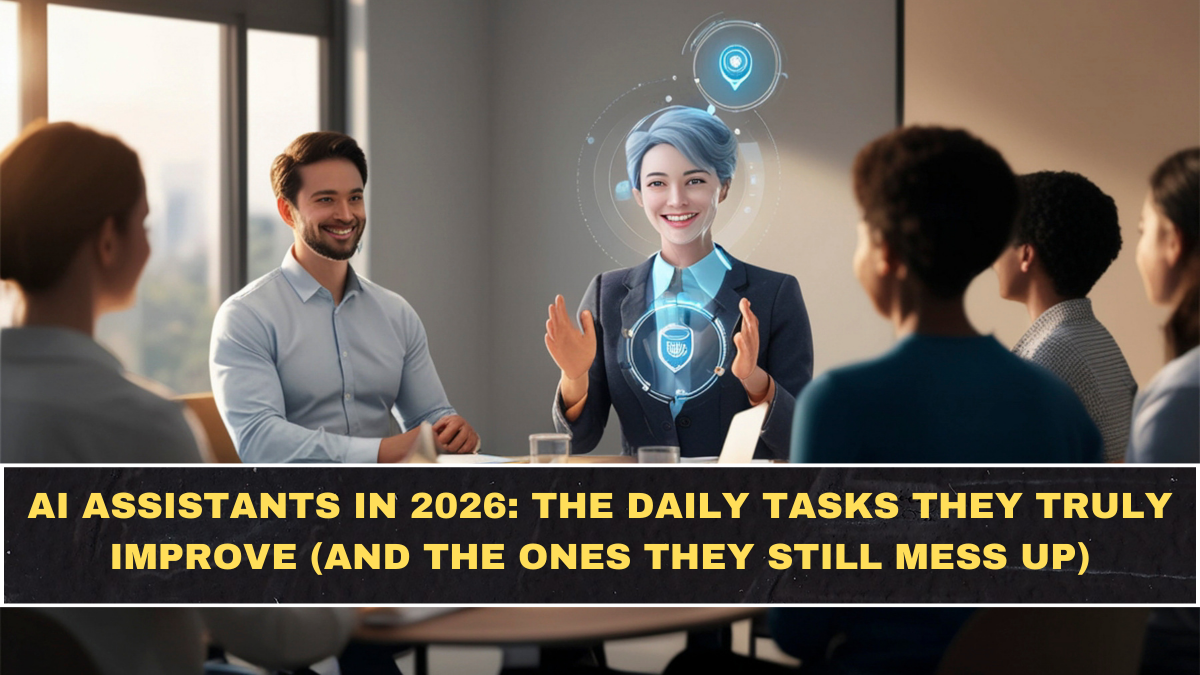
In 2026, AI assistants are no longer novelty tools that people try once and forget. They are quietly embedded into phones, email apps, browsers, note tools, and operating systems, shaping how everyday tasks get done. Most users now interact with AI assistants multiple times a day, often without consciously “opening” one. The shift is subtle, but the impact on daily routines is real and measurable.
What has changed most is expectation. People no longer expect AI assistants to feel magical or human-like. They expect them to reduce friction in boring, repetitive tasks that drain attention. When an assistant saves time, it feels useful. When it adds extra steps or creates errors, it becomes a liability. Understanding where AI assistants actually help in daily life, and where they still fall short, is essential in 2026.

What AI Assistants Are Commonly Used for in Daily Life
The most widespread use of AI assistants today is not creative writing or deep reasoning. It is task support. Scheduling meetings, drafting routine messages, summarizing long emails, and filling repetitive forms are now common assistant-driven actions.
In personal life, people rely on AI to manage reminders, shopping lists, travel planning, and basic decision comparisons. In work settings, assistants help prepare drafts, organize notes, and extract action items from meetings or documents.
These use cases succeed because they are narrow and clearly defined. The assistant does not need to “understand” the user deeply. It just needs to reduce cognitive load and speed up predictable tasks.
Where AI Assistants Actually Save Time
AI assistants perform best when the task has structure. Calendar scheduling is a good example. Suggesting time slots, resolving conflicts, and sending confirmations saves users several manual steps.
Form filling is another area where assistants shine. Repeating personal details, summarizing answers, or adapting responses to similar questions reduces fatigue, especially for applications and registrations.
Writing short, functional content such as replies, confirmations, follow-ups, and notes is also an area of strength. The assistant acts as a fast first draft engine, allowing users to edit rather than start from scratch.
In these scenarios, the time saved is real and consistent.
Daily Tasks AI Assistants Still Struggle With
Despite progress, AI assistants in 2026 still struggle with context-heavy tasks. Anything involving nuanced judgment, emotional sensitivity, or incomplete information often produces unreliable results.
Long-term planning is a common failure point. Assistants can suggest schedules, but they often ignore personal constraints, energy levels, or shifting priorities unless explicitly instructed.
They also struggle with accuracy when handling complex forms, legal language, or financial decisions. Small mistakes in these areas can create bigger problems than manual effort would have.
The key issue is that AI assistants optimize for speed, not responsibility. Users must remain the final decision-makers.
Why Some AI Assistants End Up Wasting Time
A common frustration in 2026 is “AI overhead.” This happens when users spend more time correcting, re-prompting, or verifying outputs than the task would have taken manually.
This often occurs when users ask assistants to handle vague or poorly defined tasks. The assistant produces generic output, requiring multiple revisions to become useful.
Another cause is over-automation. When assistants interrupt workflows with suggestions or notifications that are not context-aware, they break focus instead of enhancing it.
Time-saving only happens when AI fits smoothly into existing habits, not when it demands constant supervision.
The Role of Trust and Verification in Daily Use
As AI assistants become more embedded, trust becomes a daily concern. Users need confidence that outputs are reliable enough to act on without constant double-checking.
In 2026, most people develop informal trust rules. They trust assistants for drafting, organizing, and summarizing, but verify anything involving money, compliance, or commitments.
This selective trust is healthy. It allows users to benefit from speed while maintaining control over consequences.
Blind trust, on the other hand, often leads to small errors that accumulate into frustration and lost time.
How AI Assistants Are Changing Work and Home Routines
AI assistants have subtly reshaped how people structure their days. Many users now start tasks by asking an assistant to outline steps or summarize inputs before acting.
This changes the role of the human from executor to editor. Instead of doing everything manually, users guide, review, and refine.
At home, assistants help manage shared calendars, reminders, and household coordination, reducing mental load rather than replacing effort entirely.
The change is not dramatic, but it is cumulative. Over time, small efficiencies add up to noticeable relief.
What to Expect From AI Assistants Going Forward in 2026
The most realistic expectation is refinement, not revolution. AI assistants will become better at staying out of the way, understanding context from usage patterns, and reducing unnecessary prompts.
They will also become more personalized, adapting to individual preferences without requiring constant instruction. However, full autonomy is not the goal.
In 2026, the best assistants are those that feel invisible when things go right and obvious only when users need help.
Conclusion: Useful Tools, Not Digital Brains
AI assistants in daily life are neither hype nor disappointment. They are tools, and like all tools, their value depends on how and where they are used.
They excel at reducing friction in structured, repetitive tasks and fail when asked to replace human judgment. The users who benefit most are those who treat assistants as helpers, not decision-makers.
In 2026, productivity gains come from clarity, boundaries, and realistic expectations. AI assistants are powerful when used deliberately and frustrating when relied on blindly.
FAQs
What daily tasks are AI assistants best at?
AI assistants work best for scheduling, drafting short messages, summarizing content, managing reminders, and filling repetitive forms.
Can AI assistants replace personal planning?
No, they can support planning but struggle with priorities, emotional factors, and long-term judgment that humans handle better.
Why do AI assistants sometimes waste time?
They waste time when tasks are vague, over-automated, or require frequent corrections and verification.
Should AI assistant outputs always be verified?
Yes, especially for tasks involving money, legal matters, compliance, or important commitments.
Are AI assistants improving quickly in 2026?
They are improving steadily, mainly in reliability, personalization, and integration, rather than dramatic new capabilities.
How can users get the most value from AI assistants?
By using them for structured tasks, setting clear boundaries, and treating outputs as drafts rather than final decisions.