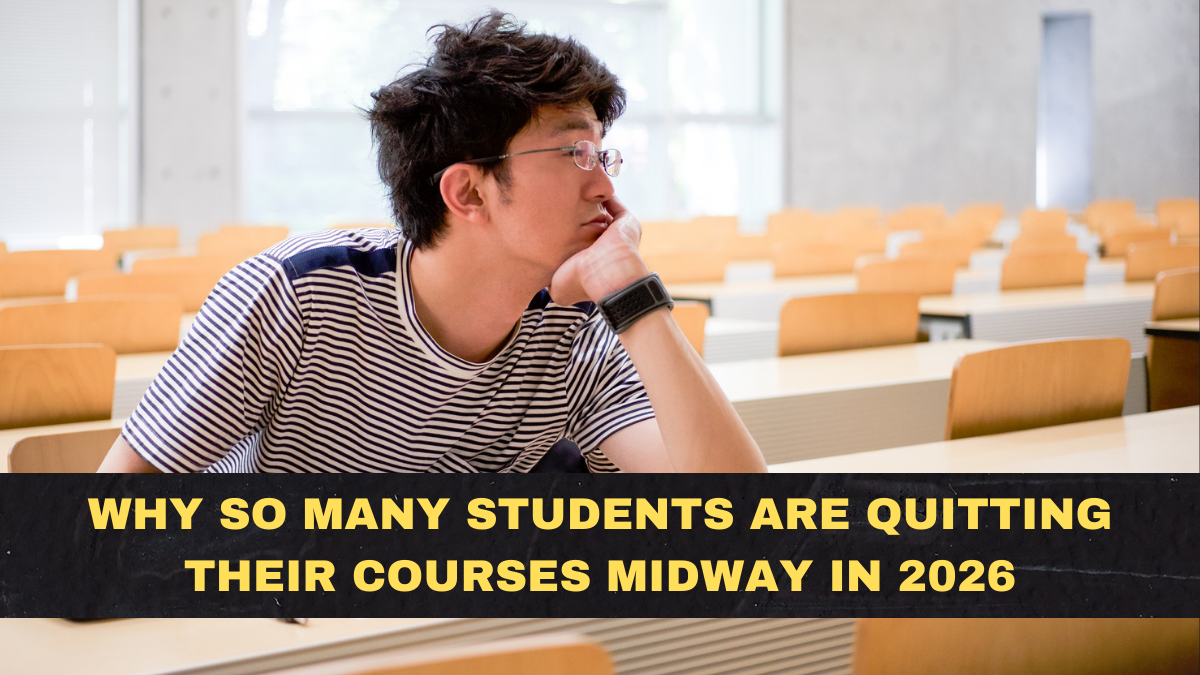
In 2026, quitting a college course midway has stopped being a rare or shocking decision. Across India, students are walking away from degrees they once worked hard to secure, often within the first few semesters. What looks like indiscipline or lack of patience from the outside is, in reality, a response to mounting pressure, mismatch, and disillusionment.
This trend is not driven by laziness or impulsiveness. It is driven by realization. Many students discover early on that the course they enrolled in does not align with their interests, abilities, or career outcomes. Students quitting courses is now a signal that something deeper in the education system is failing to meet expectations.
Why Course Dropouts Are Increasing in 2026
The most important reason behind rising dropouts is early exposure to reality. Students today have access to online discussions, alumni experiences, and workplace insights that were not easily visible earlier. They are seeing what life looks like after graduation much sooner.
Once students realize that a course may lead to low-paying jobs, limited growth, or years of struggle, motivation collapses quickly. Sitting through classes that feel disconnected from real outcomes becomes mentally exhausting.
In 2026, students are no longer willing to suffer silently for the sake of finishing a degree that feels meaningless.
Mismatch Between Course Content and Career Reality
One of the biggest triggers behind students quitting courses is the gap between what is taught and what the job market actually needs. Many courses still follow outdated syllabi with little relevance to current industry demands.
Students quickly sense that what they are learning will not make them employable. Assignments feel theoretical, exams feel mechanical, and practical exposure feels insufficient.
This mismatch creates anxiety. Students start questioning whether staying enrolled is worth the time and financial cost when skills matter more than certificates.
The Pressure Cooker Effect of College Life
Academic pressure has intensified sharply in 2026. Continuous assessments, attendance rules, internal grading, and competitive comparisons leave little room to breathe.
For students already unsure about their course choice, this pressure becomes unbearable. Stress accumulates faster than resilience can develop.
Mental health struggles, burnout, and emotional fatigue are now common reasons why students quit midway rather than pushing themselves to a breaking point.
Financial Stress Plays a Bigger Role Than Admitted
Rising education costs have made continuing a wrong course feel financially irresponsible. Fees, hostel costs, travel, and materials add up quickly, especially for middle-class families.
When students realize that the expected return does not justify the expense, guilt sets in. Many prefer to stop early rather than accumulate years of sunk cost.
In 2026, quitting a course is increasingly seen as damage control rather than failure.
Parental Expectations vs Student Reality
Family pressure remains a major factor in course selection. Many students enroll in programs chosen for them rather than by them.
Once college begins, the reality of studying something they do not enjoy hits hard. Motivation drops, attendance suffers, and performance declines.
Eventually, some students choose to quit rather than live years under emotional conflict. Students quitting courses often reflects delayed self-assertion rather than irresponsibility.
Fear of Being Stuck for Life
Students today are deeply aware that early career choices can shape long-term outcomes. Watching seniors struggle after graduation creates fear of getting trapped.
This fear pushes students to reassess quickly. Quitting midway feels safer than completing a degree that might lock them into an unwanted path.
In 2026, students prefer course correction over blind persistence.
Lack of Honest Career Guidance
Many students enter college with little clarity about what lies ahead. Career counseling is either absent or too generic to be useful.
Without guidance, students navigate confusion alone. When doubts pile up without answers, quitting feels like the only way to pause and rethink.
This highlights a systemic failure rather than individual weakness.
What Happens After Students Quit Midway
Contrary to popular belief, quitting does not always lead to collapse. Many students pivot into skill-based learning, alternative degrees, or vocational paths.
Some take time off to understand themselves better before re-entering education with clarity. Others start working early and build experience outside traditional routes.
In 2026, dropping out is increasingly a transition phase, not a dead end.
Conclusion: Quitting Is a Symptom, Not the Disease
Students quitting courses midway is not the core problem. It is a symptom of deeper issues like outdated curricula, unrealistic expectations, and poor guidance.
In 2026, students are choosing honesty over endurance. They are refusing to waste years on paths that feel wrong simply to satisfy social norms.
The real solution lies in better alignment between education, careers, and individual strengths. Until that happens, quitting midway will remain a rational response to a broken system.
FAQs
Why are more students quitting college courses in 2026?
Because students quickly realize mismatches between courses, career outcomes, and personal interests, combined with rising stress and costs.
Is quitting a course always a bad decision?
No, quitting early can prevent long-term regret if the course is clearly misaligned with goals and abilities.
Do students who quit courses struggle later?
Not always. Many successfully pivot to alternative education paths, skills, or work opportunities.
Is financial pressure a major reason for dropouts?
Yes, rising education expenses make continuing a wrong course feel risky and irresponsible.
How can students avoid quitting midway?
By researching career outcomes, seeking honest guidance, and choosing courses based on aptitude rather than pressure.
Is this trend unique to India?
While prominent in India, similar patterns are emerging globally due to changing job markets and education expectations.